
Physics had been spectacularly successful at explaining the everyday world. Then experiments with light and atoms began producing results that the old rules could not handle. What followed was one of the strangest and most successful revolutions in science.
When the Old Physics Started to Crack
At the end of the 19th century, physics seemed to be in remarkably good shape. Newton's laws described motion, Maxwell's equations explained electricity, magnetism and light, and thermodynamics dealt with heat and energy.
But a stubborn problem was hiding inside something as ordinary as a hot object.
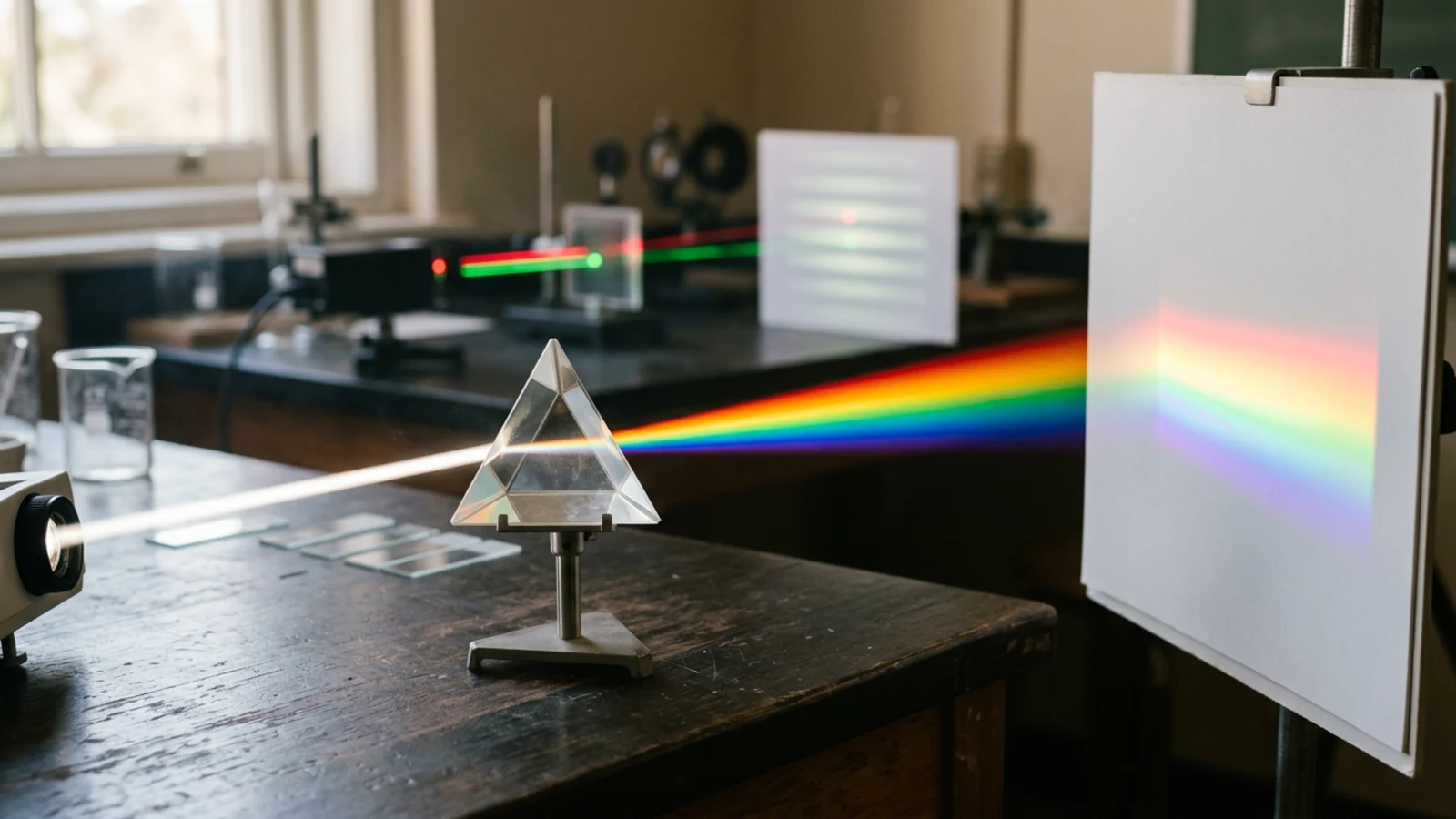
When matter is heated, it gives off radiation. Physicists could measure the pattern of wavelengths produced, but classical physics could not correctly explain the complete spectrum.
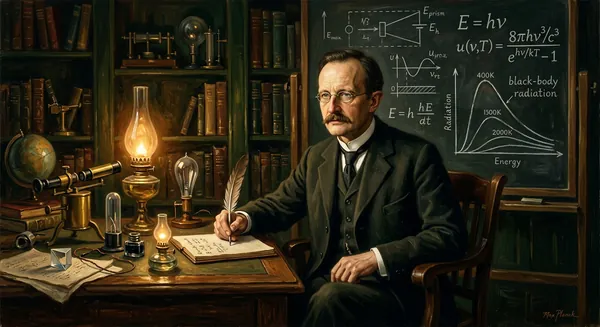
In 1900, Max Planck found a mathematical solution. To make the theory agree with experiments, he treated energy as being exchanged in discrete amounts rather than varying continuously. The size of these energy packets depended on the frequency of the radiation.
Planck had introduced the quantum.
At first, this did not look like the beginning of an entirely new description of nature. Planck was trying to solve a particular problem.
Instead, he had opened a door that physics would never manage to close.
Einstein Takes the Quantum Seriously
Albert Einstein pushed the idea much further in 1905.
Scientists had discovered that shining light onto certain metals could eject electrons. Increasing the brightness of the light could release more electrons, but whether electrons were ejected at all depended strongly on the light's frequency.
That was difficult to explain if light behaved only as a continuous wave.
Einstein proposed that light itself could behave as though its energy came in individual quanta. A single light quantum could transfer energy to an electron. Higher-frequency light carried more energy per quantum, explaining why changing the frequency could matter more than simply making the light brighter.
This work helped explain the photoelectric effect and provided powerful support for the emerging quantum idea. Einstein later received the 1921 Nobel Prize in Physics, with the prize citation specifically mentioning his discovery of the law of the photoelectric effect.
There is an important irony here.
Einstein would later become one of the most famous critics of the way quantum mechanics was interpreted. But he was also one of the people who helped create quantum physics in the first place.
He did not reject quantum phenomena.
What troubled him was the kind of physical theory that quantum mechanics eventually became.
Bohr Builds a Quantum Atom
Atoms created another problem.
Experiments showed that each chemical element produces distinctive lines of light at particular wavelengths. Classical models struggled to explain why atoms should emit only these precise frequencies.
In 1913, Niels Bohr proposed a model of the hydrogen atom in which electrons could occupy only certain allowed energy states. They could move between those states by absorbing or emitting specific amounts of energy.
The model successfully explained important features of hydrogen's spectrum and brought quantum ideas directly into the structure of the atom.
But it was not the final answer.
Bohr's picture still imagined electrons moving in definite orbits around the nucleus, rather like a tiny planetary system governed by additional quantum rules. The model worked particularly well for hydrogen but ran into serious difficulties with more complicated atoms and molecules.
During the early 1920s, physicists added more and more rules to what became known as the old quantum theory.
Eventually, the collection of fixes was no longer enough.
Physics needed a new framework.
Quantum Mechanics Arrives
The decisive change came with remarkable speed.
In 1924, Louis de Broglie proposed that matter could have wave-like properties. Then, in 1925, the young German physicist Werner Heisenberg developed a radically different way to describe atoms.
Heisenberg deliberately avoided imaginary pictures of electrons travelling along invisible paths. Instead, he concentrated on quantities connected with observations, such as the frequencies and intensities of light emitted by atoms.
The mathematics looked strange.
Max Born recognised that the arrays of numbers in Heisenberg's work were related to mathematical objects called matrices. Born and Pascual Jordan helped develop the idea into what became known as matrix mechanics.
Then another theory appeared.
In 1926, Erwin Schrödinger developed wave mechanics, building partly on de Broglie's ideas. His equation described quantum systems using a wave function and looked very different from Heisenberg's approach.
For a short time, physicists appeared to have two rival versions of quantum mechanics.
They did not.
Schrödinger demonstrated that the two mathematical approaches were equivalent. They were different ways of expressing the same underlying physics.
Within little more than a year, the patchwork of the old quantum theory had been replaced by a powerful new mathematical framework.
Then Reality Became Strange
Building the equations was only part of the problem.
Physicists also had to decide what they meant.
Max Born gave the wave function a statistical interpretation. Quantum mechanics could predict the probabilities of different experimental outcomes with extraordinary accuracy, but it did not generally describe every event as having a predetermined result waiting to be uncovered.
Heisenberg added another famous feature in 1927: the uncertainty principle. Certain pairs of physical quantities, such as position and momentum, cannot simultaneously be assigned arbitrarily precise values within quantum mechanics.
At Niels Bohr's institute in Copenhagen, Bohr, Heisenberg, Wolfgang Pauli and others argued intensely about how the new theory should be understood.
Bohr developed the principle of complementarity. Depending on the experiment, a quantum object could display behaviour associated with particles or with waves. Neither classical picture alone gave a complete account.
The collection of ideas that grew from these discussions later became associated with the Copenhagen interpretation.
Einstein remained dissatisfied.
He repeatedly challenged Bohr with thought experiments designed to expose weaknesses in the theory. Einstein accepted the experimental achievements of quantum physics and had helped establish the field himself, but he doubted that a fundamentally probabilistic description represented the final, complete account of reality.
The disagreement became one of the most famous debates in modern science.
It was not a battle between someone who believed in quantum physics and someone who did not.
It was an argument over what quantum physics was telling us about reality.
The Strangest Theory Becomes Everyday Technology
The quantum revolution did not stop with Heisenberg, Schrödinger and Bohr.
In 1928, Paul Dirac produced an equation combining quantum mechanics with Einstein's special theory of relativity for the electron. The mathematics unexpectedly implied the existence of a particle with the electron's mass but opposite electric charge.
A few years later, the positron was discovered.
Antimatter had appeared first as a consequence of an equation.
Other physicists continued extending quantum theory into the physics of atoms, nuclei, particles and materials. The resulting theories became some of the most precisely tested ideas in science.
Their effects are not confined to laboratories.
Quantum mechanics explains the behaviour that makes semiconductors possible and therefore underlies modern computer chips and smartphones. It is essential to lasers and LEDs. Quantum effects are used in solar cells, medical imaging technologies and highly accurate atomic clocks.
Even technologies that seem thoroughly ordinary can depend on physics that would have seemed almost impossible to scientists at the beginning of the 20th century.
The quantum revolution began because the old physics could not explain a handful of troublesome experiments.
It ended up changing our understanding of matter, light and measurement itself.
And despite a century of extraordinary experimental success, physicists are still arguing about what quantum mechanics ultimately says about the nature of reality.