_(2).jpg)
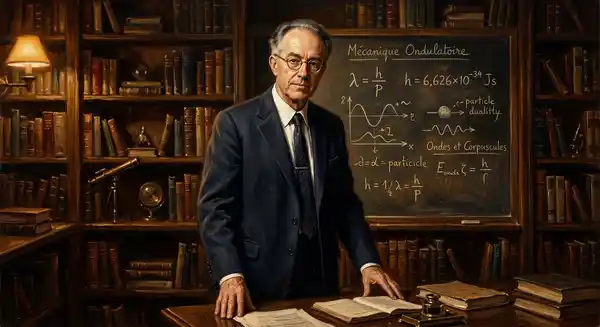
Louis de Broglie
1892–1987 · Theoretical Physicist
Louis de Broglie was a French theoretical physicist who proposed that matter particles have wave-like properties. His 1924 hypothesis earned him the Nobel Prize in Physics in 1929 and profoundly shaped the development of quantum mechanics.
“In the history of science, it is not the discoverer of a new phenomenon who is important, but the one who explains it.”
Why is this scientist famous?
Proposing in 1924 that particles of matter, such as electrons, have wave-like properties — the matter-wave hypothesis that earned him the 1929 Nobel Prize in Physics.
Louis's story
An Aristocratic Physicist
Louis-Victor Pierre Raymond de Broglie was born on 15 August 1892 in Dieppe, France, into a family of noble lineage. He initially studied history, but his older brother Maurice, a physicist who conducted pioneering X-ray experiments, drew him towards science.
De Broglie's interest in physics grew before the First World War. He entered his brother Maurice's X-ray laboratory in 1913, worked on radio communications for the French army during the war, and afterwards increasingly concentrated on theoretical physics.
The Matter-Wave Hypothesis
In 1924, de Broglie presented his doctoral thesis at the University of Paris. In it, he proposed something radical: that particles of matter, such as electrons, have wave-like properties. Just as light had been shown to behave as both waves and particles, de Broglie argued that matter should show the same duality.
His hypothesis stated that the wavelength of a particle is inversely proportional to its momentum. This meant that any moving particle — an electron, a proton, even a tennis ball — has an associated wavelength, though for large objects the wavelength is vanishingly small.
The idea was met with astonishment. De Broglie's thesis examiner reportedly asked whether there was any experimental evidence. There was not yet, but the theoretical argument was so compelling that the thesis was accepted.
Experimental Confirmation and the Nobel Prize
De Broglie's prediction was soon confirmed experimentally. In 1927, the American physicists Clinton Davisson and Lester Germer observed electron diffraction in a nickel crystal, and independently the British physicist G. P. Thomson observed electron diffraction through thin films. Both experiments showed that electrons produce diffraction patterns, just as waves do.
In 1929, de Broglie was awarded the Nobel Prize in Physics for his matter-wave hypothesis. The prize citation recognised his discovery of the wave nature of electrons.
His ideas also had a direct influence on Erwin Schrödinger, who used de Broglie's matter waves as the starting point for his wave mechanics — one of the foundational formulations of quantum mechanics.
Legacy
De Broglie spent much of his career at the Institut Henri Poincaré in Paris, where he held a chair of theoretical physics. He continued to write and lecture on quantum physics for decades.
De Broglie died on 19 March 1987 in Louveciennes, France, at the age of 94. His matter-wave hypothesis remains one of the most important ideas in modern physics. Wave-particle duality — the principle that matter and light both behave as waves and particles — is a cornerstone of quantum mechanics, and de Broglie was the first to extend it from light to matter.
What did they discover?
The Matter-Wave Hypothesis
In his 1924 doctoral thesis, de Broglie proposed that particles of matter have an associated wavelength inversely proportional to their momentum, extending wave-particle duality from light to matter.
Nobel Prize in Physics, 1929
He received the Nobel Prize in Physics for his discovery of the wave nature of electrons, which was confirmed by electron-diffraction experiments in 1927.
Influence on Wave Mechanics
De Broglie's matter-wave idea was the starting point for Schrödinger's development of wave mechanics, one of the foundational formulations of quantum mechanics.
Amazing facts
De Broglie initially studied history before switching to physics.
His older brother Maurice de Broglie was also a physicist who conducted pioneering X-ray experiments.
De Broglie worked on radio communications for the French army during the First World War.
His matter-wave hypothesis was confirmed experimentally by Davisson and Germer and by G. P. Thomson in 1927.
He lived to be 94, dying in 1987 — nearly six decades after receiving his Nobel Prize.
Both Davisson and Thomson shared the 1937 Nobel Prize in Physics for their electron-diffraction experiments.
Timeline
Born in Dieppe, France.
Presented his doctoral thesis proposing the matter-wave hypothesis.
Electron diffraction experiments by Davisson and Germer and by G. P. Thomson confirmed his prediction.
Awarded the Nobel Prize in Physics for his discovery of the wave nature of electrons.
Died in Louveciennes, France, aged 94.
Awards & honours
Related Super Scientists
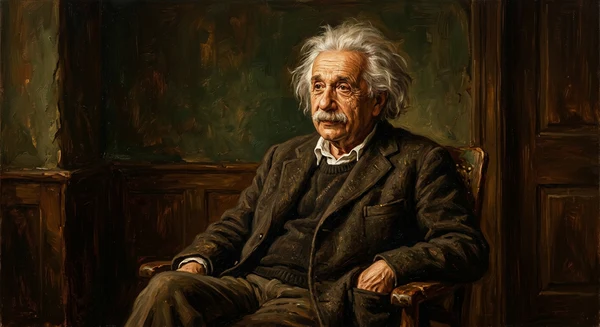
Albert Einstein
1879–1955 · Theoretical Physicist
Developing the theory of relativity and the equation E=mc².
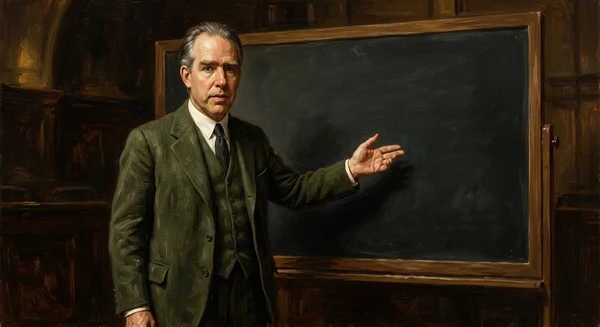
Niels Bohr
1885–1962 · Physicist
Developed the Bohr model of the atom and made foundational contributions to quantum mechanics.
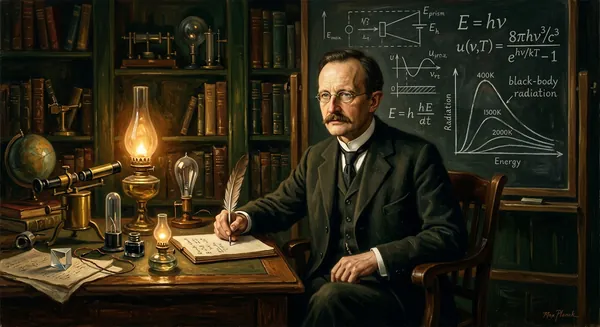
Max Planck
1858–1947 · Theoretical Physicist
Introducing the quantum of action while deriving his black-body radiation law, helping launch quantum theory.