_(2).jpg)
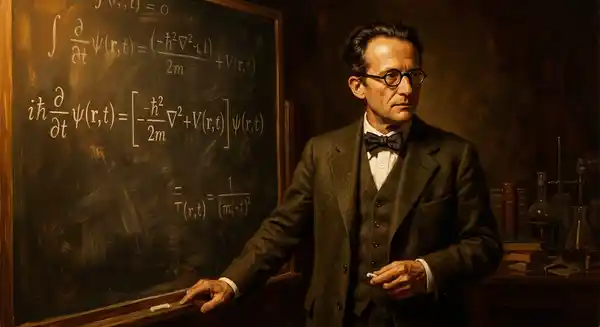
Erwin Schrödinger
1887–1961 · Theoretical Physicist
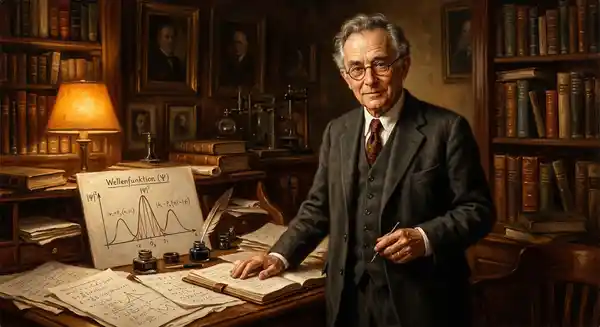
Erwin Schrödinger was an Austrian theoretical physicist who developed wave mechanics and formulated the Schrödinger equation. He shared the 1933 Nobel Prize in Physics with Paul Dirac.
“I do not like it, and I am sorry I ever had anything to do with it.”
Why is this scientist famous?
Developing wave mechanics and formulating the Schrödinger equation in 1926. He shared the 1933 Nobel Prize in Physics with Paul Dirac.
Erwin's story
From Vienna to Zurich
Erwin Rudolf Josef Alexander Schrödinger was born on 12 August 1887 in Vienna, Austria. He studied mathematics and physics at the University of Vienna from 1906 to 1910, where he was strongly influenced by the physicist Fritz Hasenöhrl.
After working at several universities during the 1920s, Schrödinger became professor at the University of Zurich in 1921. It was during his Zurich period that he produced his major wave-mechanics work.
Wave Mechanics and the Schrödinger Equation
Louis de Broglie had proposed that matter could possess wave properties. Schrödinger used this emerging matter-wave concept to develop wave mechanics.
In 1926, Schrödinger formulated the equation now called the Schrödinger equation. The equation describes how the quantum state of a system changes over time and became one of the fundamental mathematical tools of quantum mechanics.
His wave mechanics and the matrix mechanics of Heisenberg, Born and Jordan initially looked very different. Schrödinger demonstrated their mathematical equivalence. Max Born later supplied the influential probabilistic interpretation of the wavefunction.
Berlin, Exile and Dublin
In 1927, Schrödinger succeeded Max Planck as professor at the University of Berlin. He left Germany after the Nazi rise to power because of his opposition to the regime.
He subsequently worked in Oxford and later accepted a position in Graz. After Nazi Germany annexed Austria in 1938, he left again. Eventually he moved to Dublin.
From 1940, Schrödinger was Director of the School for Theoretical Physics at the Dublin Institute for Advanced Studies. He remained in Dublin until his retirement in 1955 and later returned to Vienna.
What Is Life? and the Famous Cat
In 1944, Schrödinger published What Is Life?, a book that explored the physical basis of biological information. The book influenced later scientists thinking about the nature of life and biological inheritance.
The famous 'Schrödinger's cat' thought experiment appeared in 1935 as part of a discussion of problems in interpreting quantum mechanics. It was not a real experiment but a way of illustrating the puzzling implications of quantum theory when applied to large-scale objects.
Schrödinger died on 4 January 1961 in Vienna, Austria.
What did they discover?
Wave Mechanics and the Schrödinger Equation
In 1926, Schrödinger used de Broglie's matter-wave concept to develop wave mechanics and formulated the equation that became one of the fundamental mathematical tools of quantum mechanics.
Equivalence of Wave and Matrix Mechanics
Schrödinger demonstrated the mathematical equivalence of his wave mechanics and the matrix mechanics of Heisenberg, Born and Jordan.
Nobel Prize in Physics, 1933
He shared the 1933 Nobel Prize in Physics with Paul Dirac for the discovery of new productive forms of atomic theory.
Amazing facts
Schrödinger initially studied in Vienna under the influence of physicist Fritz Hasenöhrl.
His equation remains fundamental to quantum physics.
His famous cat was a thought experiment, not a real laboratory experiment.
He worked in Austria, Switzerland, Germany, Britain and Ireland.
He also wrote about connections between physics and biology in his 1944 book What Is Life?.
He succeeded Max Planck as professor at the University of Berlin in 1927.
Timeline
Born in Vienna, Austria.
Completed university studies in Vienna.
Became professor at the University of Zurich.
Developed wave mechanics and formulated the Schrödinger equation.
Succeeded Max Planck as professor at the University of Berlin.
Shared the Nobel Prize in Physics with Paul Dirac.
Became Director of the School for Theoretical Physics at the Dublin Institute for Advanced Studies.
Retired from Dublin.
Died in Vienna, Austria.
Awards & honours
Related Super Scientists
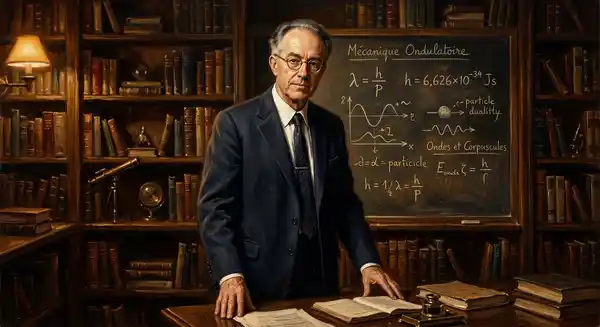
Louis de Broglie
1892–1987 · Theoretical Physicist
Proposing in 1924 that particles of matter, such as electrons, have wave-like properties — the matter-wave hypothesis that earned him the 1929 Nobel Prize in Physics.
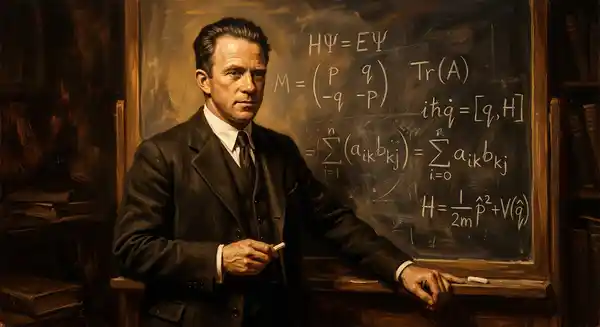
Werner Heisenberg
1901–1976 · Theoretical Physicist
Initiating matrix mechanics in 1925 and formulating the uncertainty principle in 1927. He received the 1932 Nobel Prize in Physics.
Max Born
1882–1970 · Theoretical Physicist
Making fundamental contributions to quantum mechanics, including the probabilistic interpretation of the wavefunction known as the Born rule, and helping develop matrix mechanics. He received the 1954 Nobel Prize in Physics.