_(2).jpg)
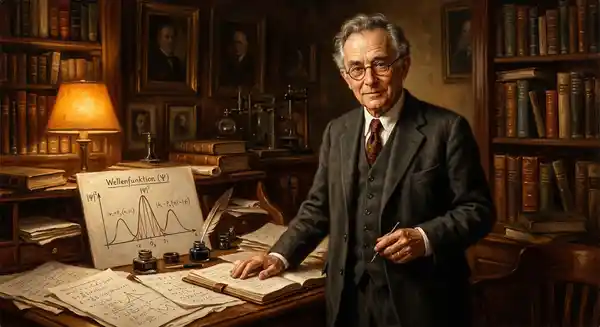
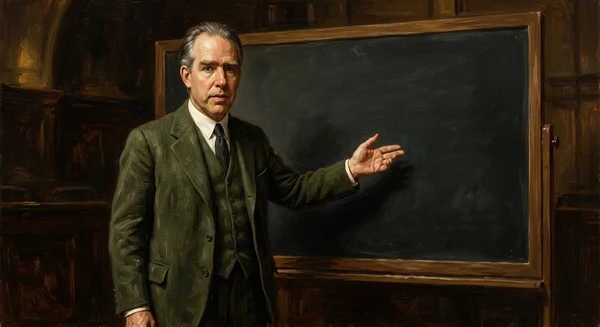
Max Born
1882–1970 · Theoretical Physicist
Max Born was a theoretical physicist who made fundamental contributions to quantum mechanics, including the Born rule and the development of matrix mechanics. He was forced to leave Germany in 1933 and later became a British citizen, receiving the 1954 Nobel Prize in Physics.
“The problem of physics is how the actual world appears to the observer.”
Why is this scientist famous?
Making fundamental contributions to quantum mechanics, including the probabilistic interpretation of the wavefunction known as the Born rule, and helping develop matrix mechanics. He received the 1954 Nobel Prize in Physics.
Max's story
From Breslau to Göttingen
Max Born was born on 11 December 1882 in Breslau, Germany (now Wrocław, Poland). He studied at universities in Breslau, Heidelberg, Zurich and Göttingen, where he earned his doctorate in 1906.
After working in several universities, Born settled in Göttingen in 1921 as professor of theoretical physics. Under his leadership, Göttingen became one of the world's great centres of physics, attracting brilliant young scientists including Werner Heisenberg, Wolfgang Pauli and Enrico Fermi.
Matrix Mechanics
In 1925, Heisenberg, then working in Born's institute, produced a new mathematical approach to atomic physics. Born recognised that the arrays of numbers Heisenberg had been using were matrices — objects from linear algebra that Born had learned about years earlier.
Born and his colleague Pascual Jordan developed the formalism further, and then Born, Heisenberg and Jordan together produced the landmark three-author paper that established matrix mechanics as a complete formulation of quantum mechanics. Born's mathematical insight was essential: he saw what Heisenberg had not yet recognised, that the new method was matrix algebra.
Matrix mechanics was one of the two foundational formulations of quantum mechanics, the other being Schrödinger's wave mechanics, which appeared the following year.
The Born Rule
In 1926, Born made what many consider his most important individual contribution. Schrödinger's wave mechanics described particles using wave functions, but the physical meaning of the wave function was unclear.
Born proposed that the modulus squared of the wave function gives a probability density for the possible results of a measurement. This meant that quantum mechanics does not predict definite outcomes — it predicts the probability of different outcomes.
This probabilistic interpretation, now called the Born rule, was a radical departure from classical physics, where outcomes are in principle deterministic. The Born rule became one of the most fundamental principles of quantum mechanics.
Exile and the Nobel Prize
In 1933, the Nazi regime removed Jewish academics from their university posts. Born, who was Jewish, left Göttingen and Germany. He worked in Cambridge and then Edinburgh, where he became Tait Professor of Natural Philosophy at the University of Edinburgh.
Born became a British citizen in 1939 and continued his research and teaching at Edinburgh until his retirement in 1952. He later returned to West Germany.
In 1954, Born received the Nobel Prize in Physics for his fundamental research in quantum mechanics, especially his statistical interpretation of the wave function. The prize was shared with Walther Bothe. Many people felt the recognition was long overdue — Born's contributions had been central to quantum mechanics for nearly three decades.
Born died on 5 January 1970 in Göttingen, aged 87.
What did they discover?
The Born Rule
Born proposed that the modulus squared of the wave function gives the probability associated with a particular measurement outcome, establishing the probabilistic interpretation at the heart of quantum mechanics.
Matrix Mechanics
Born recognised the matrix structure of Heisenberg's 1925 method and, with Pascual Jordan and Heisenberg, developed the full three-author formulation of matrix mechanics.
Nobel Prize in Physics, 1954
He received the 1954 Nobel Prize in Physics for his fundamental research in quantum mechanics, especially the statistical interpretation of the wave function.
Amazing facts
Born's granddaughter was the singer and actress Olivia Newton-John.
He was forced to leave his professorship at Göttingen in 1933 because he was Jewish.
He recognised the matrix structure of Heisenberg's work before Heisenberg himself did.
Born was Tait Professor at Edinburgh from 1936 until 1952 and became a British citizen in 1939.
His Nobel Prize in 1954 came 28 years after his most important contribution, the Born rule.
Under Born's leadership, Göttingen became one of the world's great centres of theoretical physics.
Timeline
Born in Breslau, Germany (now Wrocław, Poland).
Appointed professor of theoretical physics at the University of Göttingen.
Recognised the matrix structure of Heisenberg’s work and developed matrix mechanics with Heisenberg and Jordan.
Proposed the probabilistic interpretation of the wave function — the Born rule.
Left Germany after the Nazi regime removed Jewish academics from their posts.
Became Tait Professor of Natural Philosophy at the University of Edinburgh.
Became a naturalised British citizen.
Awarded the Nobel Prize in Physics for his statistical interpretation of the wave function.
Died in Göttingen, aged 87.
Awards & honours
Related Super Scientists
Werner Heisenberg
1901–1976 · Theoretical Physicist
Initiating matrix mechanics in 1925 and formulating the uncertainty principle in 1927. He received the 1932 Nobel Prize in Physics.
Albert Einstein
1879–1955 · Theoretical Physicist
Developing the theory of relativity and the equation E=mc².
Niels Bohr
1885–1962 · Physicist
Developed the Bohr model of the atom and made foundational contributions to quantum mechanics.