_(2).jpg)
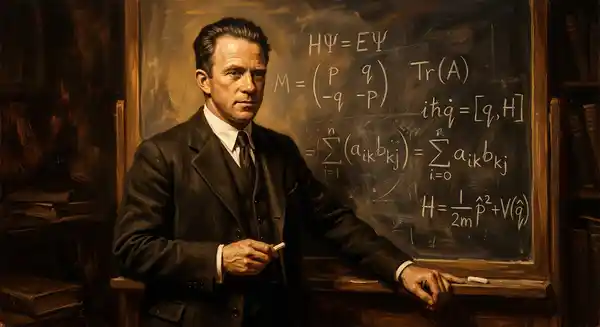
Werner Heisenberg
1901–1976 · Theoretical Physicist
Werner Heisenberg was a German theoretical physicist who initiated matrix mechanics and formulated the uncertainty principle, two of the most important contributions to quantum mechanics. He received the 1932 Nobel Prize in Physics.
“What we observe is not nature itself, but nature exposed to our method of questioning.”
Why is this scientist famous?
Initiating matrix mechanics in 1925 and formulating the uncertainty principle in 1927. He received the 1932 Nobel Prize in Physics.
Werner's story
A Young Theorist in Göttingen
Werner Karl Heisenberg was born on 5 December 1901 in Würzburg, Germany. He studied physics at the University of Munich under Arnold Sommerfeld, one of the leading physicists of the era, and then moved to the University of Göttingen, where he worked with Max Born.
Heisenberg showed extraordinary mathematical ability from an early age. By his early twenties, he was working on some of the most difficult problems in theoretical physics — the behaviour of atoms and the radiation they emit and absorb.
Matrix Mechanics
In 1925, Heisenberg produced a new approach to atomic physics. He focused on quantities that could be directly measured, such as the frequencies and intensities of light emitted by atoms, rather than unobservable quantities like electron orbits.
Heisenberg's method used arrays of numbers to represent physical quantities. His supervisor Max Born recognised that these arrays were matrices — mathematical objects from linear algebra. Born and his colleague Pascual Jordan then developed the formalism further, and Born, Heisenberg and Jordan together produced the major three-author paper that established what became known as matrix mechanics.
Matrix mechanics was one of the first complete formulations of quantum mechanics. It gave correct predictions for atomic phenomena but used mathematics that was unfamiliar to many physicists at the time.
The Uncertainty Principle
In 1927, Heisenberg formulated the uncertainty principle. He showed that in quantum mechanics, certain pairs of physical quantities — such as the position and momentum of a particle — cannot both be known with unlimited precision at the same time.
This is not a limitation of measuring instruments. The uncertainty principle is a fundamental feature of quantum theory: there is a built-in limit to how precisely complementary quantities can be simultaneously determined. The more precisely you know a particle's position, the less precisely you can know its momentum, and vice versa.
The uncertainty principle has profound implications for how quantum systems are described. It is one of the fundamental features of quantum mechanics, a theory that generally predicts probabilities for the outcomes of measurements rather than definite classical trajectories.
The War Years
During the Second World War, Heisenberg was a leading scientist in Germany's uranium research programme, which investigated the possibility of nuclear energy and nuclear weapons. The programme did not produce a nuclear weapon.
Heisenberg's wartime role has been the subject of extensive historical debate. Some accounts have suggested he deliberately slowed the programme or avoided building a bomb; others have questioned this interpretation. The historical record is complex, and historians continue to study the question.
Legacy
After the war, Heisenberg became director of the Max Planck Institute for Physics in Göttingen (later moved to Munich). He continued to work on quantum field theory and particle physics.
Heisenberg received the 1932 Nobel Prize in Physics for the creation of quantum mechanics, particularly the application of matrix mechanics to atomic theory. The prize was announced in 1933, as no prize had been awarded in physics in 1932.
He died on 1 February 1976 in Munich. Matrix mechanics and the uncertainty principle remain among the most important contributions to modern physics, and Heisenberg is regarded as one of the principal architects of quantum mechanics.
What did they discover?
Matrix Mechanics
In 1925, Heisenberg initiated a new formulation of quantum mechanics based on measurable quantities. Max Born recognised the matrix structure, and Born, Heisenberg and Jordan together developed the full formalism.
The Uncertainty Principle
In 1927, Heisenberg showed that pairs of physical quantities such as position and momentum cannot both be known with unlimited precision simultaneously — a fundamental limit built into quantum theory.
Nobel Prize in Physics, 1932
He received the 1932 Nobel Prize in Physics for the creation of quantum mechanics, particularly the application of matrix mechanics to atomic theory.
Amazing facts
Heisenberg was only 24 when he produced the breakthrough that led to matrix mechanics.
His supervisor Max Born recognised that Heisenberg's arrays of numbers were matrices — mathematical objects from linear algebra.
Born, Heisenberg and Jordan together wrote the three-author paper that established matrix mechanics as a complete formulation of quantum mechanics.
The uncertainty principle is not about measurement disturbance — it is a fundamental limit built into the structure of quantum theory.
Heisenberg was a leading scientist in Germany's wartime uranium research programme, which did not produce a nuclear weapon.
His wartime role has been the subject of extensive and ongoing historical debate.
The 1932 Nobel Prize in Physics was announced in 1933 because no physics prize was awarded in 1932.
Timeline
Born in Würzburg, Germany.
Produced the breakthrough that led to matrix mechanics.
Formulated the uncertainty principle.
Awarded the Nobel Prize in Physics for the creation of quantum mechanics.
Became director of the Kaiser Wilhelm Institute for Physics while continuing his work in Germany's uranium research programme.
Died in Munich, aged 74.
Awards & honours
Related Super Scientists
Max Born
1882–1970 · Theoretical Physicist
Making fundamental contributions to quantum mechanics, including the probabilistic interpretation of the wavefunction known as the Born rule, and helping develop matrix mechanics. He received the 1954 Nobel Prize in Physics.
Niels Bohr
1885–1962 · Physicist
Developed the Bohr model of the atom and made foundational contributions to quantum mechanics.
Max Planck
1858–1947 · Theoretical Physicist
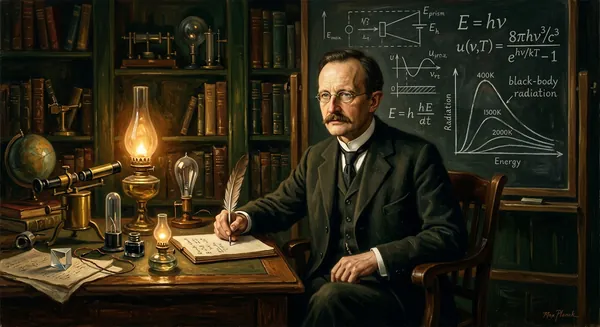
Introducing the quantum of action while deriving his black-body radiation law, helping launch quantum theory.