_(2).jpg)
Discover how Ibn al-Haytham, Newton, Young, Maxwell and Einstein transformed our understanding of light, colour, waves and photons.
Light seems familiar because it is everywhere.
Sunlight crosses your classroom. A mirror sends an image back towards you. A prism spreads white light into colours. A phone camera turns light into an electronic image.
Yet one of the simplest questions in physics proved extraordinarily difficult:
**What actually is light?**
Over many centuries, scientists discovered that no single everyday comparison is enough. Light travels in straight lines, reflects and refracts, behaves like a wave and can also exchange energy in packets that we call photons.
The answer emerged piece by piece.
Understanding how we see
Long before modern physics, people debated whether vision somehow travelled outward from the eyes or whether something from objects entered them.
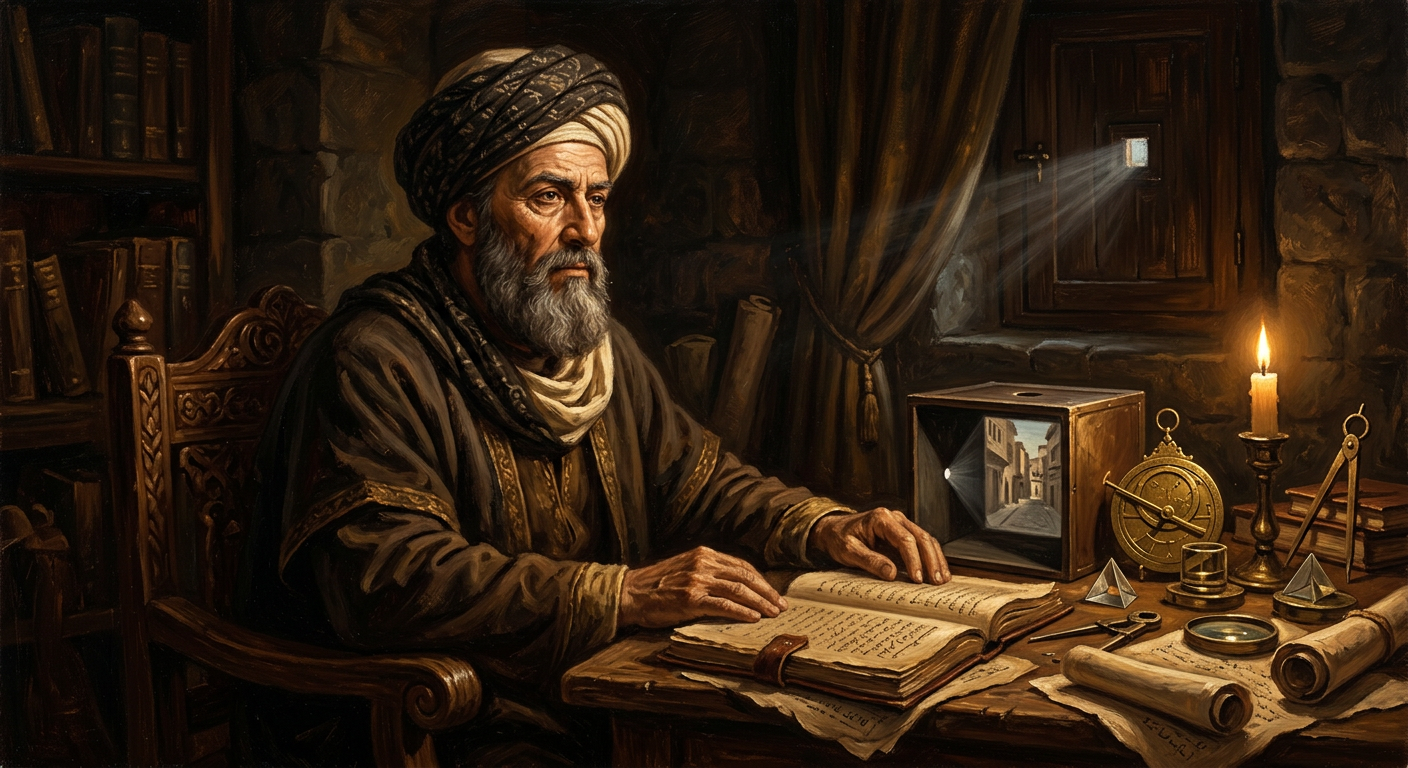
Around the beginning of the eleventh century, **Ibn al-Haytham**, also known in medieval Europe as Alhazen, transformed the study of optics.
He investigated light using observation, geometry and carefully designed experiments. His *Book of Optics* examined reflection, refraction and the way light travels.
A crucial idea was that vision depends on light reaching the eye from the things we see rather than sight being produced by rays sent out from the eye.
That sounds obvious today, but it was a major change in thinking.
Ibn al-Haytham also investigated the straight-line propagation of light. If light passes through a small opening, the geometry of the resulting image can reveal how the rays have travelled.
Optics was becoming an experimental science.
But understanding how light travels was not the same as understanding what light itself was.
Newton splits white light
More than six centuries later, **Isaac Newton** performed some of the most famous experiments in the history of optics.
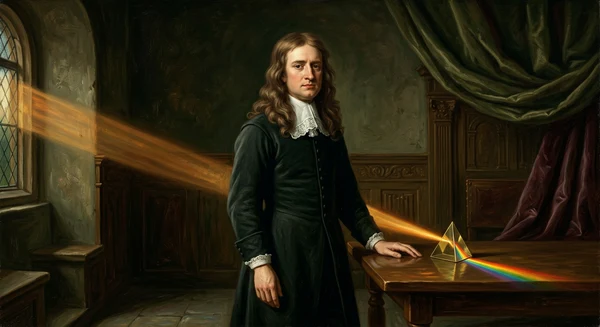
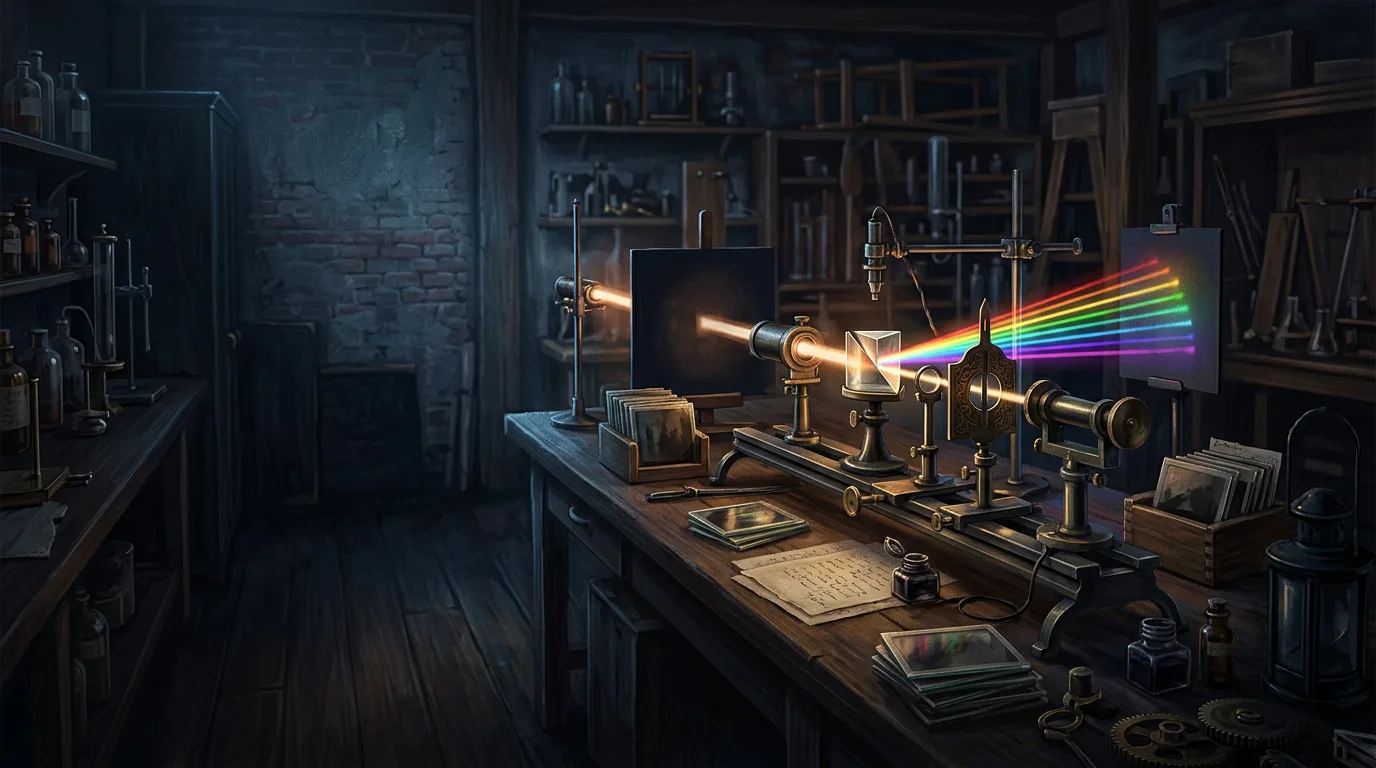
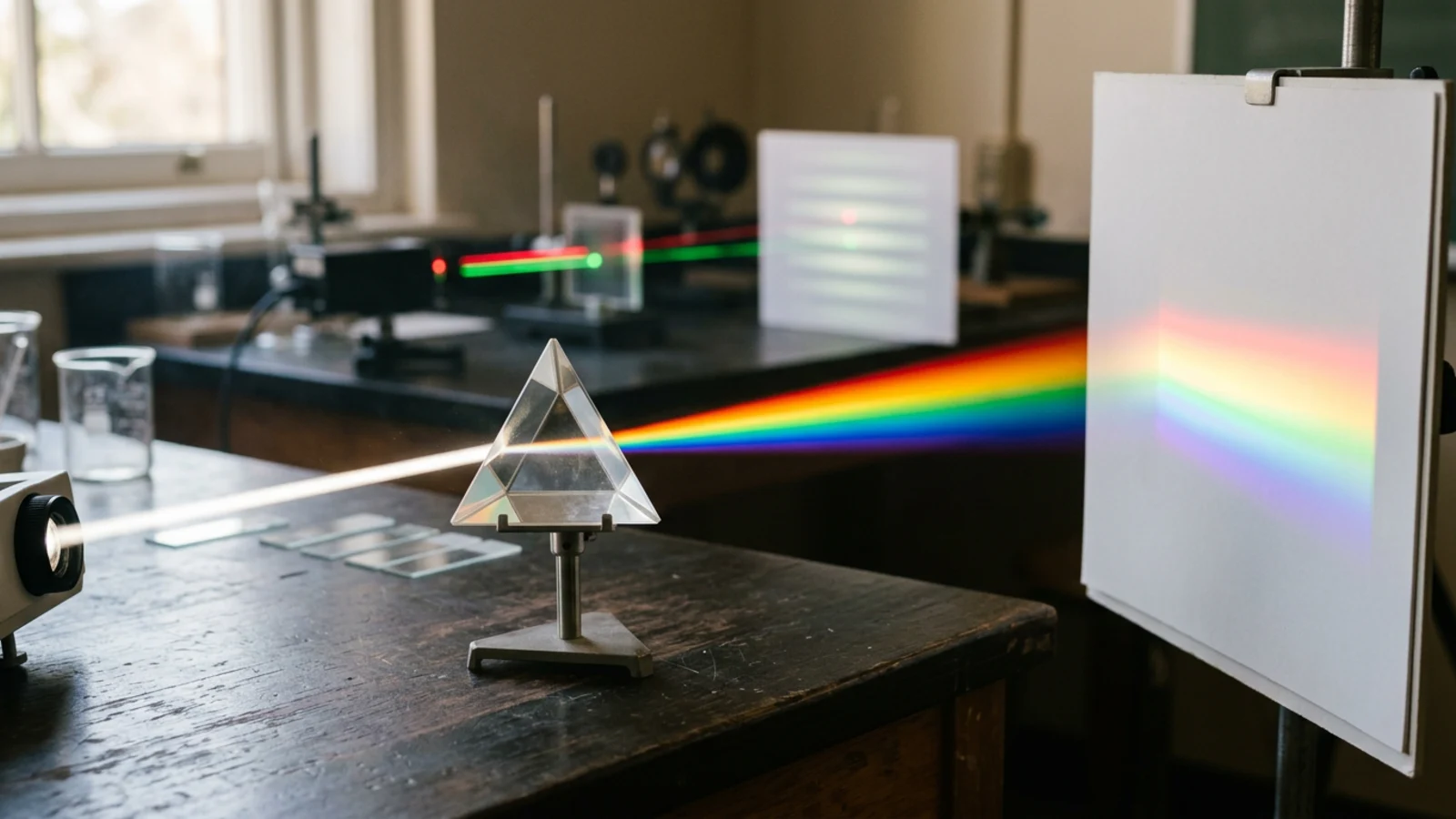
Newton allowed a narrow beam of sunlight to enter a darkened room and pass through a glass prism.
The light spread into a band of colours.
It was tempting to think that the prism had somehow coloured the light. Newton tested that idea by carrying out further experiments, including passing separated light through additional prisms.
His conclusion was much more important: **white light already contains different colours**.
The prism separates them because different colours are refracted by different amounts.
Newton reported his new theory of light and colours to the Royal Society in 1672 and later developed his optical work in *Opticks*.
This transformed the scientific understanding of colour.
A rainbow was not simply colour added to sunlight. White sunlight itself could be separated into a spectrum.
Yet another argument remained unresolved.
Was light made from tiny particles, or did it travel as a wave?
Young finds interference
At the beginning of the nineteenth century, English scientist **Thomas Young** produced powerful evidence for the wave behaviour of light.
Waves can combine.
If two water waves meet crest-to-crest, they reinforce one another. If a crest meets a trough, they can partly or completely cancel.
This is called **interference**.
Young showed that light could produce interference patterns too.
In the experiment now associated with his name, light travelling by two nearby routes produces alternating bright and dark regions. The bright areas occur where the light reinforces; the dark areas occur where it cancels.
That behaviour made sense if light behaved as a wave.
Young's work did not immediately settle every argument. Other scientists, particularly Augustin-Jean Fresnel, developed wave optics much further.
But interference became one of the strongest clues that light could not be understood simply as a stream of ordinary little particles.
Maxwell connects light with electricity and magnetism
The next major step came from a subject that at first seemed completely different.
During the nineteenth century, scientists including Michael Faraday had uncovered deep connections between electricity and magnetism.
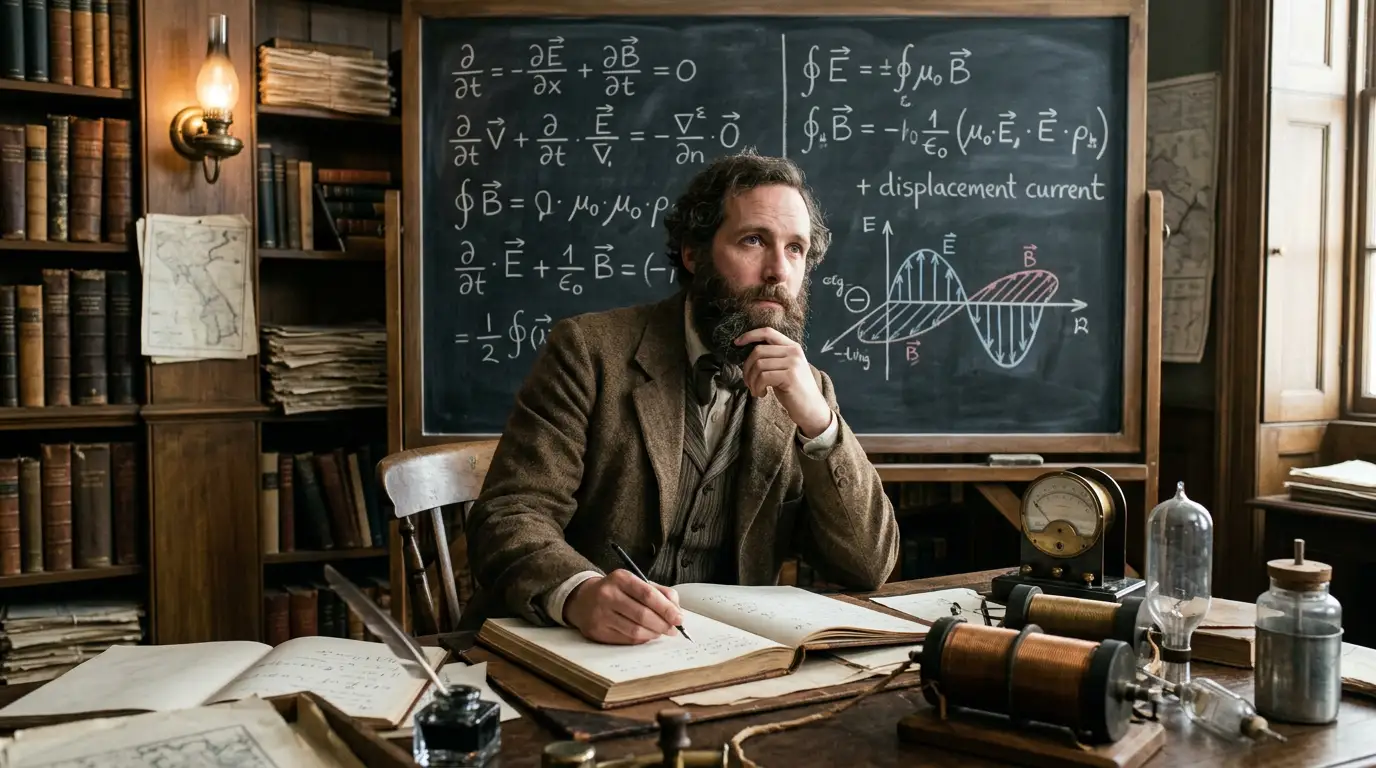
**James Clerk Maxwell** turned these ideas into a mathematical theory of electromagnetic fields.
Something remarkable appeared in the mathematics.
Changes in electric and magnetic fields could travel through space as waves, and the calculated speed of these waves was essentially the known speed of light.
Maxwell realised the significance.
Light itself could be understood as an **electromagnetic wave**.
This connected optics, electricity and magnetism in one theory.
Later experimental work, particularly by Heinrich Hertz, demonstrated electromagnetic waves outside the visible range. Scientists eventually understood that visible light occupies only a small part of a much larger electromagnetic spectrum.
Radio waves, microwaves, infrared, visible light, ultraviolet, X-rays and gamma rays are all electromagnetic radiation.
They differ mainly in wavelength and frequency.
This is the same electromagnetic spectrum pupils learn about at school today.
Then light becomes puzzling again
By the end of the nineteenth century, describing light as an electromagnetic wave was one of physics' great successes.
Then experiments revealed another problem.
Scientists studying the **photoelectric effect** found that light could knock electrons from certain materials.
The results did not behave as a simple classical wave picture seemed to predict.
Making the light brighter could increase the number of emitted electrons, but whether electrons were released at all depended strongly on the frequency of the light.
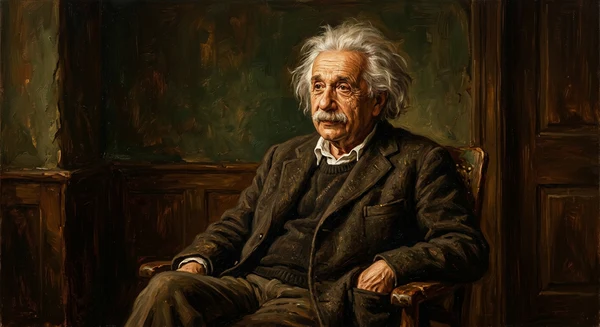
In 1905, **Albert Einstein** proposed a radical explanation.
Light transfers energy in separate packets.
Those packets later became known as **photons**.
Higher-frequency light corresponds to higher-energy photons. If individual photons do not carry enough energy, simply making the light brighter will not give each photon enough energy to release an electron.
Einstein's explanation helped establish quantum physics. His work on the photoelectric effect was specifically recognised when he received the Nobel Prize in Physics.
Now light seemed to have both wave-like and particle-like behaviour.
So is light a wave or a particle?
The surprising answer is that neither everyday picture captures light completely.
Experiments involving interference and diffraction reveal wave behaviour.
Experiments involving individual exchanges of energy reveal photon behaviour.
Modern quantum physics does not describe photons as tiny classical balls that secretly travel like miniature bullets, nor does it reduce light to an ordinary mechanical wave like ripples on water.
The older categories are useful in particular situations, but nature is stranger than either of them.
This is called **wave-particle duality**.
It is not that light changes its mind about what it is.
Rather, different experiments reveal different aspects of a quantum object that cannot be described completely using familiar objects from everyday life.
The school science behind the story
Many apparently separate school topics are pieces of this history.
**Reflection** describes light changing direction at a surface.
**Refraction** occurs when light changes direction as it passes between materials in which it travels at different speeds.
**Dispersion** explains why a prism can separate colours.
**Interference and diffraction** demonstrate the wave behaviour of light.
**The electromagnetic spectrum** places visible light among many forms of electromagnetic radiation.
**Photons** are central to the quantum description of how light exchanges energy.
These ideas were not discovered together.
They accumulated over centuries.
Why understanding light matters
Modern life depends on controlling light.
Cameras detect it. Fibre-optic cables carry information using it. Lasers are used in communications, manufacturing and medicine. Telescopes analyse light from distant stars and galaxies. Spectroscopy allows scientists to identify materials from the light they absorb or emit.
Solar cells convert light energy into electrical energy.
Medical imaging and treatment use parts of the electromagnetic spectrum that human eyes cannot see.
Even the screen displaying this article works by controlling light.
The story also shows why scientific models change.
Ibn al-Haytham helped establish an experimental science of optics.
Newton revealed that white light contains a spectrum of colours.
Young demonstrated interference.
Maxwell connected light with electricity and magnetism.
Einstein showed that a purely classical wave description was not enough.
None of these steps made all the earlier observations worthless.
Each expanded the explanation.
That is one of the most important lessons in science: a successful theory can explain a great deal and still turn out to be part of a larger story.