_(2).jpg)
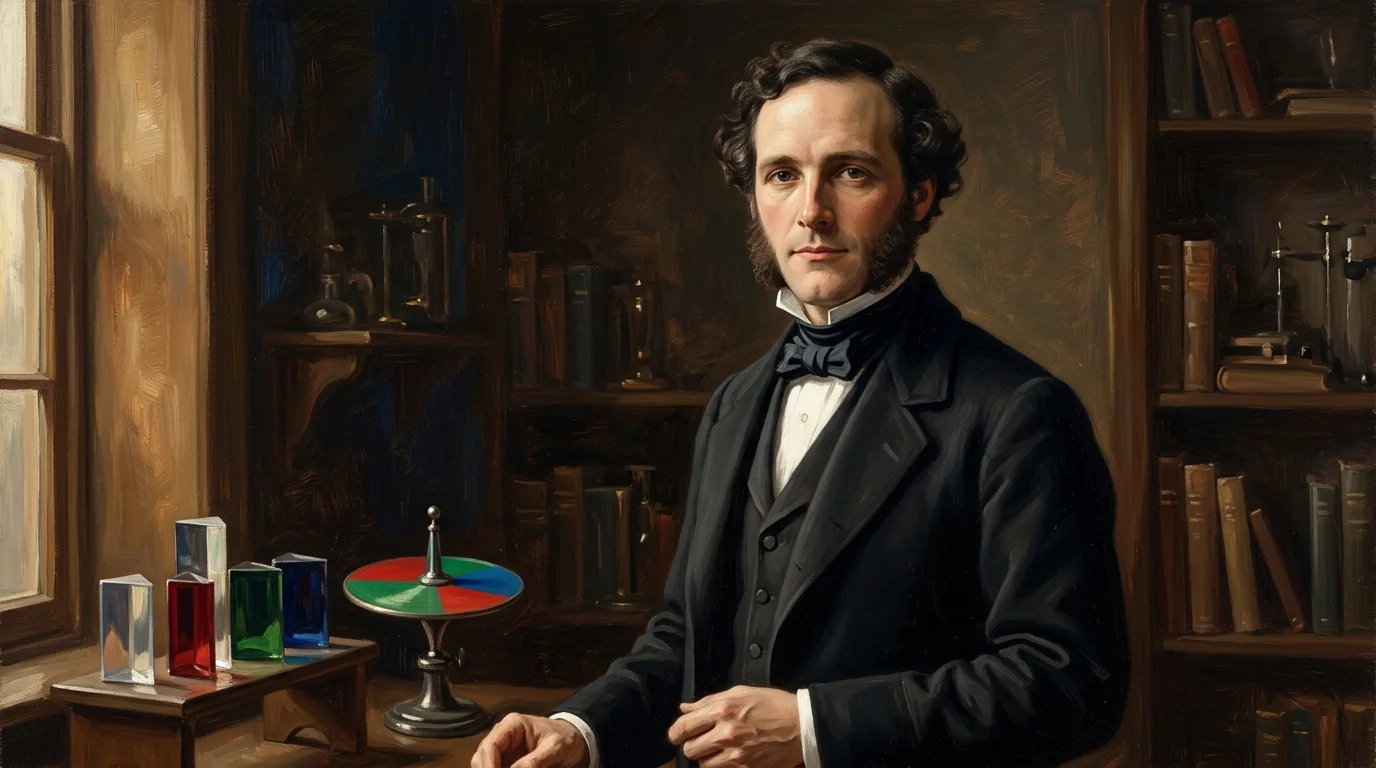
James Clerk Maxwell
1831–1879 · Physicist & Mathematician
A Scottish physicist and mathematician who unified electricity, magnetism and light into one mathematical theory, and made major contributions to our understanding of gases, colour vision and the planet Saturn.
Why is this scientist famous?
Developing the classical theory of electromagnetism, showing mathematically that electricity, magnetism and light are connected, and making major contributions to kinetic theory, colour science and the understanding of Saturn's rings.
Maxwell's electromagnetic theory eventually underpinned technologies involving electromagnetic waves, including radio, television, radar and wireless communications. His statistical treatment of gases helped establish statistical physics, and his work connected nineteenth-century physics with major developments that followed.
James's story
Early Curiosity and Mathematics
James Clerk Maxwell was born in Edinburgh on 13 June 1831 and spent much of his childhood at his family's Glenlair estate in southern Scotland. From a very young age he showed an intense curiosity about how things worked. He attended Edinburgh Academy, where his talent for mathematics quickly became clear. At only 14 he wrote a mathematical paper about oval curves. Professor James Forbes presented it to the Royal Society of Edinburgh because Maxwell was considered too young to present it himself. In 1847 he entered the University of Edinburgh, and in 1850 he moved to Cambridge, initially entering Peterhouse before transferring to Trinity College. In 1854 he graduated as Second Wrangler in the Mathematical Tripos and shared the higher Smith's Prize result with Edward Routh.
Saturn's Rings
In 1856 Maxwell became Professor of Natural Philosophy at Marischal College, Aberdeen. There he tackled the difficult mathematical question of how Saturn's rings could remain stable. He demonstrated that the rings could not remain stable as a single solid body or as a simple fluid ring. Instead, he concluded that they must consist of many separate particles orbiting Saturn. His work won the 1857 Adams Prize, and later observations of Saturn confirmed the fundamental picture of rings composed of enormous numbers of separate particles.
Electricity, Magnetism and Light
Maxwell was deeply influenced by Michael Faraday's physical ideas about electric and magnetic fields. Maxwell turned these ideas into a powerful mathematical theory. He showed that changing electric and magnetic fields could propagate through space as waves, and he calculated that these electromagnetic waves should travel at approximately the measured speed of light. This led him to the extraordinary conclusion that light itself is an electromagnetic phenomenon. His major paper, A Dynamical Theory of the Electromagnetic Field, was read to the Royal Society in 1864 and published in 1865. Maxwell's work unified electricity, magnetism and optics within one theoretical framework. His theory later provided the foundation for technologies involving electromagnetic waves, including radio, television, radar and wireless communications. The compact four vector equations normally taught today as Maxwell's equations are a later reformulation of Maxwell's much larger mathematical theory. Heinrich Hertz later experimentally demonstrated electromagnetic waves after Maxwell's death.
Colour Vision and Photography
Maxwell also carried out important research into human colour vision. He investigated how combinations of red, green and blue light could reproduce other colours. In 1861 he gave a famous demonstration of three-colour photography. Photographer Thomas Sutton took photographs of a coloured tartan ribbon through different colour filters for Maxwell's demonstration. The results were technically imperfect because the photographic materials of the period were not equally sensitive to all colours, but the experiment became an important milestone in colour photography. Maxwell devised the colour method and Thomas Sutton took the photographs used in Maxwell's pioneering 1861 three-colour photographic demonstration.
Molecules, Gases and Probability
Maxwell also made a major contribution to kinetic theory, the explanation of gases through the motion of molecules. In 1860 he introduced a statistical distribution describing the different speeds of molecules in a gas. This was important because instead of trying to specify the movement of every molecule individually, Maxwell described their behaviour using probability. Ludwig Boltzmann later developed this statistical approach further. The resulting distribution is now associated with both scientists as the Maxwell-Boltzmann distribution.
King's College and Cambridge
Maxwell was Professor of Natural Philosophy at King's College London from 1860 to 1865. This was an exceptionally productive period during which much of his electromagnetic theory was developed. In 1871 he became the first Cavendish Professor of Experimental Physics at the University of Cambridge. He oversaw the design and construction of the new Cavendish Laboratory, which opened in 1874 and later became one of the world's most important centres for physics. His major book, A Treatise on Electricity and Magnetism, was published in 1873. He died in Cambridge on 5 November 1879, aged 48.
What did they discover?
Classical Electromagnetic Theory
Maxwell developed the mathematical theory connecting electricity and magnetism and showed that electromagnetic disturbances propagate as waves.
Light as Electromagnetic Radiation
By finding that electromagnetic waves should travel at approximately the speed of light, Maxwell concluded that light is an electromagnetic phenomenon.
Maxwell Distribution / Kinetic Theory
He introduced a statistical description of molecular velocities in gases, a foundational development in statistical physics.
Saturn's Rings
He mathematically demonstrated that Saturn's rings must consist of many separately orbiting particles rather than a single stable solid or fluid ring.
Colour Science
His research on colour vision led to a pioneering 1861 three-colour photographic demonstration with photographer Thomas Sutton.
Cavendish Laboratory
As Cambridge's first Cavendish Professor, Maxwell oversaw the creation of the Cavendish Laboratory.
Amazing facts
Maxwell showed remarkable curiosity about how things worked from a very young age.
He wrote his first mathematical paper on oval curves when he was only 14.
At Cambridge he finished as Second Wrangler and shared the top Smith's Prize result with Edward Routh.
He mathematically predicted that Saturn's rings must consist of enormous numbers of separate orbiting particles.
He calculated that electromagnetic waves should travel at roughly the speed of light, helping him recognise that light itself is electromagnetic.
His 1861 colour demonstration used photographs of a tartan ribbon taken by Thomas Sutton through different colour filters.
His work on gases introduced probability and statistical distributions into an important area of physics.
He became Cambridge's first Cavendish Professor of Experimental Physics and oversaw construction of the Cavendish Laboratory.
Timeline
Born in Edinburgh, Scotland
At age 14, his first mathematical paper on oval curves was presented to the Royal Society of Edinburgh
Entered the University of Edinburgh
Moved to Cambridge; transferred from Peterhouse to Trinity College
Graduated from Cambridge as Second Wrangler and shared the Smith's Prize result with Edward Routh
Became Professor of Natural Philosophy at Marischal College, Aberdeen
Won the Adams Prize for his analysis of the stability of Saturn's rings
Became Professor of Natural Philosophy at King's College London; published major work on the kinetic theory of gases
Demonstrated his three-colour photographic method with photographs taken by Thomas Sutton
Elected Fellow of the Royal Society
A Dynamical Theory of the Electromagnetic Field published
Became Cambridge's first Cavendish Professor of Experimental Physics
Published A Treatise on Electricity and Magnetism
Cavendish Laboratory opened under Maxwell's direction
Died in Cambridge, England
Awards & honours
Related Super Scientists
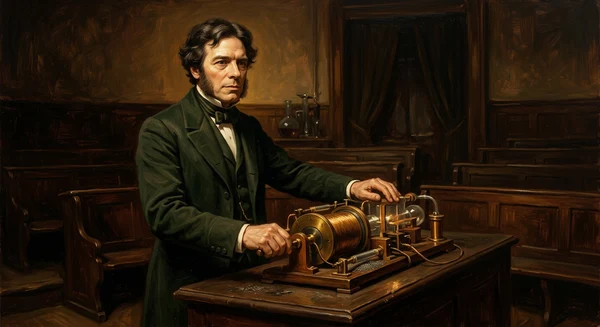
Michael Faraday
1791–1867 · Physicist & Chemist
Discovered electromagnetic induction and created pioneering devices that became the foundations of the electric motor, transformer and generator.
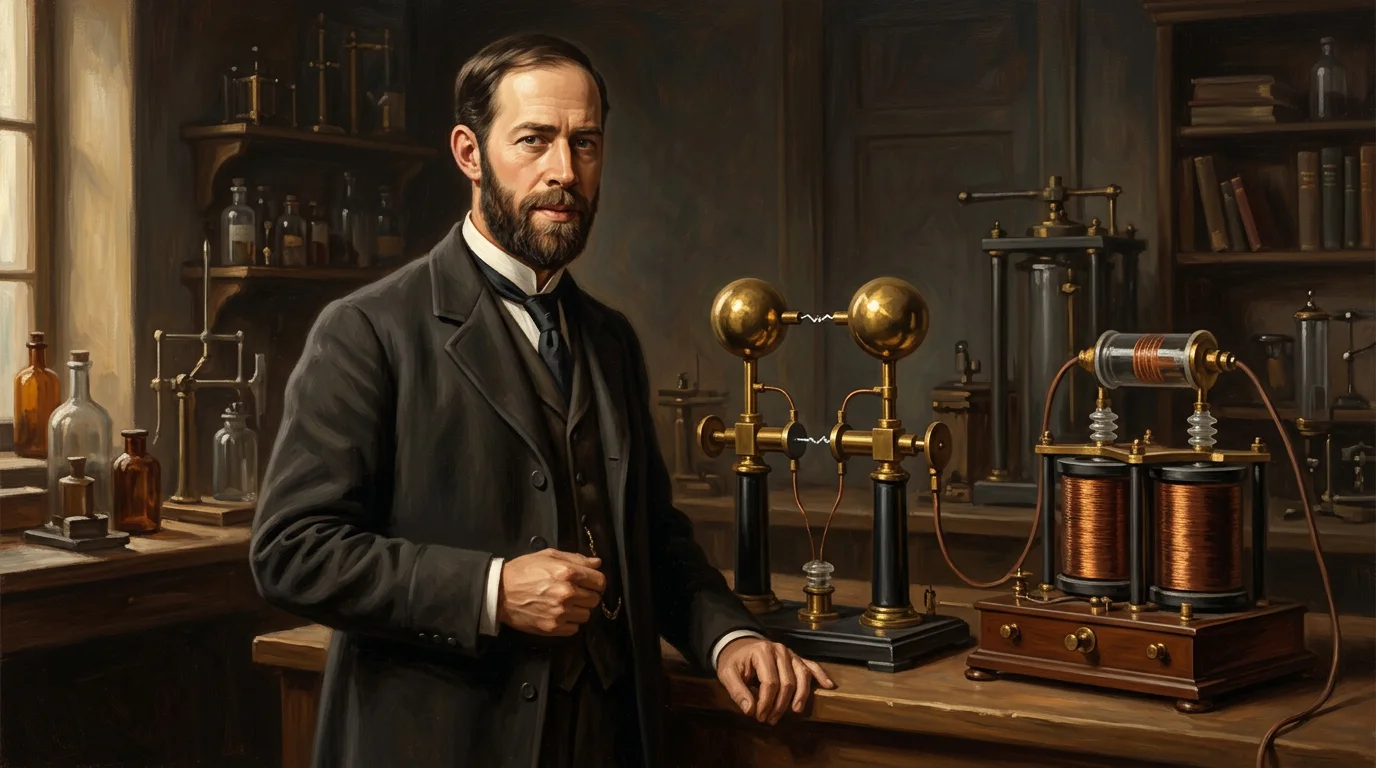
Heinrich Hertz
1857–1894 · Physicist
Experimentally demonstrated electromagnetic waves in the late 1880s, confirming key predictions of James Clerk Maxwell's electromagnetic theory. The unit hertz (Hz) is named after him.
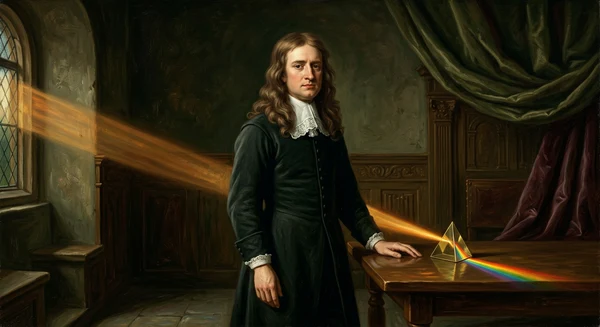
Isaac Newton
1643–1727 · Physicist & Mathematician
Formulating the laws of motion and universal gravitation.