_(2).jpg)
Discover how Carnot, Joule, Kelvin, Clausius and Boltzmann transformed heat from a mysterious fluid into the science of energy and thermodynamics.
Touch a mug of hot chocolate and energy transfers to your hand.
Put an ice cube in a drink and energy transfers into the ice.
Rub your hands together and they become warmer.
These everyday experiences seem simple, but for centuries scientists struggled to explain what heat actually was.
Was it a substance?
Was it movement?
Why did engines need a hot side and a cold side?
And could movement itself be turned into heat?
Answering those questions produced a new branch of physics:
**thermodynamics**.
When heat was thought to be a fluid
During the eighteenth and early nineteenth centuries, many scientists described heat using the **caloric theory**.
Caloric was imagined as an invisible, weightless substance associated with hot objects.
A hot body contained more caloric, and caloric could flow from hotter objects to colder ones.
The theory could explain some observations surprisingly well.
Heat really does transfer spontaneously from a warmer object to a cooler one.
But describing heat as a material fluid eventually created serious problems.
Experiments would show that heat could be generated again and again by mechanical work.
If caloric were a conserved substance stored inside matter, where was all this new heat coming from?
Carnot studies the perfect engine
Before caloric theory disappeared, **Sadi Carnot** made an extraordinary contribution while still reasoning partly within it.
Steam engines had already transformed industry, but their underlying physics was poorly understood.
Carnot asked a fundamental question:
**Is there a maximum possible efficiency for a heat engine?**
In 1824 he analysed an idealised engine operating between a hot region and a cold region.
Carnot recognised that the ability to produce useful work depended fundamentally on a **temperature difference**.
A heat engine needs energy transfer from a hotter reservoir towards a colder one.
His idealised **Carnot cycle** became enormously important because it separated the fundamental physics of engines from the engineering details of a particular machine.
Carnot did not possess the modern energy theory of heat.
Yet his analysis became one of the foundations on which thermodynamics was built.
Joule turns motion into heat
The caloric picture faced increasingly serious experimental challenges.
One of the most important came from English physicist **James Prescott Joule**.
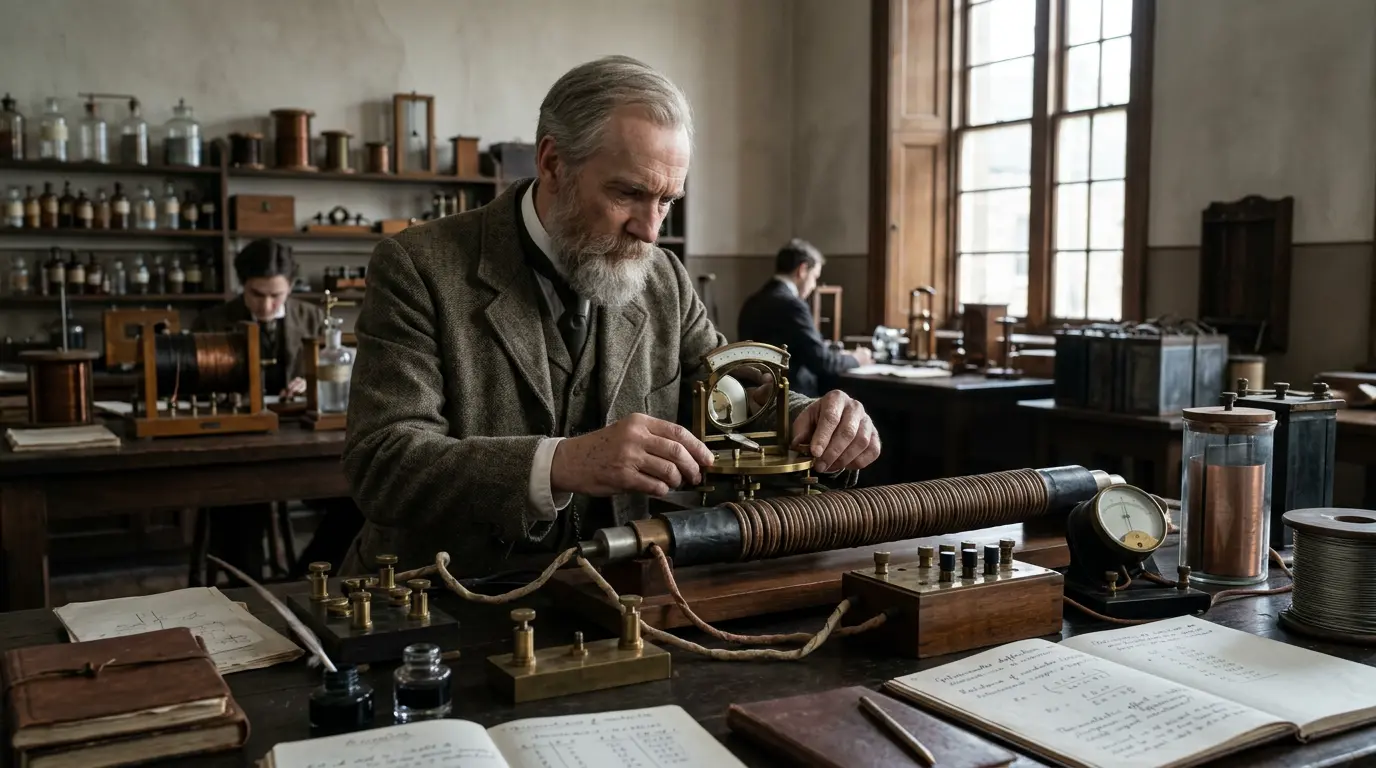
Joule investigated connections between electricity, mechanical work and heating.
His most famous experiments measured the **mechanical equivalent of heat**.
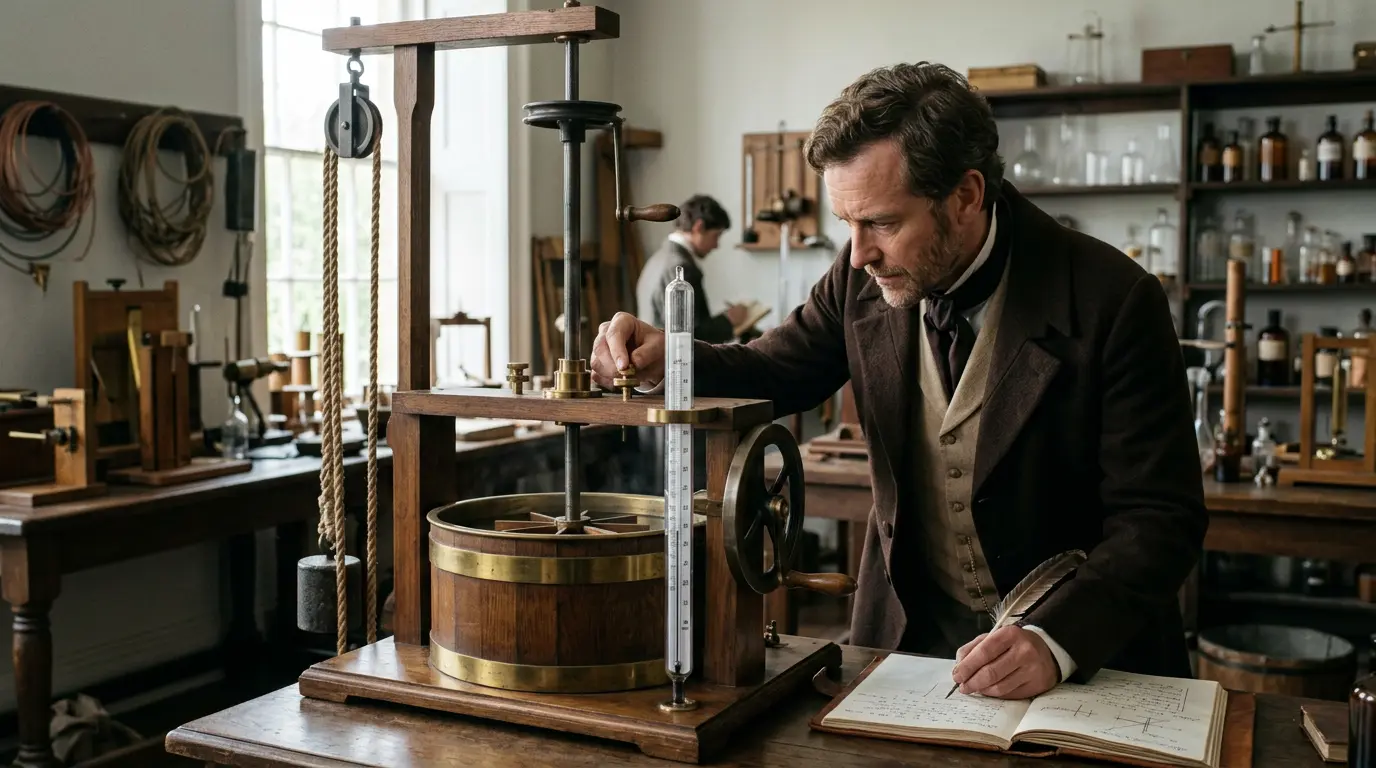
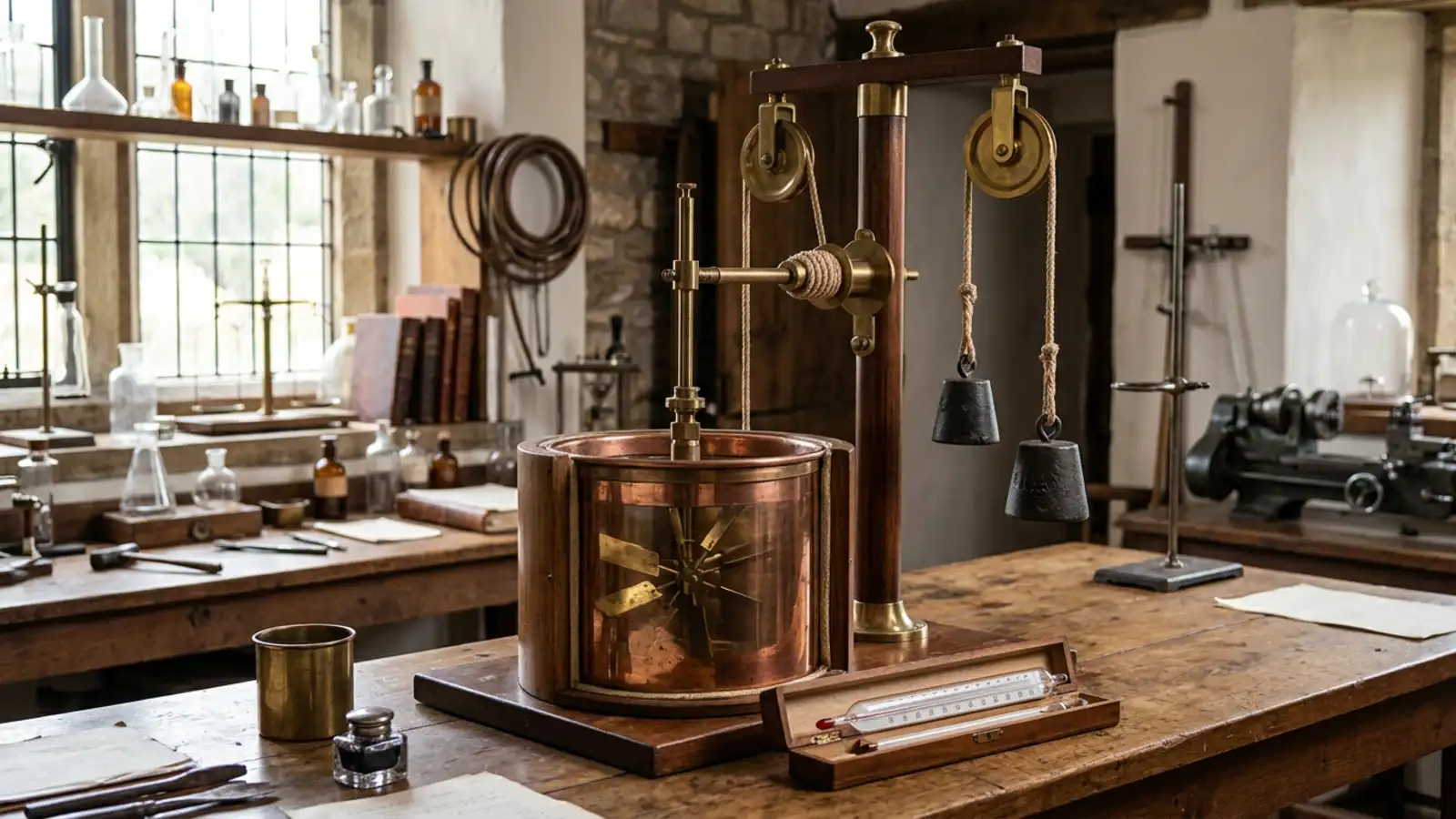
In one arrangement, falling weights turned paddles inside a container of water.
The moving paddles stirred the water.
The water became slightly warmer.
Joule carefully compared the mechanical work done by the falling weights with the increase in thermal energy.
The conclusion was profound.
Mechanical work and heating were not completely different things linked by a mysterious heat substance.
Energy could be transferred mechanically and appear as an increase in a system's internal energy.
Together with work by other scientists, these results helped establish the principle of **conservation of energy**.
Energy can change form and can be transferred, but it is not simply created from nothing or destroyed.
The SI unit of energy is now called the **joule**.
Heat and temperature are not the same thing
The new physics also clarified an important distinction that still causes confusion.
**Temperature** describes the thermal state of a system.
**Heat** is energy transferred because of a temperature difference.
An object does not technically contain a quantity called “heat” in the same way it contains mass.
It has internal energy.
When energy transfers from a hotter system to a colder one because of their temperature difference, we call that transfer **heating** or heat transfer.
This distinction explains why temperature alone does not tell you how much energy is involved.
A cup of boiling water may have a higher temperature than a warm swimming pool, but the pool contains vastly more material and therefore can involve much more internal energy.
Kelvin searches for an absolute scale
Scottish physicist **William Thomson**, later Lord Kelvin, worked closely with the developing science of thermodynamics.
Ordinary temperature scales such as Celsius choose convenient reference points.
But Thomson wanted a temperature scale based on fundamental physics.
In 1848 he proposed an **absolute temperature scale**.
Its zero would correspond to the limiting lowest thermodynamic temperature:
**absolute zero**.
The modern Kelvin scale begins at absolute zero, which corresponds to −273.15 °C.
A temperature interval of one kelvin has the same size as one degree Celsius, although the scales have different zero points.
The kelvin is now the SI unit of thermodynamic temperature.
Modern physics has greatly refined the microscopic meaning of temperature, but Kelvin's absolute scale became fundamental to thermodynamics.
Clausius and the direction of change
Conservation of energy tells us that energy cannot simply disappear.
But that does not explain why many processes naturally happen in one direction and not the other.
A hot drink left on a table cools down.
The surrounding room does not spontaneously become colder while concentrating enough energy back into the drink to make it hot again.
German physicist **Rudolf Clausius** was one of the scientists who developed the **second law of thermodynamics**.
He helped formalise the idea that heat does not spontaneously flow from a colder body to a hotter one without other changes occurring.
Clausius also introduced the term **entropy**.
Entropy is one of the deepest concepts in physics. In thermodynamics it helps describe the direction of natural processes and the limits on converting energy into useful work.
This explains why even an idealised engine cannot turn all transferred thermal energy into useful mechanical work.
Some constraints are built into nature itself.
Boltzmann looks at the particles
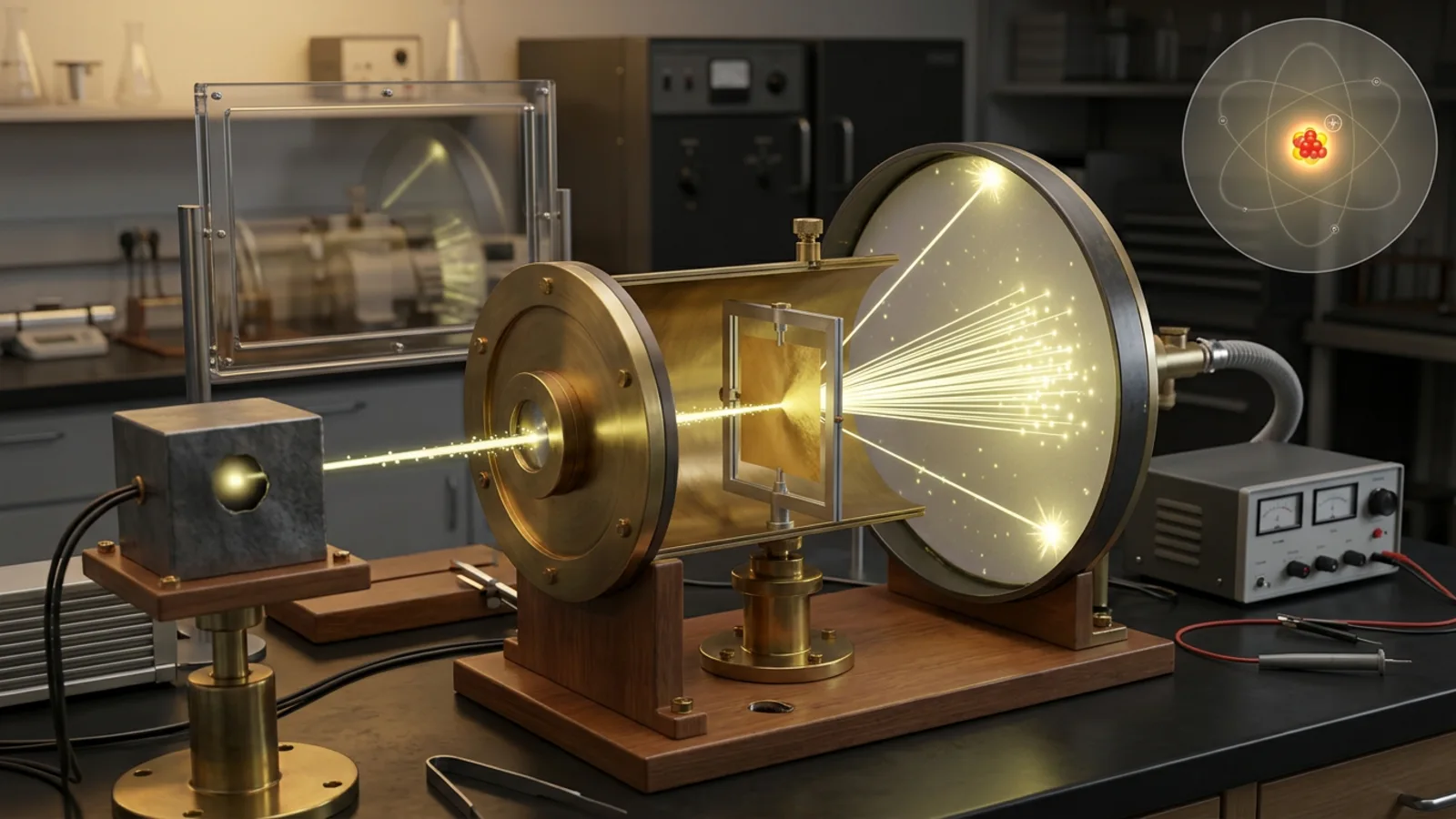
Thermodynamics was extraordinarily successful even before scientists completely understood matter at the microscopic level.
A deeper explanation came from the motion and statistics of enormous numbers of particles.
**Ludwig Boltzmann** was a central figure in developing statistical mechanics.
Imagine a gas.
Its atoms or molecules move constantly, colliding with one another and with the walls of their container.
We cannot realistically track every particle in a glass of air.
But we can describe huge collections of particles statistically.
Temperature is related to the distribution of microscopic energy among those particles.
Boltzmann also connected entropy with the number of microscopic arrangements compatible with a system's large-scale state.
This gave thermodynamics a microscopic foundation.
The familiar world of hot and cold could be connected with the invisible behaviour of atoms and molecules.
The school science behind the story
Several school topics come directly from this history.
**Conduction** transfers thermal energy through interactions within or between materials.
**Convection** transfers energy through the bulk movement of fluids.
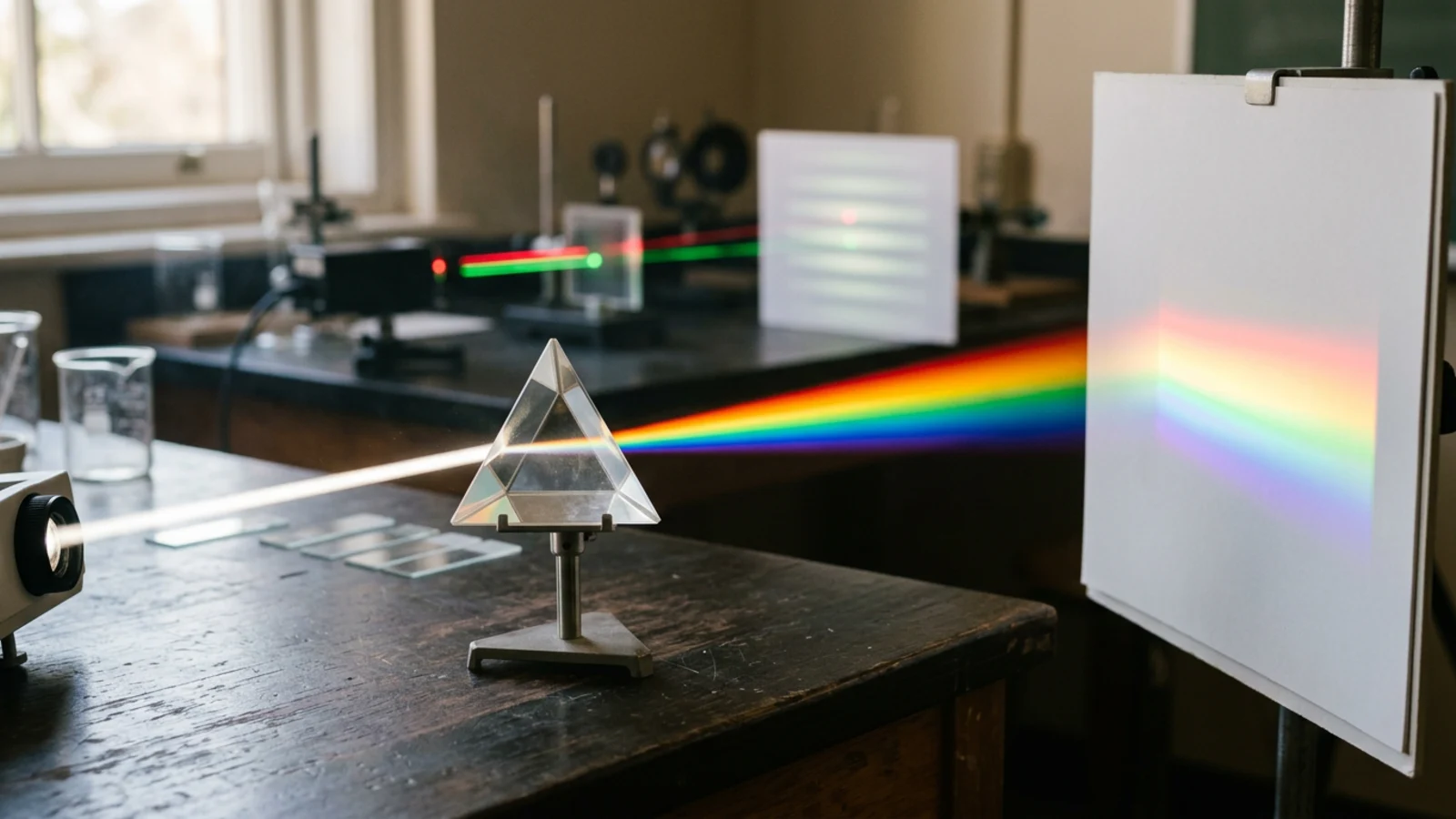
**Thermal radiation** transfers energy by electromagnetic radiation and does not require matter.
A temperature difference drives net thermal energy transfer.
Heating a substance can increase its temperature, change its state or both.
The amount of energy required depends on properties including mass, specific heat capacity and, during a change of state, specific latent heat.
And whenever energy changes form, total energy is conserved.
These are not separate facts.
They belong to the same thermodynamic story.
Why heat still matters
Thermodynamics controls much of modern technology.
Power stations convert energy into electrical output.
Car engines convert chemical energy into mechanical work.
Refrigerators and heat pumps use work to transfer thermal energy in a direction it would not spontaneously flow.
Computers must remove unwanted thermal energy.
Engineers designing spacecraft, buildings, batteries and industrial processes all have to understand heat transfer.
Thermodynamics even places limits on how efficient machines can be.
We cannot solve every engineering problem simply by building a more perfect motor.
Nature itself sets boundaries.
From an invisible fluid to energy and particles
The history of heat is a useful reminder that an incorrect theory can still contain useful observations.
Caloric theory treated heat as a substance, which was ultimately wrong.
Carnot nevertheless discovered deep constraints on heat engines while using some caloric ideas.
Joule's experiments helped replace the fluid picture with energy conservation.
Kelvin gave thermodynamics an absolute temperature scale.
Clausius developed the second law and entropy.
Boltzmann linked those large-scale laws to the statistical behaviour of particles.
The result is far richer than simply saying that hot things contain “more heat”.
Heat became part of a general science of energy, matter and change.