_(2).jpg)
Follow Dalton, Thomson, Rutherford, Bohr and Chadwick as experiments transformed the atom from a simple idea into the nuclear model taught today.
You cannot see an atom with a classroom microscope.
Yet almost everything around you is made from atoms.
The air, your desk, your body, the Earth and distant stars are built from matter whose structure is hidden far below ordinary vision.
Scientists did not discover that structure by simply looking closely enough.
They worked it out from evidence.
Over little more than a century, the atom changed from an apparently indivisible building block into a system containing electrons and a tiny nucleus made from protons and neutrons.
Each new experiment forced scientists to redraw the picture.
Dalton gives chemistry atoms
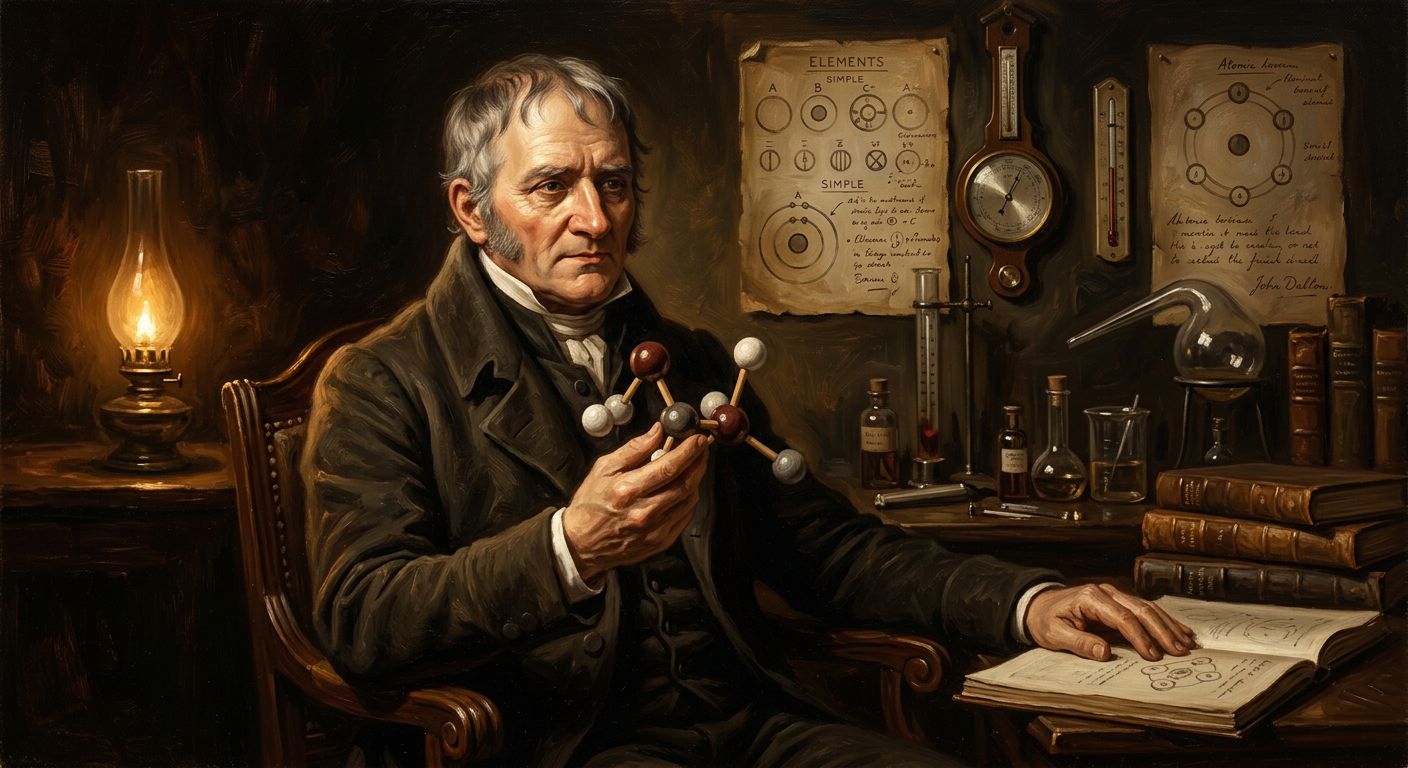
Ideas resembling atomism existed in the ancient world, but the modern scientific story changed dramatically with **John Dalton** in the early nineteenth century.
Dalton was trying to explain patterns in chemistry.
Elements combine in regular proportions. A chemical compound does not normally contain an arbitrary amount of each element.
Dalton proposed that matter consisted of atoms and that chemical reactions involved atoms being combined, separated and rearranged.
Different chemical elements had different atoms.
This gave chemists a powerful way of thinking about chemical reactions and relative atomic masses.
Dalton's particular model was not our modern model. He did not know about electrons, nuclei, isotopes or quantum mechanics.
But his atomic theory made atoms scientifically useful.
For much of the nineteenth century, an atom could still be pictured as a tiny indivisible unit.
Then experiments with electricity showed that atoms had something inside them.
Thomson discovers something smaller than the atom
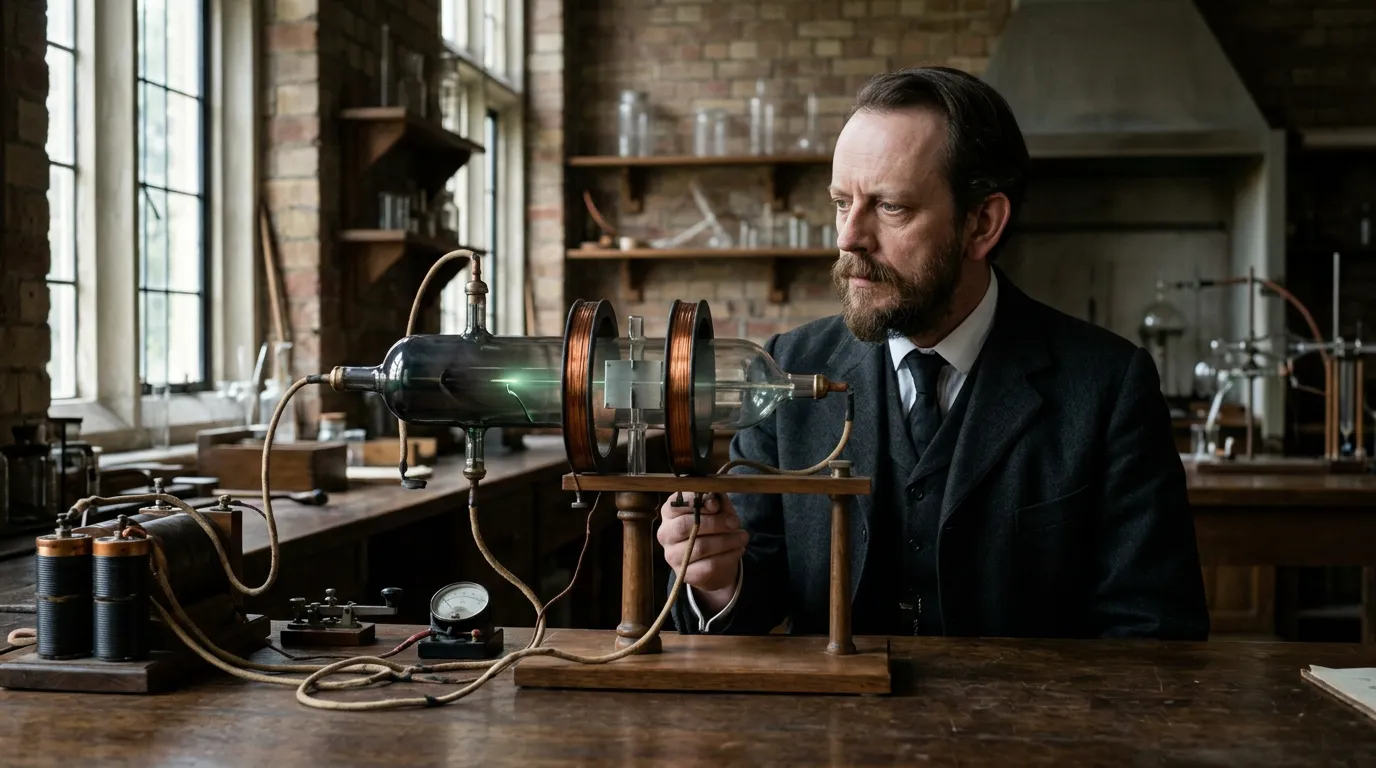
In the late nineteenth century, researchers were experimenting with **cathode rays** produced inside glass tubes containing gas at very low pressure.
What were these mysterious rays?
At Cambridge's Cavendish Laboratory, **J. J. Thomson** investigated how cathode rays responded to electric and magnetic fields.
In 1897, his measurements led him to conclude that the rays consisted of negatively charged particles far smaller than an atom.
These particles became known as **electrons**.
That was a major shock to the older picture.
If atoms contained electrons, atoms were not indivisible after all.
Thomson attempted to construct a new model. Negative electrons were embedded within a region of positive charge.
This later became popularly known as the **plum pudding model**.
It was a reasonable attempt to explain the evidence available at the time.
It was also wrong.
An experiment that should have been boring
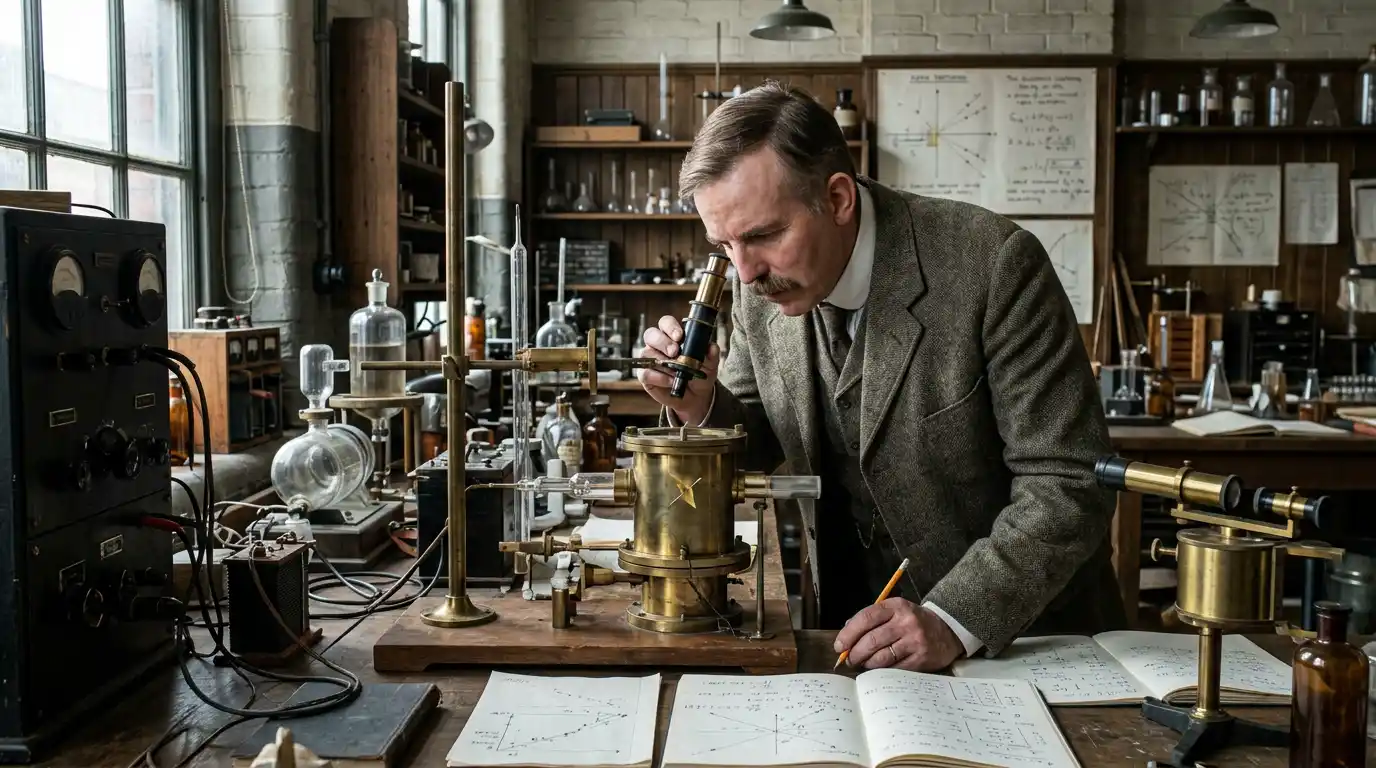
At the University of Manchester, **Ernest Rutherford** was studying radioactivity and the way alpha particles passed through matter.
Rutherford worked with **Hans Geiger** and the young **Ernest Marsden**.
Their scattering experiments became one of the most important examples in science of an unexpected result changing a theory.
Alpha particles are positively charged and relatively massive compared with electrons.
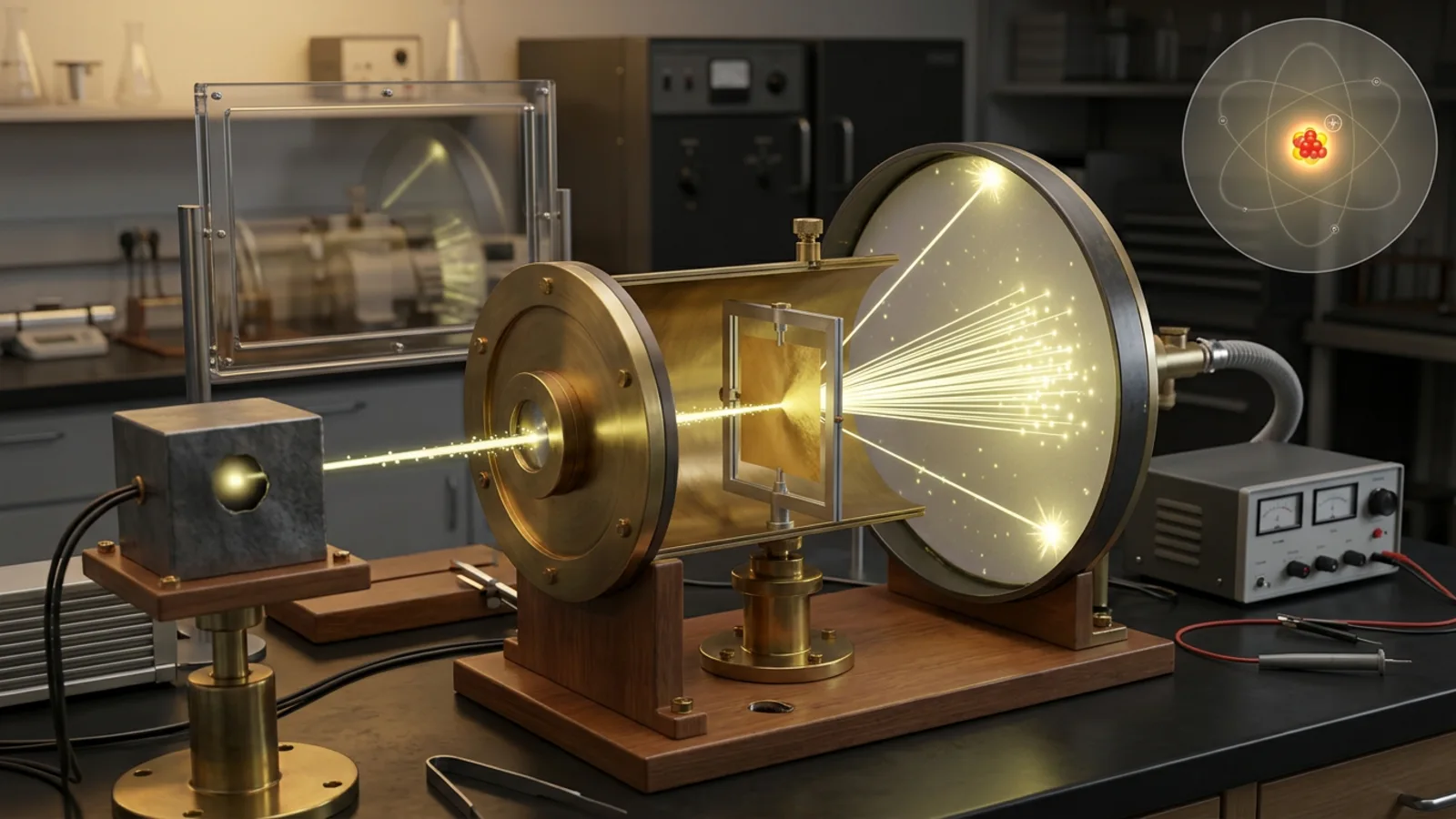
Geiger and Marsden directed alpha particles towards extremely thin metal foil and detected where the particles travelled afterwards.
If Thomson's diffuse model of positive charge was correct, the heavy, fast alpha particles should mostly travel through with only modest changes in direction.
Most did.
But some did something startling.
A tiny proportion were scattered through very large angles. Some even travelled backwards.
The existing model could not explain that.
Rutherford puts the mass in the middle
Rutherford eventually developed an explanation and published his nuclear model in 1911.
The atom's positive charge and much of its mass could not be spread throughout its whole volume.
Instead, they had to be concentrated in an extraordinarily small central region.
The **atomic nucleus** had entered physics.
Because only a small proportion of the alpha particles came close enough to this concentrated positive region to be strongly deflected, the results also implied something surprising:
Most of the atom's volume is comparatively empty space.
Electrons occupied the region around the nucleus.
This was a radically different atom from Thomson's model.
But Rutherford's picture created another problem.
According to classical physics, electrons moving around a nucleus should lose energy. If that happened continuously, atoms should be unstable.
Clearly another idea was needed.
Bohr introduces energy levels
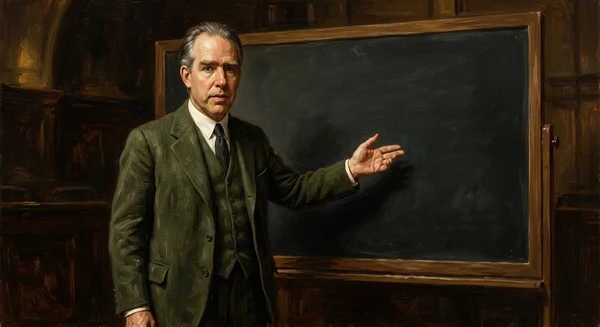
In 1913, Danish physicist **Niels Bohr** developed a new atomic model using ideas from the emerging quantum theory.
Bohr proposed that electrons could occupy only certain allowed states associated with particular energies.
They could move between these states by absorbing or emitting specific amounts of energy.
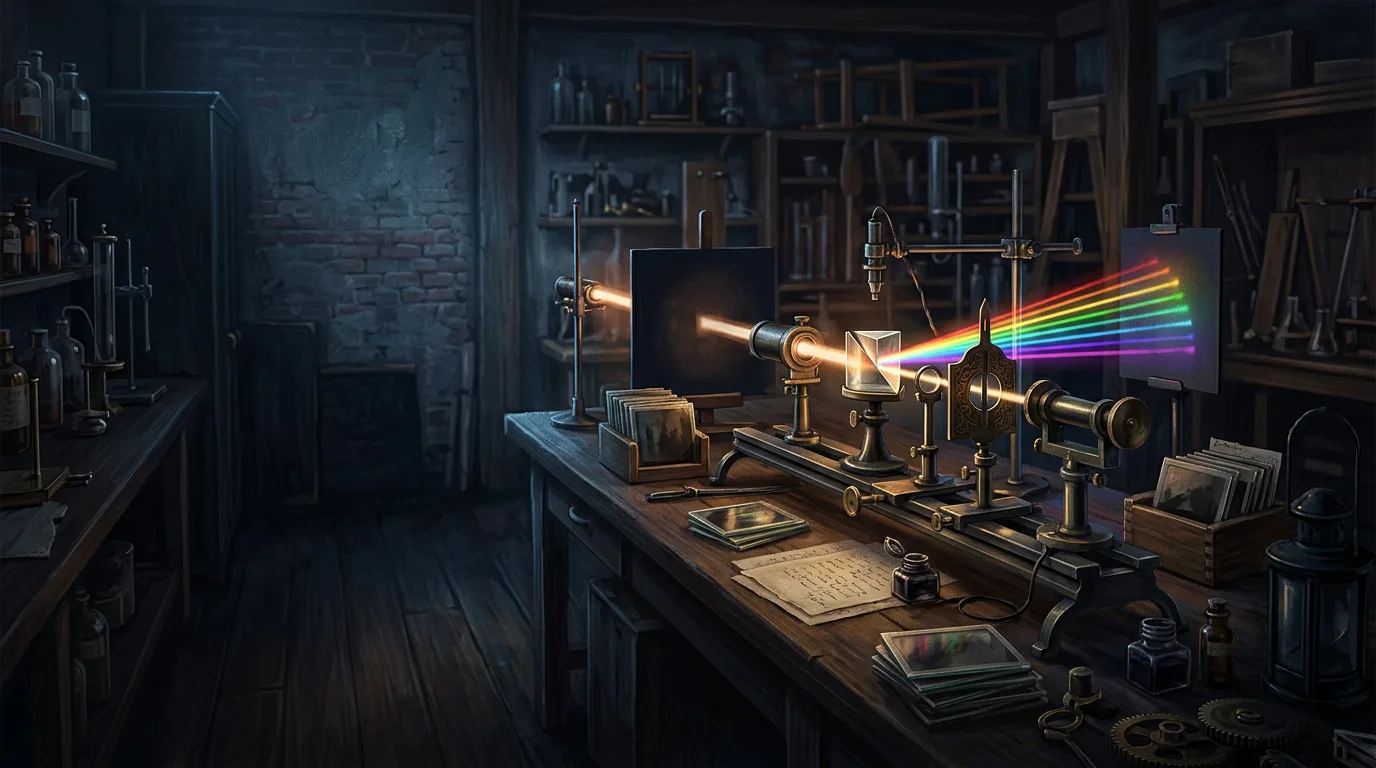
This helped explain why atoms produce characteristic **line spectra** rather than emitting every possible colour of light.
Bohr's model was especially successful for hydrogen.
The familiar school diagram showing electrons on neat shells around a nucleus is related to this stage in the history.
But it is important not to mistake that diagram for a photograph of an atom.
Modern quantum mechanics replaced simple planetary-style electron orbits with a more sophisticated description involving quantum states and orbitals.
The shell model remains useful because it helps explain patterns in chemistry, including electron arrangements and the behaviour of elements.
What was the nucleus made from?
Discovering the nucleus did not finish the story.
Rutherford's later work helped establish the proton as a positively charged constituent of atomic nuclei.
But there was a puzzle.
Nuclear masses could not be explained properly using protons alone.
Scientists suspected that another particle might be hidden in the nucleus.
Because it would have no electric charge, it would be much harder to detect than a charged particle.
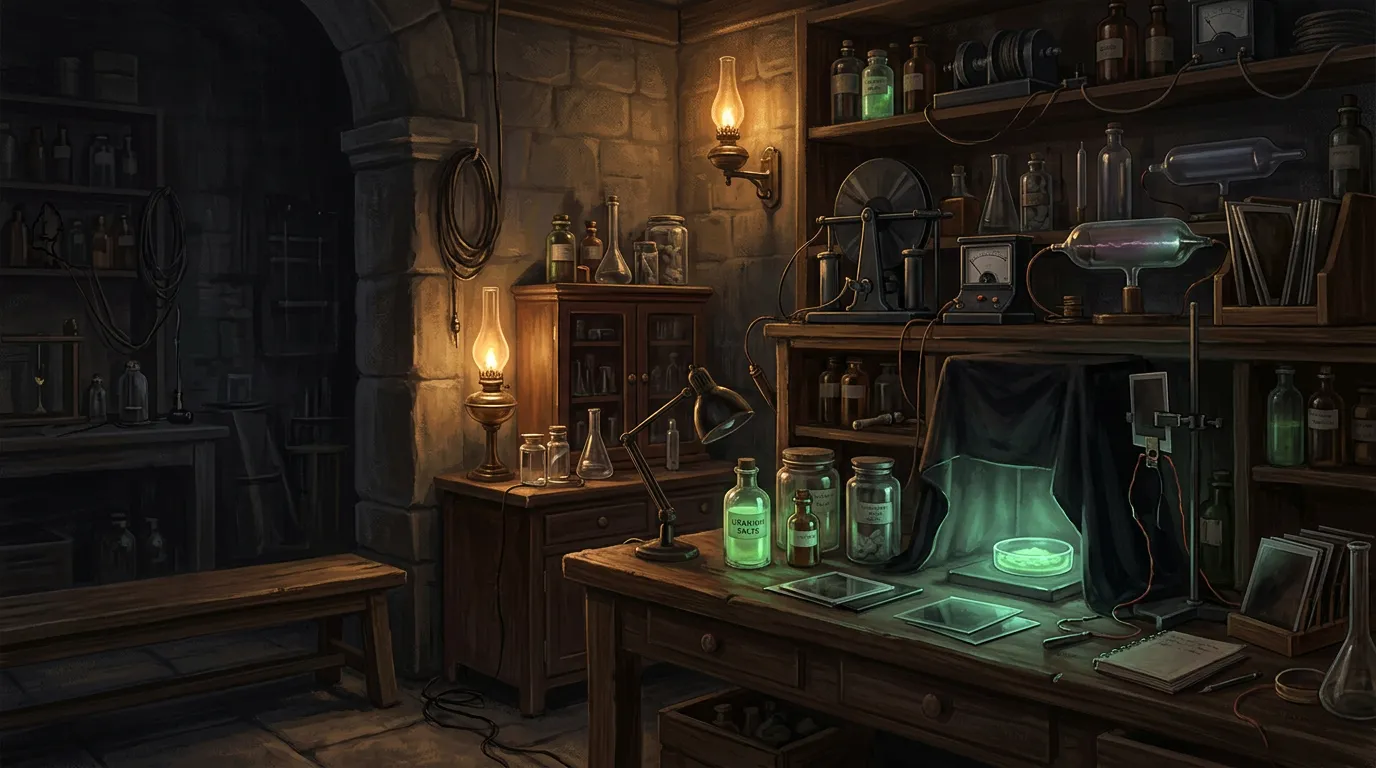
In 1932, **James Chadwick** investigated penetrating radiation produced when beryllium was bombarded with alpha particles.
Other researchers had already observed the radiation and some had interpreted it as extremely energetic electromagnetic radiation.
Chadwick tested how it interacted with matter.
The results were much better explained if the radiation consisted of electrically neutral particles with approximately the mass of a proton.
The **neutron** had been discovered.
Chadwick received the 1935 Nobel Prize in Physics for this work.
The school model of the atom
The basic nuclear model taught in school now contains three familiar particles.
**Protons** carry positive electric charge and are in the nucleus.
**Neutrons** have no net electric charge and are also in the nucleus.
**Electrons** carry negative charge and occupy regions around the nucleus.
The number of protons determines which element an atom is.
Atoms of the same element can contain different numbers of neutrons. These are **isotopes**.
Electrons are central to chemical reactions and bonding.
This means that ideas pupils often meet separately — elements, isotopes, ions, bonding and radioactivity — all connect back to atomic structure.
Models are not failures when they are replaced
The history of the atom can look strange on a classroom poster.
Dalton model.
Thomson model.
Rutherford model.
Bohr model.
It can seem as though scientists simply kept getting the answer wrong.
That misses the point.
A scientific model is a tool for explaining the evidence available at the time.
Dalton's atoms helped explain chemical proportions.
Thomson changed the model when electrons showed that atoms had internal structure.
Geiger and Marsden's scattering evidence exposed a serious problem with Thomson's model.
Rutherford introduced the nucleus to explain those observations.
Bohr used new quantum ideas to explain atomic stability and spectra more successfully.
Chadwick added the neutron when nuclear evidence required another particle.
Each model was judged by what it could explain and predict.
New evidence demanded better models.
That is science working properly.
Our modern picture goes deeper
Protons and neutrons are not the deepest known level of matter.
Modern particle physics shows that protons and neutrons themselves contain smaller particles called **quarks**.
Electrons belong to a different family of fundamental particles called leptons.
Quantum mechanics also gives us a much richer description of electrons in atoms than simple circular orbits.
Yet the nuclear atom discovered through the work of Thomson, Rutherford's Manchester group, Bohr, Chadwick and many others remains the foundation on which much of modern chemistry and nuclear physics is built.
It explains why elements differ.
It helps explain chemical bonding.
It makes sense of isotopes and radioactivity.
And it demonstrates something especially important for school science:
Scientists do not have to see something directly to discover it.
Sometimes they learn what is hidden by carefully measuring what happens when something else interacts with it.
That is exactly how the inside of the atom was revealed.