_(2).jpg)
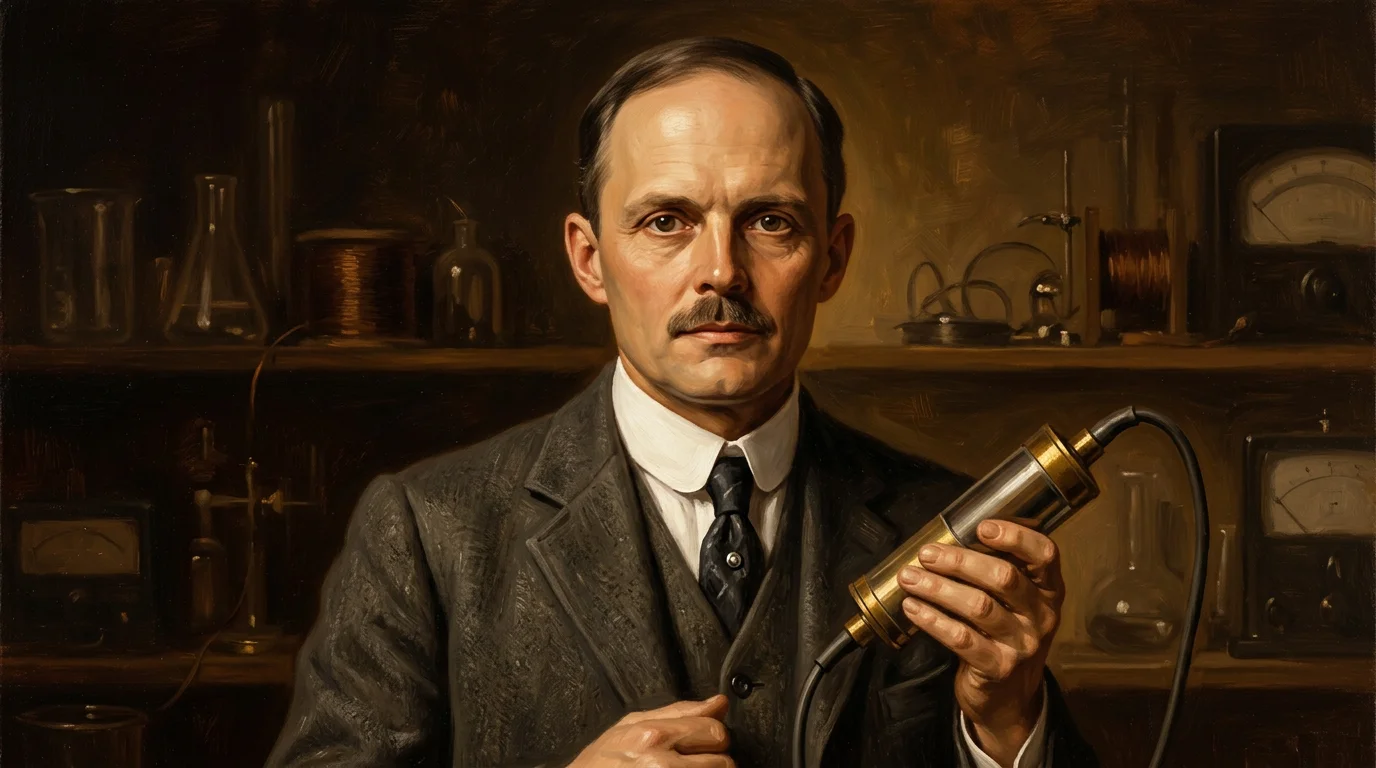
Hans Geiger
1882–1945 · Experimental physicist
Hans Geiger helped develop radiation detection techniques and carried out the crucial alpha-particle scattering experiments with Ernest Marsden under Ernest Rutherford's direction.
“Counting is the beginning of all science.”
Why is this scientist famous?
Hans Geiger developed methods for detecting and counting ionising radiation, participated in the Geiger–Marsden scattering experiments that helped reveal the atomic nucleus, and later developed the Geiger–Müller counter with Walther Müller.
Geiger's work on radiation detection and the alpha-particle scattering experiment helped reveal the structure of the atom and made radiation measurement practical for science and safety.
Hans's story
Early Life and Education
Hans Geiger was born on 30 September 1882 in Neustadt an der Weinstraße, Germany. He grew up in an academic family — his father was a university professor. Geiger studied physics at Munich and Erlangen, receiving his PhD at Erlangen in 1906 for research involving electrical discharges through gases.
That doctoral work on electrical discharges would prove surprisingly relevant. The techniques he learned for detecting tiny electrical signals in gases became the foundation of his later work on radiation detection.
Counting Alpha Particles
Soon after his PhD, Geiger went to the University of Manchester to work in Ernest Rutherford's laboratory. An important problem in early radioactivity research was simply being able to detect and count individual particles reliably. Early experiments sometimes required researchers to sit in darkness and count tiny flashes of light on a screen by eye.
Geiger worked with Rutherford on electrical methods that made counting radioactive particles much more practical. In 1908 Rutherford and Geiger published an electrical method for counting alpha particles. Geiger continued improving radiation detection techniques throughout his career.
The Geiger–Marsden Experiment
At Manchester, Rutherford asked Geiger and undergraduate Ernest Marsden to investigate how alpha particles behaved when fired at very thin metal foils. In 1909 they found that while most alpha particles passed through with only small changes in direction, a very small number were scattered through surprisingly large angles — with some effectively bouncing back toward the source.
This was completely unexpected under the prevailing 'plum pudding' model of the atom. Rutherford later interpreted these results as evidence that most of an atom's positive charge and mass were concentrated in a tiny central nucleus. Geiger and Marsden performed the crucial experiments; Rutherford interpreted the results and developed the nuclear model. It was not any one person's discovery alone.
The Geiger–Nuttall Law
Geiger also worked with John Mitchell Nuttall. Their research established the Geiger–Nuttall relationship, which linked characteristics of alpha-particle emission with radioactive decay rates. As with his other work, this was a collaborative finding — not Geiger's alone.
Coincidence Counting with Walther Bothe
In the 1920s Geiger also worked with physicist Walther Bothe on coincidence counting — detecting whether two events occurred at the same time. Their experiments on the Compton effect provided important evidence that interactions between radiation and electrons occurred as individual, connected events, strengthening the developing quantum description of light.
The Geiger–Müller Counter
Geiger developed early electrical devices for detecting radioactive particles, but the familiar instrument people call a 'Geiger counter' was actually the result of collaboration with his doctoral student Walther Müller. In 1928, while working at Kiel, Geiger and Müller published work on an improved gas-filled counting tube.
The improved Geiger–Müller counter could detect several forms of ionising radiation and became far more practical than earlier radiation counters. The device that people commonly call a Geiger counter is properly associated with both Geiger and Müller.
Later Career
Geiger returned to Germany in 1914. His later academic career included positions at Kiel, Tübingen and the Technische Hochschule Berlin. In 1936 he became director of the Physics Institute at the Technische Hochschule Berlin, where he continued research in nuclear physics and cosmic radiation.
He died on 24 September 1945 in Potsdam, Germany. His legacy lives on every time someone uses a radiation detector — a direct descendant of the counting tube he developed with Walther Müller.
What did they discover?
Electrical Counting of Alpha Particles
In 1908 Rutherford and Geiger published an electrical method for counting individual alpha particles, replacing the laborious visual counting of scintillation flashes.
Geiger–Marsden Scattering Experiment
In 1909 Geiger and Ernest Marsden, under Rutherford's direction, found that a tiny fraction of alpha particles were scattered through very large angles by thin metal foils. Rutherford interpreted this as evidence for the atomic nucleus.
Geiger–Nuttall Relationship
Geiger and John Mitchell Nuttall established a relationship linking alpha-particle emission characteristics with radioactive decay rates.
Geiger–Müller Counter
In 1928 Geiger and Walther Müller published an improved gas-filled counting tube that could detect several forms of ionising radiation. This became the practical radiation detector known worldwide as the Geiger counter.
Bothe–Geiger Coincidence Experiments
Geiger and Walther Bothe developed coincidence-counting methods and used them in experiments on the Compton effect, providing important evidence for the particle-like behaviour of radiation.
Amazing facts
Geiger originally trained by studying electrical discharges through gases — knowledge that became useful for detecting radiation.
He worked in Ernest Rutherford's Manchester laboratory early in his career.
Early radiation experiments sometimes required researchers to sit in darkness and count tiny flashes of light by eye.
Geiger helped develop electrical methods that made counting radioactive particles much more practical.
The surprising 1909 Geiger–Marsden results showed that a tiny fraction of alpha particles could be scattered almost backwards.
Those results helped Rutherford develop the nuclear model of the atom.
The familiar Geiger counter should more accurately be called the Geiger–Müller counter because Walther Müller was an essential collaborator.
Geiger also worked on cosmic rays and nuclear physics later in his career.
Timeline
Born in Neustadt an der Weinstraße, Germany.
Received PhD at Erlangen for research on electrical discharges through gases.
Joined Rutherford's laboratory at the University of Manchester.
Rutherford and Geiger published an electrical method for counting alpha particles.
Geiger–Marsden scattering experiment revealed unexpected large-angle deflection of alpha particles.
Continued development of automatic radiation counting techniques.
Geiger–Nuttall relationship established.
Returned to Germany.
Geiger and Walther Müller published their improved counting-tube design.
Became director of the Physics Institute at Technische Hochschule Berlin.
Died in Potsdam, Germany.
Related Super Scientists
Ernest Rutherford
1871–1937 · Physicist
Discovering the nuclear structure of the atom and pioneering the field of nuclear physics.
Ernest Marsden
1889–1970 · Experimental physicist and scientific administrator
Ernest Marsden carried out the famous 1909 alpha-particle scattering experiments with Hans Geiger under Ernest Rutherford, and later became one of the most influential organisers of science in New Zealand.
Henri Becquerel
1852–1908 · Experimental physicist
Henri Becquerel discovered that uranium emitted penetrating radiation spontaneously, providing the starting point for the scientific study of natural radioactivity.