_(2).jpg)
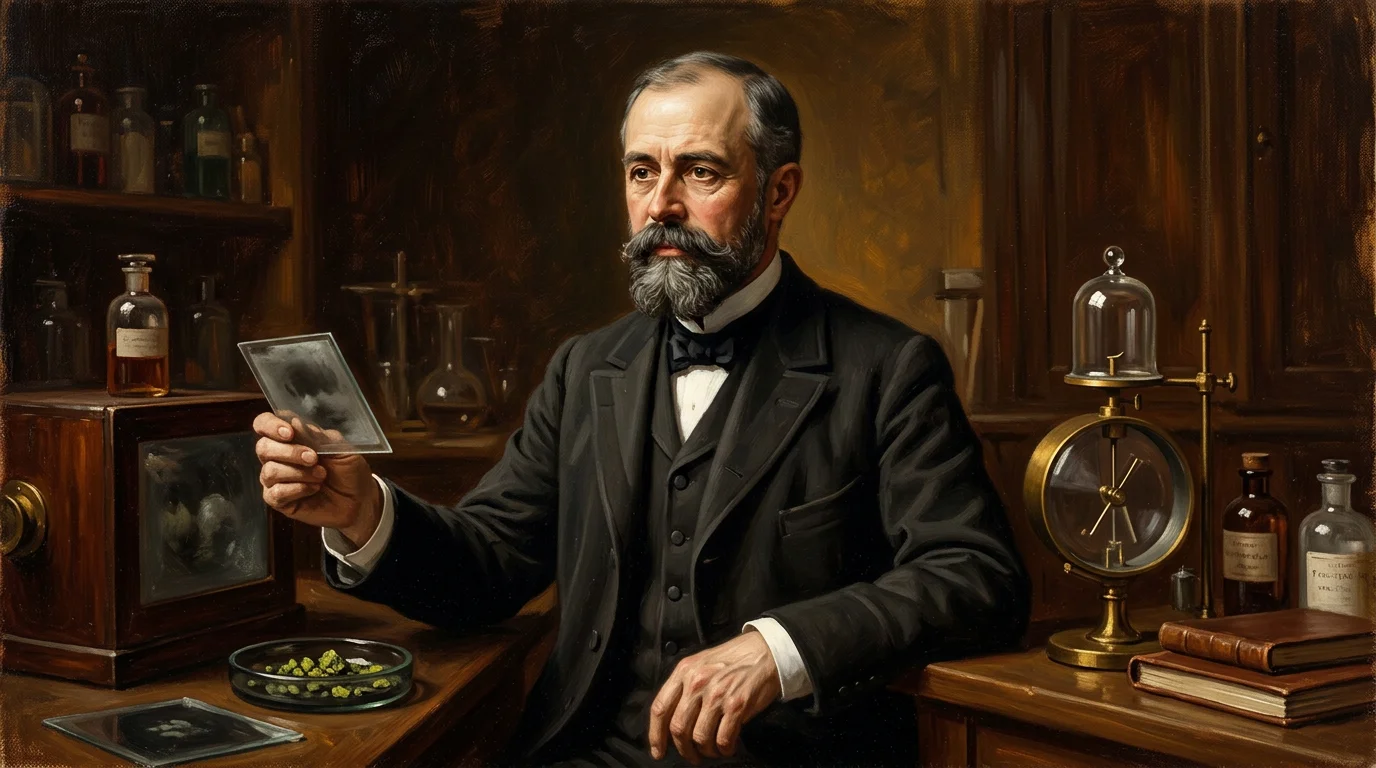
Henri Becquerel
1852–1908 · Experimental physicist
Henri Becquerel discovered natural radioactivity in uranium in 1896, opening the door to nuclear physics and sharing the 1903 Nobel Prize in Physics with Marie and Pierre Curie.
“One must believe in the fertility of the obscure, and in the efficacy of the luminous.”
Why is this scientist famous?
Henri Becquerel discovered that uranium emitted penetrating radiation spontaneously, providing the starting point for the scientific study of natural radioactivity.
Becquerel's discovery of natural radioactivity launched the field of nuclear physics. The SI unit of radioactive activity, the becquerel (Bq), is named after him.
Henri's story
A Scientific Family
Henri Becquerel was born in Paris on 15 December 1852 into an unusually scientific family. His father, Alexandre Edmond Becquerel, was a physicist who researched light, phosphorescence and solar phenomena. His grandfather, Antoine César Becquerel, was also a physicist. Henri therefore grew up surrounded by experimental science and naturally continued work connected with light and phosphorescence.
He entered the École Polytechnique in 1872, then trained as an engineer through the Ponts et Chaussées, qualifying in 1877. He earned his doctorate in science in 1888. Before the work that made him famous, he researched phosphorescence, the absorption of light by crystals, polarisation of light and terrestrial magnetism.
The X-Ray Question
Wilhelm Röntgen's discovery of X-rays was announced in late 1895, and scientists immediately wanted to know whether X-rays might be connected with phosphorescence. Because Becquerel was already an expert on phosphorescent materials, he was perfectly placed to investigate.
He placed uranium salts near photographic plates that had been carefully wrapped to keep ordinary light away. His idea was to see whether uranium salts, after being exposed to sunlight, might emit penetrating radiation similar to X-rays.
Discovery of Natural Radioactivity
Weather prevented Becquerel from carrying out the sunlight exposure he had originally planned. The uranium salts and wrapped photographic plates were simply left together in a drawer. When Becquerel eventually developed the plates, he found strong images even though the uranium had not been exposed to sunlight at all.
This was not merely a lucky accident. Becquerel was already conducting a deliberate scientific investigation, and he immediately recognised the significance of the unexpected result. He followed it with systematic experiments showing that uranium compounds emitted penetrating radiation spontaneously, without needing any external source of energy. The radiation was a property of uranium itself. This was the discovery of natural radioactivity.
From Becquerel to the Curies
Becquerel's discovery opened an entirely new field of research. Marie Curie and Pierre Curie subsequently investigated radioactive substances much more extensively. Marie Curie coined the term 'radioactivity', and together the Curies discovered the elements polonium and radium.
It is important to distinguish their contributions. Becquerel discovered spontaneous radiation from uranium. Marie and Pierre Curie greatly extended the study of radioactivity and discovered radium and polonium. Becquerel did not discover those elements, nor did he coin the term 'radioactivity'.
Nobel Prize and Legacy
In 1903 the Nobel Prize in Physics was divided between Becquerel and the Curies. Becquerel received half the prize for his discovery of spontaneous radioactivity. Marie and Pierre Curie shared the other half for their joint research on radiation phenomena.
Becquerel also received the Royal Society's Rumford Medal in 1900 and was elected a Foreign Member of the Royal Society in 1908, the year he died. His discovery became one of the foundations of nuclear physics. The SI unit measuring radioactive activity is named the becquerel, symbol Bq, officially adopted in 1975. One becquerel means one radioactive decay per second.
What did they discover?
Discovery of Natural Radioactivity
Becquerel discovered that uranium compounds emitted penetrating radiation spontaneously, without needing to be exposed to sunlight first. This was the first observation of natural radioactivity.
Nobel Prize in Physics, 1903
Becquerel shared the 1903 Nobel Prize in Physics with Marie and Pierre Curie. He received half the prize for his discovery of spontaneous radioactivity from uranium.
The Becquerel Unit (Bq)
The SI unit of radioactive activity was named the becquerel in his honour, officially adopted in 1975. One becquerel represents one radioactive decay per second.
Amazing facts
Becquerel came from a scientific family: both his father and grandfather were physicists.
He was already an expert on phosphorescence before the experiment that led to radioactivity.
His uranium salts affected photographic plates even when the plates were wrapped against ordinary light.
The crucial observation showed that uranium did not need sunlight before emitting its mysterious radiation.
His discovery inspired Marie and Pierre Curie to investigate radioactive materials much more deeply.
He received half of the 1903 Nobel Prize in Physics, while Marie and Pierre Curie shared the other half.
The SI unit of radioactive activity, the becquerel (Bq), was named after him in 1975.
One becquerel represents one radioactive decay per second.
Timeline
Born in Paris, France.
Entered the École Polytechnique.
Became an engineer in the Ponts et Chaussées.
Received doctorate in science.
Discovered spontaneous radiation from uranium.
Received the Royal Society's Rumford Medal.
Shared the Nobel Prize in Physics with Marie and Pierre Curie.
Elected Foreign Member of the Royal Society.
Died at Le Croisic, Brittany, France.
The SI unit becquerel (Bq) was officially adopted in his honour.
Awards & honours
Related Super Scientists
Marie Curie
1867–1934 · Physicist & Chemist
Pioneering the study of radioactivity and discovering the elements polonium and radium with Pierre Curie.
Pierre Curie
1859–1906 · Physicist
Co-discovered radium and polonium and pioneered the study of radioactivity with Marie Curie.
Ernest Rutherford
1871–1937 · Physicist
Discovering the nuclear structure of the atom and pioneering the field of nuclear physics.