_(2).jpg)

Pascual Jordan
1902–1980 · Theoretical Physicist
Pascual Jordan was a German theoretical physicist who co-developed matrix mechanics alongside Max Born and Werner Heisenberg, and later contributed to quantum field theory.
“I believe that the unity of nature is the great thing to be discovered.”
Why is this scientist famous?
Being one of the principal early developers of matrix mechanics and making important contributions to quantum field theory.
Pascual's story
From Hanover to Göttingen
Ernst Pascual Jordan was born on 18 October 1902 in Hanover, Germany. He began his university studies at the Technical University of Hanover in 1921 before moving to the University of Göttingen in 1922, where he studied physics, mathematics and zoology.
Göttingen was one of the great centres of physics in the 1920s, led by Max Born. Jordan received his doctorate there in 1924 and remained as Born's assistant.
Matrix Mechanics
In 1925, Werner Heisenberg, working at Göttingen, introduced a new mathematical approach to atomic physics. Max Born recognised that Heisenberg's arrays of numbers were matrices — objects from linear algebra.
Born and Jordan then developed the matrix formalism further, and the three physicists — Born, Heisenberg and Jordan — produced their famous three-author paper giving a comprehensive formulation of what became known as matrix mechanics. Jordan's contribution to this work was substantial.
Matrix mechanics was one of the first complete formulations of quantum mechanics. It gave correct predictions for atomic phenomena using mathematics that was unfamiliar to many physicists at the time.
Quantum Field Theory and Later Work
Jordan later made important contributions to quantum field theory, including work on second quantisation. His name also survives mathematically in Jordan algebras.
In 1927, Jordan spent several months at Niels Bohr's institute in Copenhagen as a Rockefeller fellow. He became associate professor at the University of Rostock in 1929 and full professor there in 1935.
In later decades Jordan's work extended into gravitation and cosmology. He joined the Nazi Party in May 1933 and remained a member until 1945 — historical context that is part of his biography, though it does not diminish his scientific contributions.
Hamburg and Legacy
From 1947 Jordan worked at the University of Hamburg, becoming full professor there in 1953. He retired in 1970.
From 1957 to 1961, Jordan served as a member of the West German Bundestag for the CDU, combining his scientific career with a period in politics.
Jordan's contribution to matrix mechanics has sometimes received less public attention than those of Born and Heisenberg, but his role in establishing one of the foundational formulations of quantum mechanics was significant. He worked with several major quantum theorists including Born, Heisenberg, Pauli and Wigner.
Jordan died on 31 July 1980 in Hamburg, West Germany.
What did they discover?
Matrix Mechanics
Jordan co-developed matrix mechanics with Max Born and Werner Heisenberg. Born recognised the matrix structure of Heisenberg's 1925 formulation, and Born, Heisenberg and Jordan together produced the comprehensive three-author paper.
Quantum Field Theory
Jordan made important contributions to early quantum field theory, including work on second quantisation.
Jordan Algebras
His name survives mathematically in Jordan algebras, a structure studied in mathematics and physics.
Amazing facts
Jordan originally studied a mixture of mathematics, physics and zoology at Göttingen.
His contribution to matrix mechanics has sometimes received less public attention than those of Born and Heisenberg.
He worked with several major quantum theorists including Born, Heisenberg, Pauli and Wigner.
His later work extended into gravitation and cosmology.
He served as a member of the West German Bundestag from 1957 to 1961.
He spent several months at Niels Bohr's institute in Copenhagen as a Rockefeller fellow in 1927.
Timeline
Born in Hanover, Germany.
Received his doctorate from the University of Göttingen.
Worked with Born and Heisenberg on matrix mechanics.
Completed his habilitation in theoretical physics.
Became associate professor at the University of Rostock.
Became full professor at Rostock.
Became full professor at the University of Hamburg.
Died in Hamburg, West Germany.
Related Super Scientists
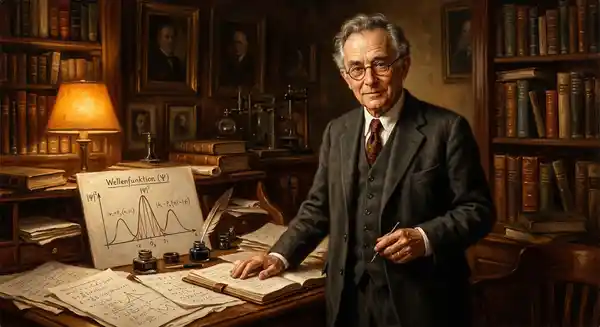
Max Born
1882–1970 · Theoretical Physicist
Making fundamental contributions to quantum mechanics, including the probabilistic interpretation of the wavefunction known as the Born rule, and helping develop matrix mechanics. He received the 1954 Nobel Prize in Physics.
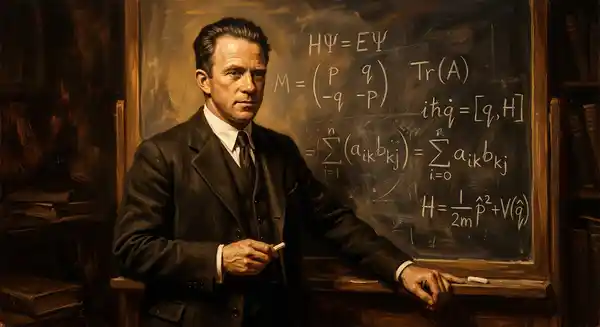
Werner Heisenberg
1901–1976 · Theoretical Physicist
Initiating matrix mechanics in 1925 and formulating the uncertainty principle in 1927. He received the 1932 Nobel Prize in Physics.
Niels Bohr
1885–1962 · Physicist
Developed the Bohr model of the atom and made foundational contributions to quantum mechanics.