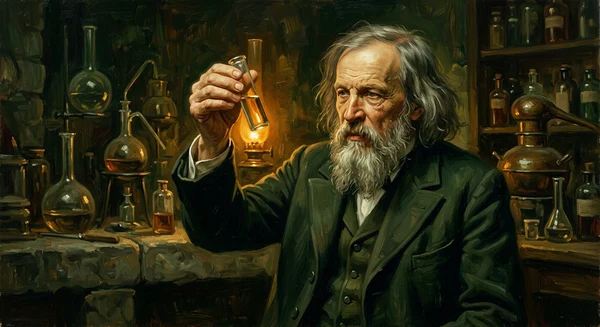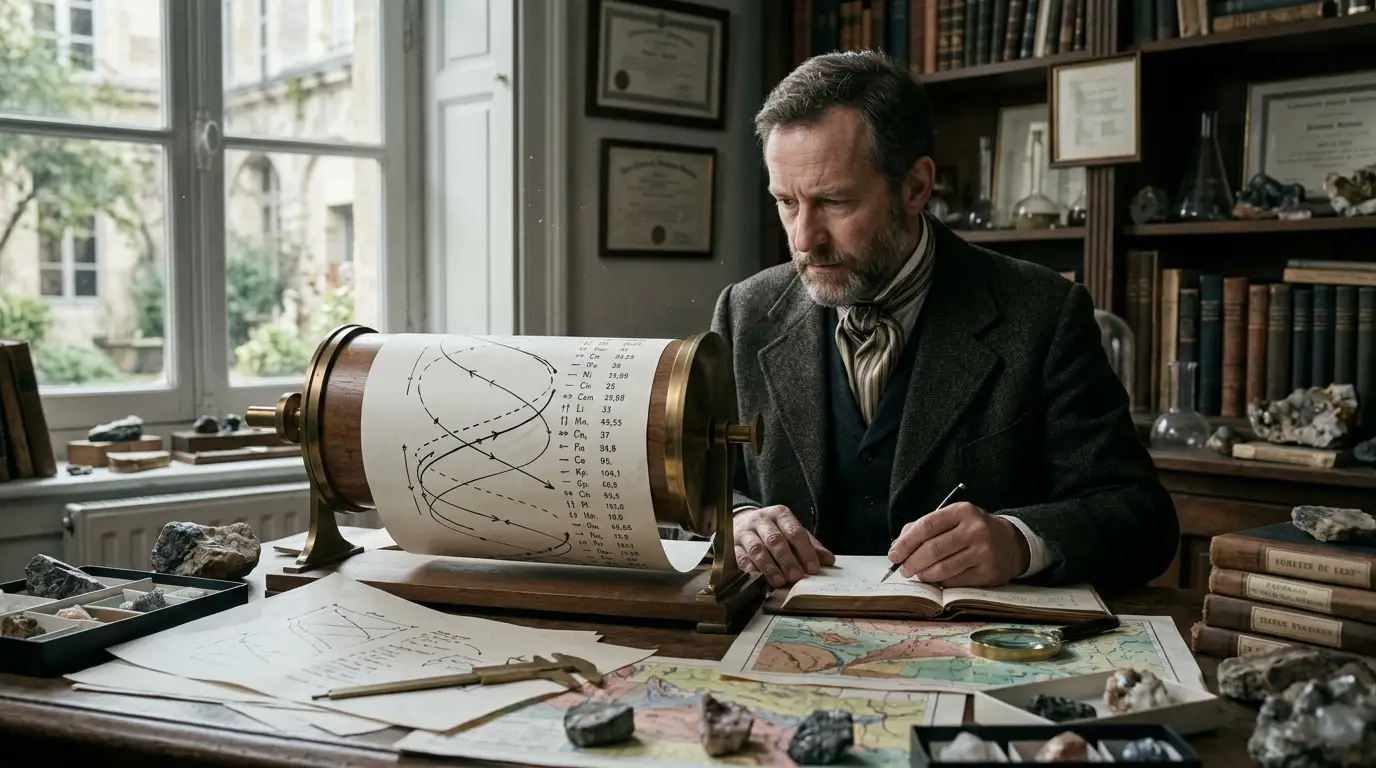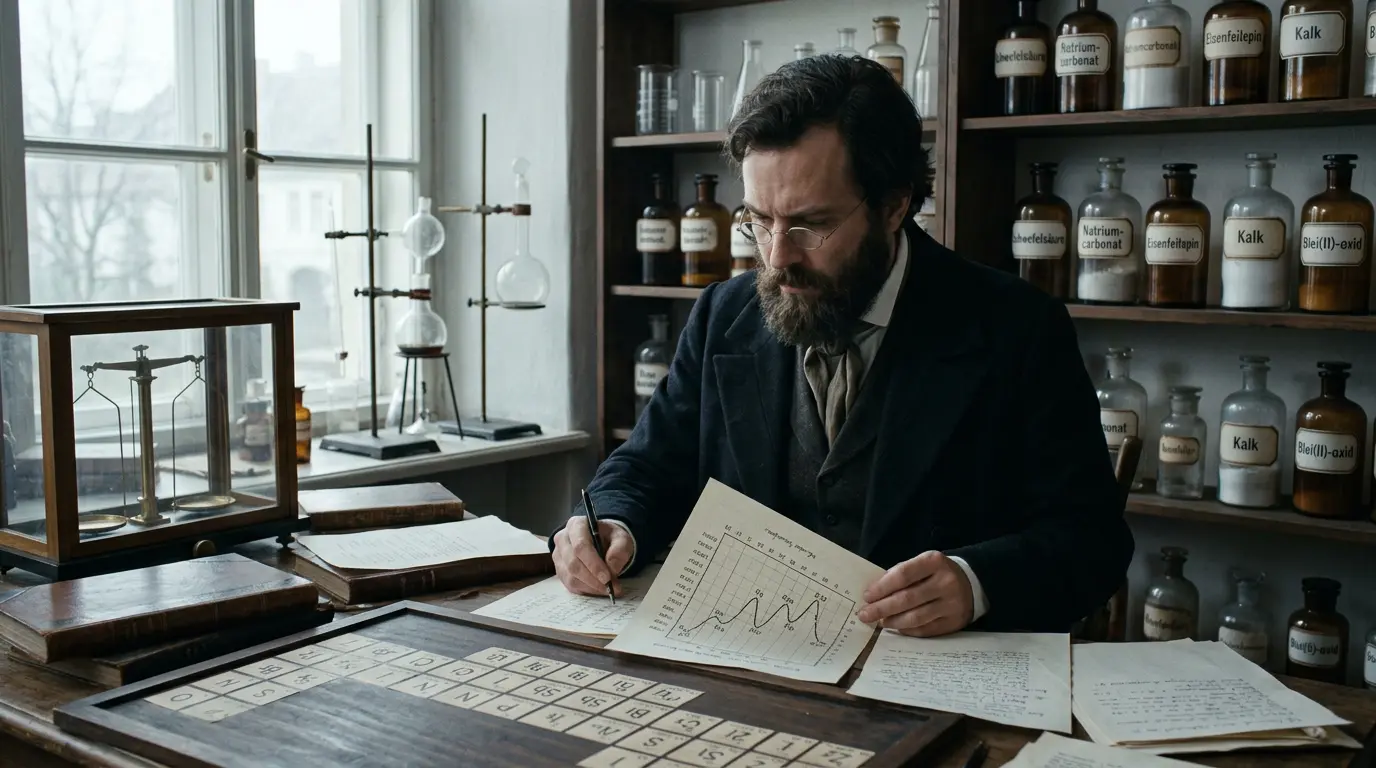

Dmitri Mendeleev did not discover the periodic pattern alone. What made his work extraordinary was that he trusted the pattern enough to leave empty spaces — and describe elements that nobody had yet found.
Chemistry Had a Problem
By the middle of the 19th century, chemists knew of more than 60 elements. New ones kept appearing, each with its own reactions, compounds and properties, but there was no convincing system that tied them all together.
Scientists could see hints of order. Johann Wolfgang Döbereiner had grouped some elements into threes with similar properties. Alexandre-Émile Béguyer de Chancourtois arranged elements in a spiral around a cylinder. John Newlands noticed that chemical properties seemed to repeat and compared the pattern with musical octaves.
Julius Lothar Meyer, a German chemist, was also developing increasingly sophisticated arrangements of the elements. One of his tables was strikingly similar to the periodic system that would later make Dmitri Mendeleev famous.
So Mendeleev did not suddenly look at a chaotic list and see something nobody else had noticed. A number of chemists were closing in on the same idea.
What Mendeleev did next was different.
Mendeleev Trusts the Pattern
Mendeleev was writing a chemistry textbook when he began looking for a useful way to organise the known elements. In 1869, he presented a periodic system in which elements were arranged largely according to atomic weight while those with similar chemical properties appeared in related groups.
The arrangement was not perfect. Sometimes the known atomic weights seemed to put an element in the wrong place. Instead of blindly following the numbers, Mendeleev was prepared to give chemical behaviour more weight when the two disagreed.
More daringly, he refused to squeeze every known element together merely to make the table look complete. Where the repeating pattern suggested that an element ought to exist, Mendeleev left a gap.
Then he began describing what should eventually fill it.
He called some of the missing elements eka-aluminium, eka-boron and eka-silicon, using the Sanskrit word eka, meaning one, to indicate their position relative to known elements.
This turned the periodic table into something much more powerful than a filing system.
It could make predictions.
The Empty Spaces Begin to Fill
In 1875, the French chemist Paul-Émile Lecoq de Boisbaudran discovered a new element and named it gallium. Its properties were remarkably close to those Mendeleev had predicted for eka-aluminium.
Mendeleev had estimated an atomic weight of about 68 and a density of about 6 grams per cubic centimetre. Gallium's measured values were close: an atomic weight of about 69.7 and a density around 5.9 grams per cubic centimetre.
Then came scandium in 1879, matching important features of Mendeleev's predicted eka-boron. Germanium followed in 1886 and fitted his description of eka-silicon.
The gaps were turning into real elements.
This was enormously persuasive. A table built merely to organise existing knowledge would have been useful. A system capable of pointing towards matter that had not yet been discovered was something much more impressive.
It helped turn Mendeleev from one contributor among several into the scientist most closely associated with the periodic table.
He Wasn't a Chemical Fortune Teller
It is tempting to tell this part of the story as though Mendeleev somehow saw the future.
He didn't.
His predictions were deductions based on patterns in the known elements, and not everything he predicted turned out to exist. Some proposed elements were wrong, including one he called Newtonium.
That makes the successful predictions more interesting, not less.
Mendeleev was doing something central to science: taking a pattern seriously enough to make claims that future experiments could test. Gallium, scandium and germanium supplied particularly dramatic tests because chemists could compare the newly discovered elements with descriptions written years earlier.
Mendeleev also got other important scientific ideas wrong. He resisted some emerging ideas about atoms and later opposed concepts including radioactivity and the electron.
Being responsible for one extraordinary scientific insight did not make him correct about everything.
The periodic system survived because the evidence for it became stronger, not because Mendeleev was infallible.
A Puzzle Mendeleev Couldn't Solve
There was still something awkward about the table.
Mendeleev had arranged the elements mainly using atomic weights, but a few pairs refused to behave properly. Tellurium, for example, has a greater atomic weight than iodine, yet their chemical properties require tellurium to appear before iodine in the periodic system.
Mendeleev put them where their chemistry said they belonged.
He was right about the order, but he could not explain why.
The answer arrived after his death.
In 1913, the young British physicist Henry Moseley studied the characteristic X-rays emitted by different elements. His measurements showed that the elements followed a much more fundamental numerical sequence than atomic weight.
That sequence was atomic number.
Moseley's work connected an element's position in the periodic table with the positive charge of its nucleus. The troublesome reversals involving pairs such as tellurium and iodine were no longer mysterious: atomic number, not atomic weight, was the correct basis for ordering the elements.
The modern periodic table finally had its underlying number.
The Table Never Stopped Changing
Mendeleev would not recognise every part of the periodic table hanging in a classroom today.
The noble gases were discovered after his original table and eventually formed a new group. Scientists uncovered electrons, protons and neutrons and learned why chemical properties repeat. Quantum mechanics supplied a deeper explanation based on the arrangement of electrons around atomic nuclei.
Other elements were created artificially.
In 2016, IUPAC formally approved the names of elements 113, 115, 117 and 118 — nihonium, moscovium, tennessine and oganesson — completing the seventh row of the table. The modern periodic table therefore contains 118 officially recognised elements.
Its appearance has changed many times, and scientists have proposed hundreds of alternative layouts. The important inheritance from Mendeleev is not one particular rectangular chart.
It is the periodic system underneath it.
More Than Something to Memorise
Schoolchildren sometimes meet the periodic table as a wall full of symbols that somehow need to be remembered.
That misses its real beauty.
The table exists precisely because chemists discovered that the elements do not need to be treated as 118 unrelated substances. Their properties repeat in patterns. Position gives clues about behaviour, bonding and reactivity.
That was the power Mendeleev saw.
He was not the first person to notice periodicity, and he did not create the modern table by himself. Meyer, Newlands, de Chancourtois and others were important parts of the story, while Moseley later revealed the ordering principle that modern chemistry uses.
Mendeleev's exceptional contribution was to trust the pattern.
He left spaces where other scientists might have seen holes.
Then he told chemistry what it should find there.
And chemistry found it.