_(2).jpg)

Acids and bases are familiar in school chemistry, but their definitions changed repeatedly as scientists discovered ions, protons, pH and electron pairs.
Lemon juice tastes sour.
Soap can feel slippery.
Some substances change the colour of indicators, some react with metals and some neutralise one another.
At school, we call many of these substances acids and bases.
That sounds as though scientists have always known exactly what those words mean.
They have not.
The definitions changed as chemistry changed.
Acids were once classified mainly by their observable properties. Later they were explained through oxygen, then through ions in water, then through proton transfer and finally through the movement of electron pairs.
Each new model answered questions that the earlier one could not.
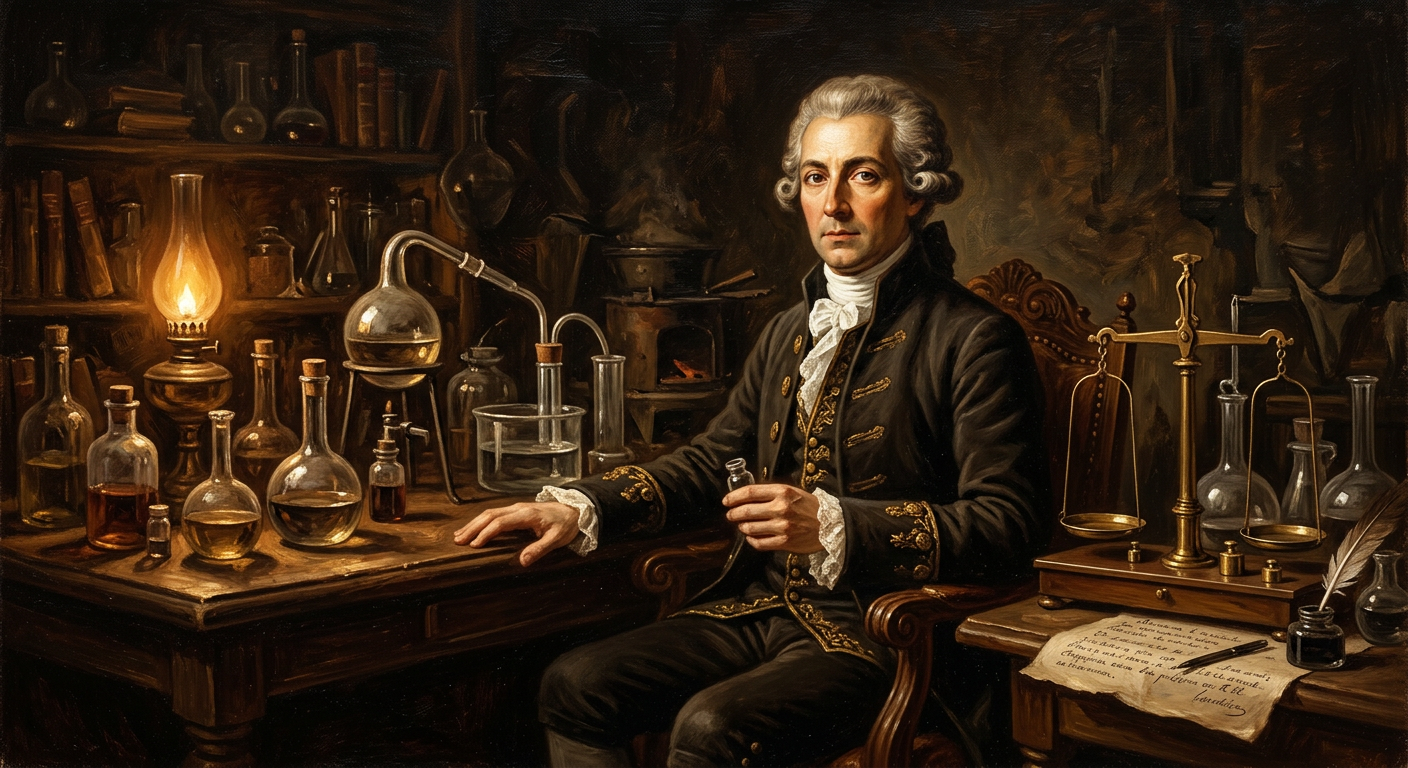
Lavoisier tries to explain acidity with oxygen
During the eighteenth century, chemistry was being transformed from a collection of recipes and observations into a more quantitative science.
**Antoine Lavoisier** played a central role in that transformation.
He helped establish oxygen as a key part of combustion and built a new chemical language around the elements and the compounds they formed.
Lavoisier also tried to explain acids.
He believed that oxygen was the essential ingredient that made a substance acidic.
The name oxygen itself came from Greek roots meaning something like "acid former".
This was a serious scientific proposal rather than a wild guess. Many important acids known to chemists did contain oxygen.
Sulfuric acid and nitric acid are examples.
But the idea was wrong.
Hydrochloric acid, for example, contains hydrogen and chlorine but no oxygen.
As chemists learned more about elements and compounds during the nineteenth century, it became clear that oxygen could not be the universal explanation for acidity.
That failure was useful.
It showed that the familiar behaviour of acids had to come from something deeper than one particular element.
Electricity reveals ions in solution
The next major change came from experiments involving electricity and dissolved substances.
Some solutions conduct electric current.
Pure water conducts very poorly, but dissolve certain substances in it and the behaviour changes dramatically.
Acids, bases and salts are among the substances that can produce conducting solutions.
By the late nineteenth century, scientists were trying to understand why.
Swedish scientist Svante Arrhenius proposed that substances called electrolytes form electrically charged particles called ions when dissolved in water.
His ideas were controversial at first.
How could ordinary salt, for example, produce charged particles simply by dissolving?
But the ion theory explained important patterns in conductivity and chemical reactions.
For acids and bases, it supplied a new definition.
In the Arrhenius model, an acid increases the concentration of hydrogen ions in aqueous solution, while a base increases the concentration of hydroxide ions.
For example, hydrochloric acid in water can be represented as producing H+ and Cl− ions.
Sodium hydroxide produces Na+ and OH− ions.
In real aqueous chemistry, a bare proton does not float freely for long; it associates strongly with water molecules. School equations often use H+ as a convenient shorthand.
Neutralisation becomes an ionic reaction
The Arrhenius model made one of the most familiar school reactions easier to understand.
Mix hydrochloric acid with sodium hydroxide and the overall reaction can be written:
hydrochloric acid + sodium hydroxide → sodium chloride + water
But the essential acid–base change is simpler.
Hydrogen ions from the acid react with hydroxide ions from the base:
H+ + OH− → H2O
The sodium and chloride ions remain in solution as spectator ions.
This helps explain why strong acids reacting with strong bases in dilute solution show a very similar underlying neutralisation process.
Arrhenius's theory connected acid–base chemistry with the new science of ions.
It was powerful.
But it had an important limitation.
It was built around reactions in water.
Chemists were finding acid–base behaviour that did not fit comfortably inside that definition.
Sørensen gives acidity a scale
Knowing that a solution is acidic is useful.
Knowing how acidic it is can be much more useful.
At the Carlsberg Laboratory in Copenhagen, Danish chemist Søren Peder Lauritz Sørensen was studying chemical conditions important in biochemical research.
In 1909 he introduced the pH concept as a practical way of expressing acidity.
Modern pH is a logarithmic measure related to hydrogen-ion activity.
In ordinary school chemistry, it is often introduced through hydrogen-ion concentration.
That logarithmic scale matters.
A change of one pH unit represents a tenfold change in the relevant hydrogen-ion measure.
So pH 3 is not just slightly more acidic than pH 4.
It represents about ten times the hydrogen-ion activity on the usual simplified interpretation.
At around room temperature, school chemistry commonly treats pH 7 as neutral, values below 7 as acidic and values above 7 as alkaline.
The exact neutral pH depends on temperature, so 7 is not a universal number under every condition.
Sørensen had given chemistry a compact way to compare solutions that could differ enormously in acidity.
Indicators make invisible chemistry visible
Acid–base indicators are useful because their molecular forms have different colours under different chemical conditions.
Litmus, universal indicator and phenolphthalein are familiar school examples.
An indicator does not make a solution acidic or alkaline.
It responds to the chemical environment.
That is why indicators can be used to follow a titration.
In a titration, a solution of known concentration is added carefully to another solution so that the reaction can be measured.
Near the endpoint, a suitable indicator changes colour over a particular pH range.
Modern laboratories can also measure pH electronically.
But the principle remains similar:
a chemical property that cannot be seen directly is converted into something measurable.
Brønsted and Lowry broaden the definition
In 1923 two chemists, working independently, proposed a more general way to think about acids and bases.
They were Danish chemist Johannes Brønsted and British chemist Thomas Martin Lowry.
In the Brønsted–Lowry model:
- an acid is a proton donor - a base is a proton acceptor
A proton in this context is H+.
This definition is broader than the Arrhenius model because it focuses on proton transfer rather than requiring a substance simply to produce H+ or OH− when dissolved in water.
Consider ammonia reacting with water.
Ammonia does not contain an OH− group waiting to be released.
Instead, an ammonia molecule can accept a proton from a water molecule.
The ammonia behaves as a Brønsted–Lowry base.
The water behaves as an acid in that reaction.
This model also leads naturally to conjugate acid–base pairs.
When an acid donates a proton, what remains can accept a proton again and therefore behaves as its conjugate base.
When a base accepts a proton, the new species is its conjugate acid.
Acid and base behaviour is therefore relational.
A substance can behave differently depending on what it is reacting with.
Lewis makes the idea broader again
The same year brought another major acid–base idea.
American chemist Gilbert Newton Lewis had already transformed explanations of chemical bonding by focusing on pairs of electrons.
He extended that electron-pair thinking to acids and bases.
In the modern Lewis model:
- a Lewis base donates an electron pair - a Lewis acid accepts an electron pair
No proton has to move.
That makes the Lewis definition broader than the Brønsted–Lowry definition.
A substance such as boron trifluoride can behave as a Lewis acid because it can accept an electron pair even though it has no hydrogen ion to donate.
Ammonia can behave as a Lewis base because the nitrogen atom has a lone pair of electrons available for bonding.
This is a powerful reminder that "acid" does not have only one useful meaning in chemistry.
Different definitions are tools for different problems.
Strong does not mean concentrated
Acid–base language causes one common school-science mistake.
A strong acid is not simply an acid with a lot of acid in the bottle.
Strength describes how extensively the acid ionises or donates protons under specified conditions.
Concentration describes how much of the substance is present in a given volume.
A dilute solution of a strong acid can contain less acid overall than a concentrated solution of a weak acid.
Similarly, a strong base and a concentrated base are not automatically the same thing.
Chemistry becomes much clearer once strength and concentration are kept separate.
The school science behind the story
Modern school chemistry uses several parts of this history at once.
The pH scale describes acidity and alkalinity.
Indicators reveal changes in acid–base conditions.
Neutralisation is often modelled using hydrogen and hydroxide ions.
Titrations allow concentrations to be determined.
At more advanced levels, Brønsted–Lowry theory explains proton transfer and conjugate acid–base pairs.
Lewis theory extends acid–base chemistry to electron-pair donation and acceptance.
These ideas are not rival answers where only the newest one is allowed.
They are models with different ranges of usefulness.
The Arrhenius definition remains excellent for many simple reactions in water.
Brønsted–Lowry theory handles proton-transfer chemistry more generally.
Lewis theory reaches reactions where no proton transfer is required.
Why acids and bases matter
Acid–base chemistry is everywhere.
The stomach uses strongly acidic conditions during digestion.
Blood chemistry depends on tightly controlled acid–base balance.
Soil pH affects the availability of nutrients to plants.
Industrial chemists control pH during manufacturing.
Water treatment, food production, batteries, medicines and environmental monitoring all depend on acid–base behaviour.
Ocean chemistry is also strongly influenced by carbon dioxide dissolving in seawater and altering its acid–base equilibria.
A topic that begins in school with coloured indicator paper therefore reaches into biology, industry, climate science and medicine.
A definition that kept growing
The history of acids and bases is not a story of scientists repeatedly failing to define two simple words.
It is a story of chemistry gaining deeper levels of explanation.
Lavoisier tried to connect acidity with chemical composition.
Arrhenius connected acids and bases with ions in water.
Sørensen gave acidity a quantitative scale.
Brønsted and Lowry focused on proton transfer.
Lewis widened the idea to electron pairs.
Each step made chemistry more powerful.
And each reminds us that scientific definitions are not merely dictionary entries.
They are tools built to explain observations and predict what will happen next.