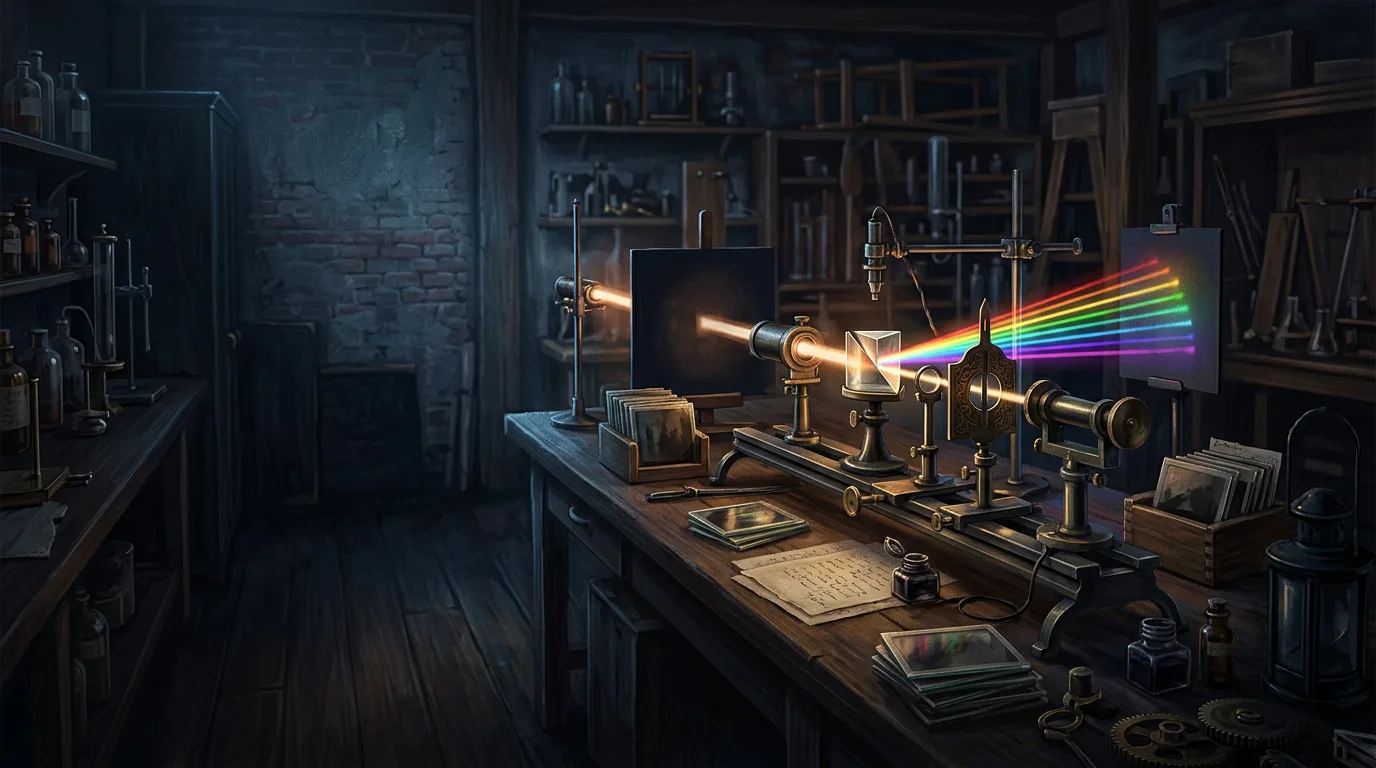
_(2).jpg)
Why do objects fall, the Moon stay in orbit and planets circle the Sun? Discover how scientists gradually uncovered the physics of gravity.
Drop a pencil and it falls.
Jump into the air and you return to the ground.
Look much farther away and the same universe contains moons orbiting planets, planets orbiting stars and entire galaxies held together by gravity.
Today we treat gravity as one of the fundamental features of nature.
But explaining it took centuries.
Scientists first had to understand how falling objects move. Then they had to realise that the motion of a falling object and the motion of the Moon could be part of the same problem.
Eventually, even that explanation had to be extended.
Galileo studies falling objects
For a long time, ideas inherited from ancient Greek philosophy strongly influenced explanations of motion.
One common expectation was that heavier objects should naturally fall faster than lighter ones.
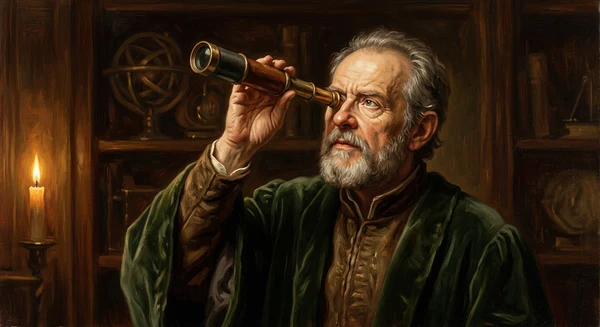
**Galileo Galilei** challenged this way of thinking.
The famous story that he dropped objects from the Leaning Tower of Pisa is not the important evidence here and should not be treated as the foundation of his work.
Galileo's more significant contribution came from mathematical reasoning and experiments involving motion, particularly inclined planes.
An inclined plane slows the vertical motion enough to make changes easier to measure.
Galileo found that falling motion is **accelerated**: an object gains speed as it falls.
His work led to the relationship that the distance travelled from rest under uniform acceleration grows with the square of the elapsed time.
He also argued that, without the effects of the surrounding medium, bodies of different weights would fall at the same rate.
Modern experiments in a vacuum make this especially clear.
The important lesson was that motion could be described mathematically rather than simply explained by saying that heavy things naturally seek the ground.
Falling is not the same as weight
This distinction matters in school physics.
**Mass** describes how much matter an object contains and is measured in kilograms.
**Weight** is a force caused by a gravitational field.
Near Earth's surface:
**weight = mass × gravitational field strength**
The gravitational field strength near Earth's surface is approximately 9.8 newtons per kilogram, although it varies slightly with location.
An astronaut travelling to the Moon does not suddenly lose most of their mass.
Their weight changes because the gravitational field is different.
Understanding that distinction requires thinking of gravity as an interaction rather than simply as a property of heavy objects.
That was the kind of transformation that came with Isaac Newton.
Newton connects Earth and the heavens
By the seventeenth century, astronomers could describe planetary motion increasingly accurately.
But there was a deeper question.
Why did the planets move as they did?
Why did the Moon not simply travel away from Earth in a straight line?
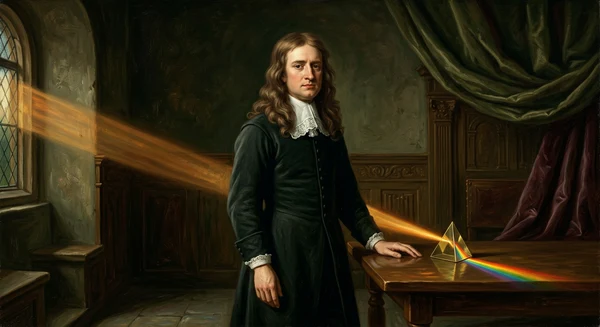
**Isaac Newton** developed a remarkable answer.
In his *Principia*, published in 1687, Newton presented his laws of motion and a law of **universal gravitation**.
According to the Newtonian model, every mass attracts every other mass.
The strength of the gravitational force increases with the masses of the objects and decreases with the square of the distance between them.
This meant that the physics of the heavens and the physics of Earth were not separate systems.
The same gravity that accelerates an object towards the ground also acts on the Moon.
An orbit can therefore be understood as a kind of continuous free fall.
The Moon is constantly falling towards Earth while also moving sideways fast enough that it keeps missing it.
Newton had unified two worlds.
A law with a difficult measurement
Newton's theory could describe gravitational attraction extremely well, but gravity between everyday laboratory objects is extraordinarily weak.
Earth's pull is obvious because Earth has an enormous mass.
The attraction between two metal balls is far harder to detect.
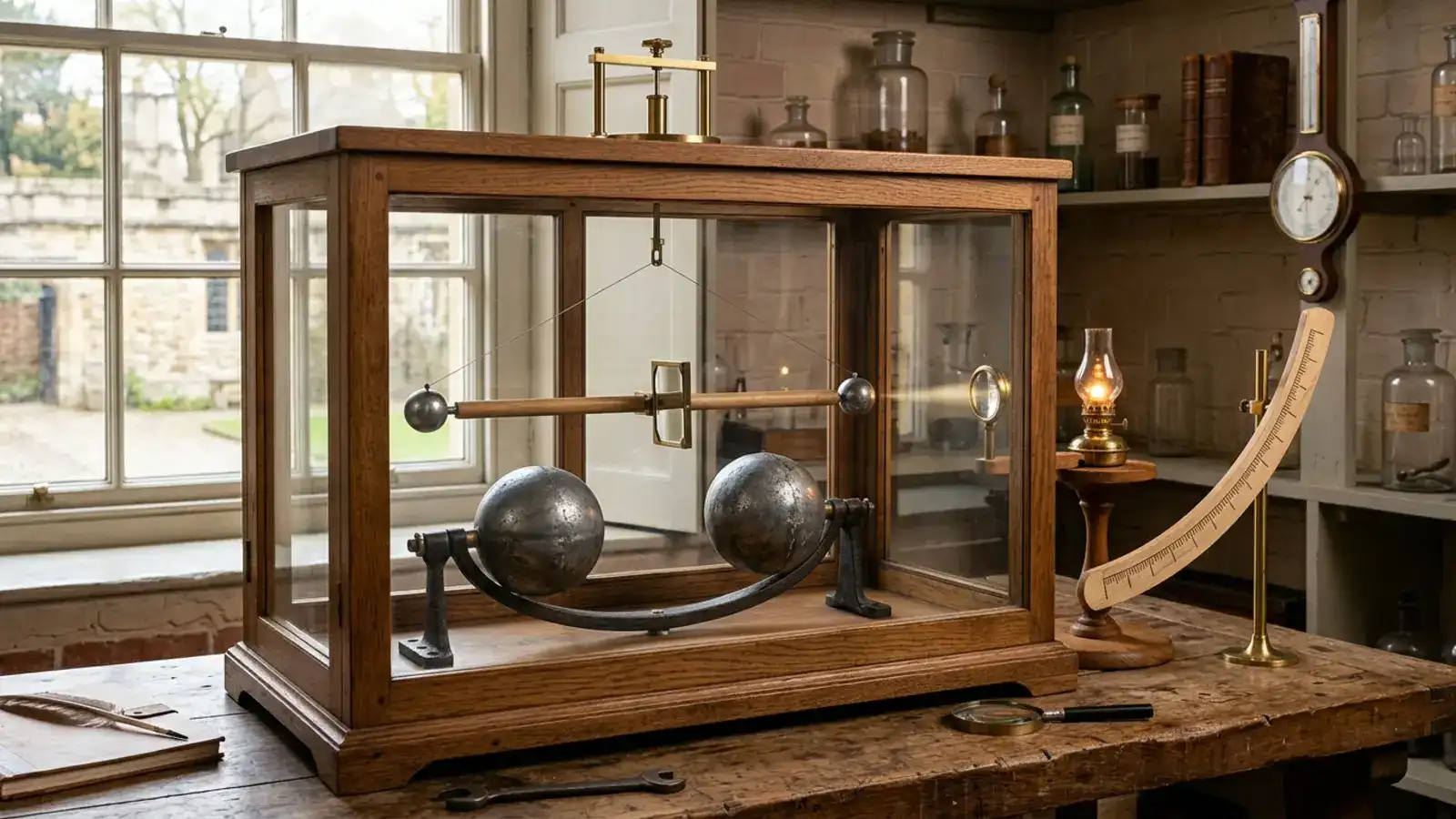
English natural philosopher **John Michell** designed a sensitive torsion-balance experiment that could reveal this tiny force.
Michell died before carrying out the experiment.
His apparatus eventually passed to **Henry Cavendish**, who modified the setup and performed the measurements.
In 1798 Cavendish published *Experiments to Determine the Density of the Earth*.
The experiment used small lead spheres attached to a suspended rod and much larger lead spheres placed nearby.
The gravitational attraction between the spheres produced a tiny twist.
By measuring that movement with extraordinary care, Cavendish could compare the attraction between the laboratory masses with Earth's gravitational pull and determine Earth's mean density.
It is often described today as the Cavendish experiment for measuring the gravitational constant, **G**.
Historically, Cavendish described his aim as determining Earth's density rather than measuring G in the modern form.
Either way, the experiment demonstrated something remarkable:
Gravity could be measured between ordinary objects in a laboratory.
Why Newton's gravity is still useful
Newton's theory remains extraordinarily powerful.
Engineers can use it to calculate forces and trajectories.
Astronomers use Newtonian gravity for many planetary and orbital problems.
Satellite motion can often be understood very accurately with Newton's equations.
For ordinary school calculations, Newtonian gravity is usually exactly the model we need.
But by the early twentieth century, scientists knew that there were situations where the Newtonian description was not enough.
A deeper theory was coming.
Einstein changes the picture
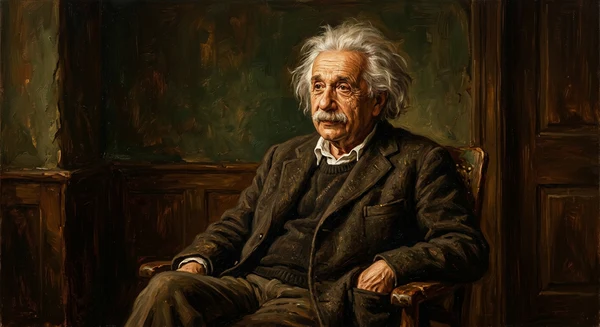
In 1915 **Albert Einstein** completed his general theory of relativity.
Newton had described gravity as an attraction between masses.
Einstein introduced a very different way of understanding it.
Mass and energy affect the geometry of **spacetime**, and objects follow paths through that curved spacetime.
In this description, Earth is not simply being pulled around the Sun by an invisible force acting across empty space.
The Sun changes the geometry of the spacetime around it, and Earth's orbit follows from motion through that geometry.
For weak gravitational fields and everyday speeds, Einstein's theory gives almost the same practical answers as Newton's.
That is why Newtonian physics remains so useful.
But general relativity explains effects that Newton's theory cannot describe completely.
These include subtle changes in planetary orbits, the bending of light by gravity, gravitational time effects and gravitational waves.
Gravity can change time
One of general relativity's strangest consequences is that gravity affects the passage of time.
Clocks at different gravitational potentials do not run at exactly the same rate.
This is not merely theoretical.
Modern satellite navigation depends on extremely accurate clocks.
Systems such as GPS have to account for relativistic effects so that timing errors do not accumulate into large position errors.
An idea developed to explain the deepest structure of space and time therefore matters when a phone works out where you are.
The school science behind the story
Gravity connects several topics that can initially seem separate.
Objects near Earth accelerate because of Earth's gravitational field.
Weight is the gravitational force acting on a mass.
The force becomes weaker as objects move farther apart.
Planets and satellites remain in orbit because gravity continually changes the direction of their motion.
On a larger scale, gravity shapes stars, solar systems and galaxies.
Newton's equations are enough for most school-level calculations.
Einstein's theory becomes important when gravity is very strong, measurements must be exceptionally precise or we want a deeper description of spacetime.
Different models can therefore be useful at different levels.
Science did not simply replace Newton
It is tempting to tell the story as:
Galileo was replaced by Newton, and Newton was replaced by Einstein.
That is misleading.
Galileo's studies of motion helped establish mathematical laws of falling bodies.
Newton produced a much more general theory connecting terrestrial and celestial motion.
Michell and Cavendish brought tiny gravitational attractions into the laboratory.
Einstein extended the description into a theory of spacetime.
Newton's theory did not become useless when Einstein developed general relativity.
It became understood as an extremely accurate approximation within a huge range of everyday conditions.
That is often how science advances.
A successful model can remain useful even after scientists discover a deeper one.