_(2).jpg)
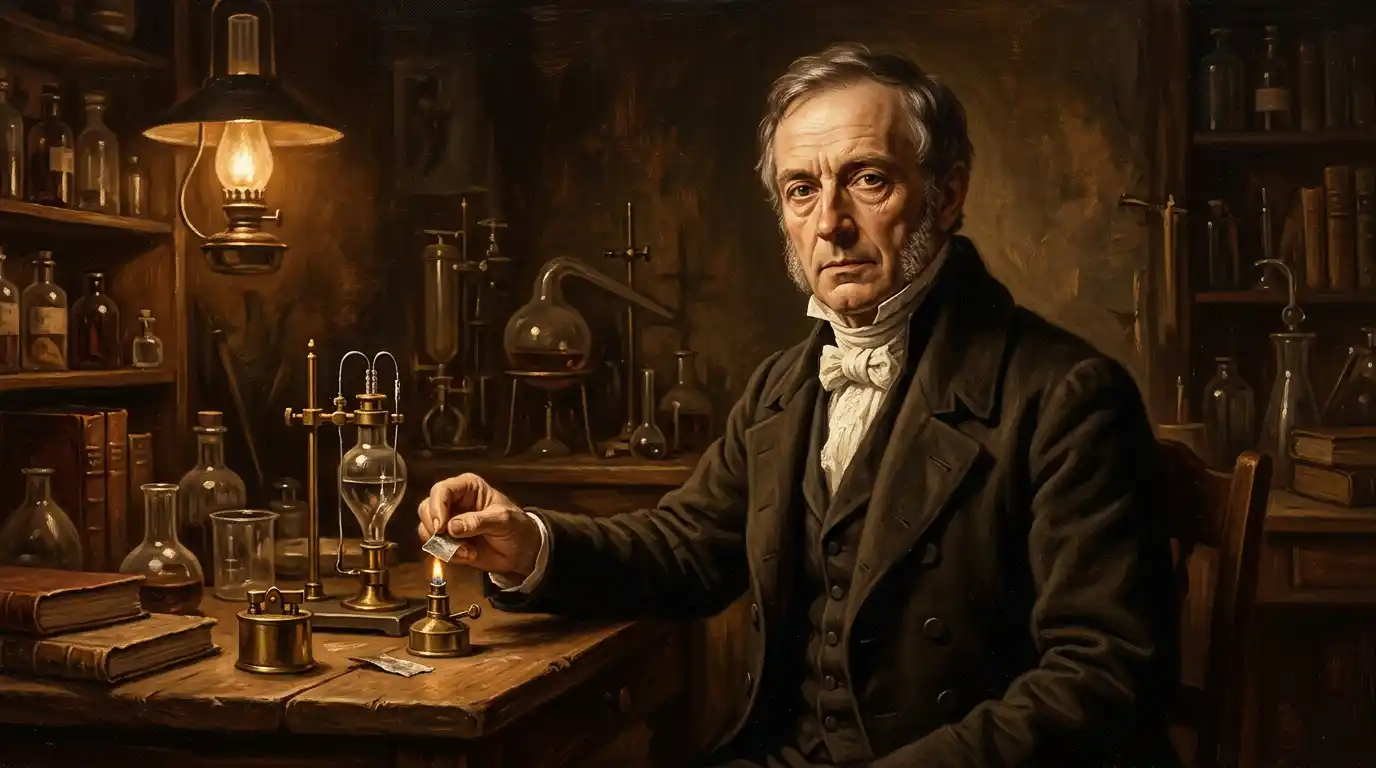
Johann Wolfgang Döbereiner
1780–1849 · Chemist
A German chemist who identified triads of chemically similar elements and made important contributions to platinum catalysis.
“The progress of science depends on the interaction between theory and experiment.”
Why is this scientist famous?
Identified relationships between groups of three chemically similar elements, later known as Döbereiner's triads — an important early step towards recognising periodic relationships. He also carried out important work on platinum catalysis and developed the Döbereiner lighter.
Johann's story
A Chemist in Weimar
Johann Wolfgang Döbereiner was born on 13 December 1780 in Hof, a small town in Bavaria. His family had little money, and he received only a basic formal education. As a young man he apprenticed with an apothecary and taught himself chemistry through reading and practical experiments.
Despite his lack of formal university training, Döbereiner's abilities attracted attention. In 1810 he was appointed to a professorship at the University of Jena, where he taught chemistry and conducted research for the rest of his career. His position at Jena brought him into contact with some of the most influential thinkers of his era, including Johann Wolfgang von Goethe, who took a keen interest in science and relied on Döbereiner for chemical advice.
Triads of Elements
Döbereiner's most enduring contribution came from studying the relationships between chemical elements. In the 1810s and 1820s, the number of known elements was growing, and chemists were beginning to look for patterns among them.
Döbereiner noticed that certain groups of three elements shared remarkably similar chemical properties. He also observed that the atomic weight of the middle element in each group was close to the average of the other two. One example was calcium, strontium and barium, which were chemically alike and followed the pattern he had identified.
These groups became known as Döbereiner's triads. They were not the periodic table itself, but they were one of the earliest pieces of evidence that elements were connected by underlying relationships. Later chemists built on this idea as they searched for a more complete system of classification.
Platinum and Catalysis
Döbereiner also carried out important research on platinum and its remarkable properties. He discovered that finely divided platinum could cause certain gases to combine without itself being consumed — a phenomenon that would later be called catalysis.
This was not a minor side project. Döbereiner's observations of platinum-catalysed reactions were among the earliest experimental studies of catalytic processes, which would become enormously important in chemistry and industry.
He turned this discovery into a practical device. The Döbereiner lighter used a stream of hydrogen gas directed at a platinum sponge. The platinum caused the hydrogen to ignite on contact with air, producing a flame without flint or matches. The lighter became a commercial success and was widely used for decades.
Legacy
Döbereiner died on 24 March 1849 in Jena. By that time, chemistry was moving rapidly, and new elements were being discovered that his triads could not accommodate.
His work on triads was not forgotten, however. When later chemists such as Mendeleev and Lothar Meyer developed more comprehensive periodic systems, they built on foundations that included Döbereiner's recognition of recurring patterns among the elements. His research on platinum catalysis, meanwhile, opened a field that would become central to modern chemistry.
What did they discover?
Döbereiner's Triads
Döbereiner identified groups of three chemically similar elements in which the middle element's atomic weight was close to the average of the other two. These triads were an important early step towards the periodic table.
Platinum Catalysis
Döbereiner demonstrated that finely divided platinum could cause gases to combine without being consumed itself, providing one of the earliest experimental studies of catalytic action.
The Döbereiner Lighter
He invented a lighter that used platinum-catalysed hydrogen ignition to produce a flame without flint or matches. It became one of the first commercially successful lighters.
Amazing facts
Döbereiner had little formal education and trained as an apothecary's apprentice before teaching himself chemistry.
Johann Wolfgang von Goethe consulted Döbereiner on chemical questions and valued his practical expertise.
Döbereiner's triads were published decades before Mendeleev's periodic table.
The Döbereiner lighter was so successful that it was manufactured and sold for decades after its invention.
Döbereiner's work on platinum catalysis was among the earliest experimental investigations of what would later be called catalysis.
He spent nearly his entire academic career at the University of Jena, from his appointment in 1810 until his death in 1849.
Timeline
Born in Hof, Bavaria.
Appointed extraordinary professor of chemistry and technology at the University of Jena.
Appointed full professor of chemistry at the University of Jena.
Identified the first chemical triad using calcium, strontium and barium.
Invented the Döbereiner lighter based on platinum-catalysed hydrogen ignition.
Published his expanded work on triads of elements.
Died in Jena, aged 68.
Related Super Scientists
Dmitri Mendeleev
1834–1907 · Chemist & Inventor
Developed an influential periodic table and periodic law, leaving gaps for undiscovered elements and predicting several of their properties.
John Dalton
1766–1844 · Chemist
Proposed that all matter is made of atoms and was the first to describe colour blindness.
Antoine Lavoisier
1743–1794 · Chemist
A founder of modern chemistry who helped overthrow phlogiston theory, established a quantitative approach to chemical reactions and helped create modern chemical nomenclature.