_(2).jpg)
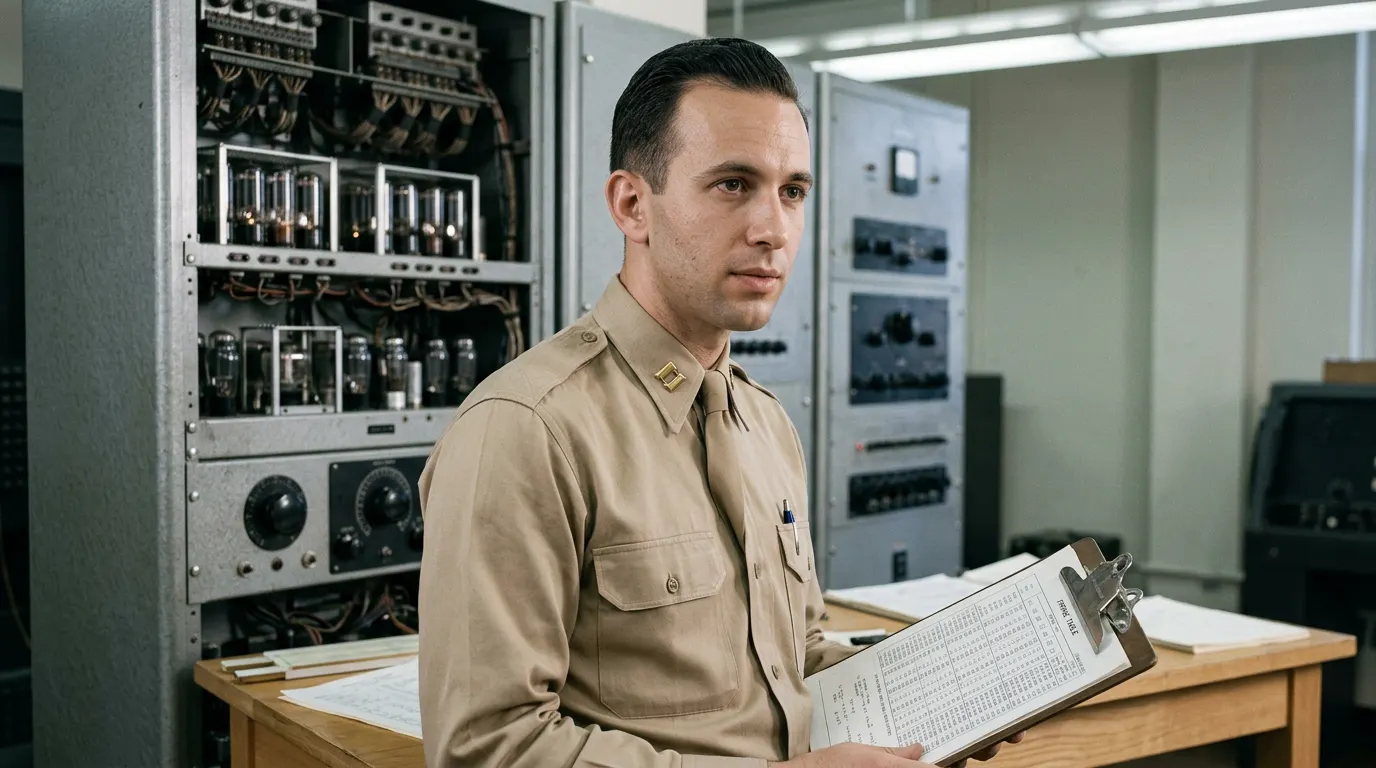
Herman H. Goldstine
1913–2004 · Mathematics, computing and numerical analysis
Herman Goldstine was a mathematician whose wartime Army role helped make ENIAC possible and who later collaborated with John von Neumann on early computer design.
Why is this scientist famous?
An American mathematician who helped connect wartime calculation, ENIAC and early stored-program computing.
Goldstine helped connect mathematics, wartime computation, early electronic computers and later computer research, strengthening the mathematical and numerical foundations of computing.
Herman's story
A mathematician goes to war
Herman Heine Goldstine was born in Chicago, Illinois, on 13 September 1913. He earned three degrees from the University of Chicago: a bachelor’s in 1933, a master’s in 1934 and a doctorate in mathematics in 1936. After teaching at the University of Chicago and then the University of Michigan from 1939, his career took a sharp turn when the United States entered the Second World War. Goldstine served as an Army mathematician connected with the Ballistic Research Laboratory at Aberdeen Proving Ground, where the urgent need to calculate artillery firing tables created an enormous arithmetic problem.
The Army liaison for ENIAC
Goldstine was assigned as the Army’s liaison to the Moore School of Electrical Engineering at the University of Pennsylvania. In that role he helped secure the Army support and funding that allowed the ENIAC project to proceed. ENIAC, which stands for Electronic Numerical Integrator and Computer, was a landmark large-scale electronic digital computing machine. Goldstine participated in its development, but the project was the work of a large team led in design by J. Presper Eckert and John Mauchly, supported by engineers, programmers and Army sponsors. Goldstine’s contribution was especially important as the institutional link that helped make the project possible.
The Institute for Advanced Study and IBM
In 1946 Goldstine joined the Institute for Advanced Study in Princeton, where he collaborated closely with John von Neumann on the Electronic Computer Project and on the logical and mathematical development of early stored-program computing. In 1958 he moved to IBM, where he became director of mathematical sciences at the Thomas J. Watson Research Center and later an IBM Fellow in 1969. His later career also included important work in numerical analysis and the mathematical foundations of computing.
A career linking mathematics and machines
Goldstine received the National Medal of Science in 1983 for fundamental contributions to the development of the digital computer, computer programming and numerical analysis. He was elected to the U.S. National Academy of Sciences in 1974. His career is a reminder that early computing was not the achievement of any one person but a network of mathematicians, engineers, programmers and military sponsors working together to solve urgent real-world problems.
What did they discover?
Securing Army support for ENIAC
As the Army liaison to the Moore School, Goldstine helped secure the backing that allowed the ENIAC project to proceed, connecting wartime ballistic calculation needs with electronic computation.
Collaboration with von Neumann
At the Institute for Advanced Study, Goldstine worked closely with John von Neumann on early computer design and the mathematical development of stored-program computing.
Mathematical foundations of computing
His later work at IBM helped strengthen the mathematical and numerical analysis foundations that underpinned the growing field of digital computing.
Amazing facts
Goldstine trained as a mathematician before becoming one of the important figures in early computing.
He earned three University of Chicago mathematics degrees by 1936.
His wartime work involved the enormous calculation problem of producing artillery firing tables.
He acted as a link between the U.S. Army and the University of Pennsylvania team building ENIAC.
He helped secure the Army backing that allowed the ENIAC project to proceed.
He later worked with John von Neumann on the Institute for Advanced Study computer project.
IBM made him an IBM Fellow in 1969, one of the company’s highest technical distinctions.
In 1983 he received the National Medal of Science for work spanning digital computers, programming and numerical analysis.
Timeline
Born in Chicago, Illinois
Earned a bachelor’s degree in mathematics from the University of Chicago
Earned a master’s degree from the University of Chicago
Completed his doctorate in mathematics at the University of Chicago
Moved to the University of Michigan to teach mathematics
Serving in the U.S. Army as a mathematician connected with ballistic calculations
Army support was secured for the ENIAC project
Joined the Institute for Advanced Study Electronic Computer Project
Joined IBM
Appointed an IBM Fellow
Elected to the National Academy of Sciences
Received the National Medal of Science
Died on 16 June 2004
Awards & honours
Related Super Scientists
John von Neumann
1903–1957 · Mathematics, physics, computing, game theory and applied science
Playing a decisive role in shaping the stored-program computer model and the architecture commonly associated with his name.
J. Presper Eckert
1919–1995 · Electrical engineering, computing and invention
Co-designing ENIAC, helping create EDVAC, BINAC and UNIVAC, and making major engineering advances in early electronic computing.
Jean Bartik
1924–2011 · Computer programming and early computing
Being one of the original programmers of ENIAC and helping establish programming as a real technical discipline.
Herman Hollerith
1860–1929 · Engineering, statistics, invention and data processing
Developing the punched-card tabulating system used to process the 1890 United States Census and helping establish mechanised data processing.
Claude Shannon
1916–2001 · Mathematics, electrical engineering, information theory, cryptography and computing
Founding information theory and making a landmark contribution to digital circuit design.