_(2).jpg)
Jean Bartik
1924–2011 · Computer programming and early computing
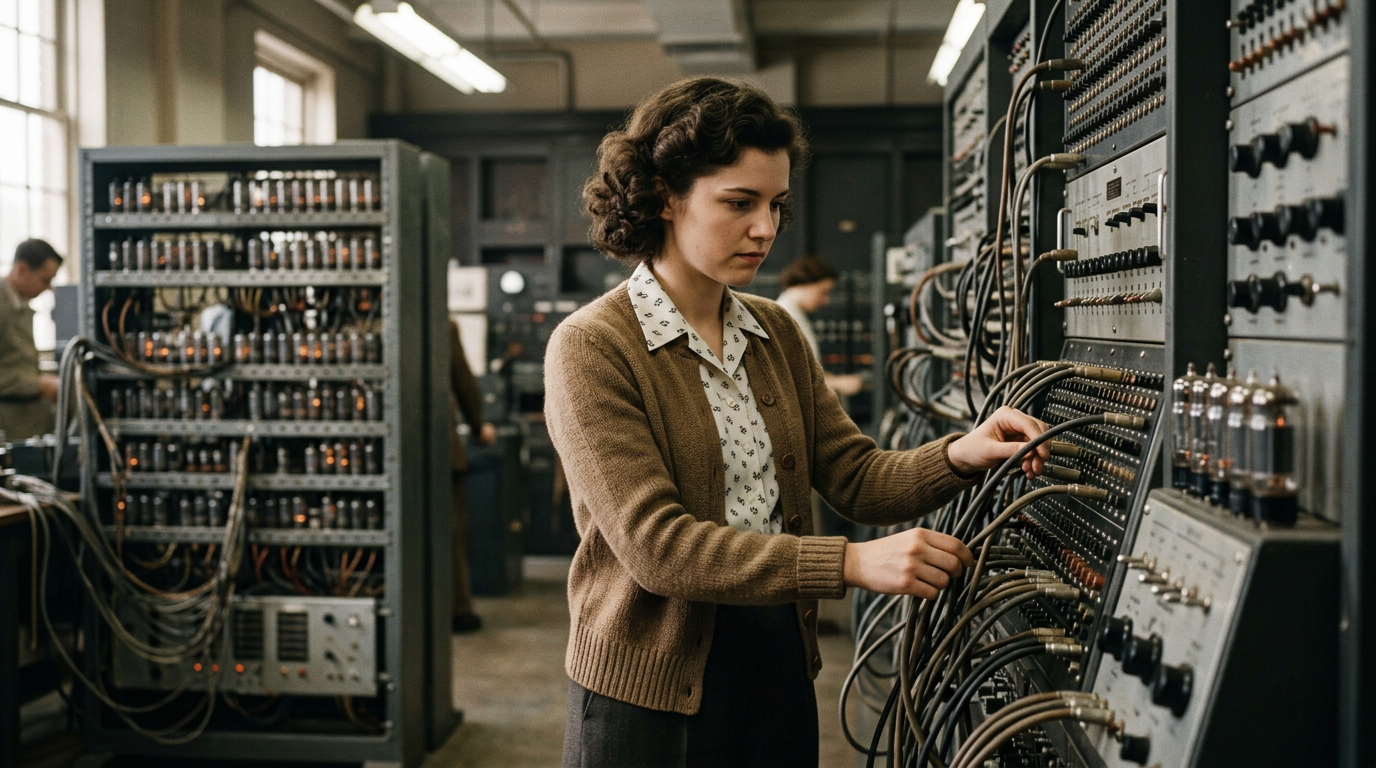
Jean Bartik was one of the six original ENIAC programmers who helped invent what computer programming would become, using cables, switches and plugboards.
“We could debug down to the vacuum tube!”
Why is this scientist famous?
Being one of the original programmers of ENIAC and helping establish programming as a real technical discipline.
Jean Bartik helped establish programming as a real scientific and technical activity. Her story is essential for understanding the human side of the birth of computing, and she shows children that early computing was not only the work of male hardware pioneers.
Jean's story
From Mathematics to Wartime Computing
Jean Jennings Bartik was born in Gentry County, Missouri, on 27 December 1924. She studied mathematics at Northwest Missouri State Teachers College and graduated in 1945. After graduating, she went to the University of Pennsylvania to work on ballistics calculations for the U.S. Army. She began as a human computer, doing calculations by hand before electronic programming existed.
Programming ENIAC
In 1945, Bartik was selected as one of the six original ENIAC programmers. ENIAC was one of the most important machines in computing history, and the programmers had no instruction manual because the machine was so new. They had to work out how to translate mathematical procedures into configurations of switches, plugboards and cables. Programming ENIAC involved cables, switches and plugboards rather than a keyboard and screen. The ENIAC programmers helped invent programming methods while doing the job.
From ENIAC to Stored-Program and Beyond
In 1946, ENIAC was unveiled to the public. In the late 1940s, Bartik helped convert ENIAC into a stored-program computer. She also worked on later early computers including BINAC and UNIVAC I in the late 1940s and early 1950s. She was a pioneering computing professional whose work was essential to early programming.
Recognition and Legacy
Bartik's role was under-recognised for many years. In 1997 she was inducted into the Women in Technology International Hall of Fame, and in 2008 she was named a Fellow of the Computer History Museum. She became an important symbol of women's contributions to computing history. Her story helps show that computing history includes programmers as well as machine builders. She died in Poughkeepsie, New York, on 23 March 2011.
What did they discover?
ENIAC Programming
She was one of the six original ENIAC programmers who had to work out how to translate mathematical procedures into physical configurations of switches, plugboards and cables.
Stored-Program Conversion
She helped convert ENIAC into a stored-program computer, an important step in computing evolution.
BINAC and UNIVAC I
She worked on later early computers including BINAC and UNIVAC I, helping establish programming as a discipline.
Inventing Programming in Practice
The ENIAC programmers helped invent what computer programming would become, with no instruction manual and entirely new methods.
Amazing facts
Bartik began as a human calculator before electronic programming existed.
She was one of the six original ENIAC programmers.
Programming ENIAC involved cables, switches and plugboards rather than a keyboard and screen.
The ENIAC programmers helped invent programming methods while doing the job.
Bartik later worked on BINAC and UNIVAC I.
Her role was under-recognised for many years.
She became an important symbol of women's contributions to computing history.
Her story helps show that computing history includes programmers as well as machine builders.
Timeline
Born in Gentry County, Missouri
Graduated from Northwest Missouri State Teachers College and joined work at the University of Pennsylvania
Chosen as one of the six original ENIAC programmers
ENIAC was unveiled to the public
Helped convert ENIAC into a stored-program computer
Worked on BINAC and UNIVAC I
Inducted into the Women in Technology International Hall of Fame
Named a Fellow of the Computer History Museum
Died in Poughkeepsie, New York
Awards & honours
Related Super Scientists
Alan Turing
1912–1954 · Mathematician & Computer Scientist
Making foundational contributions to theoretical computer science and artificial intelligence, and playing a major role in Allied codebreaking during the Second World War.
Grace Hopper
1906–1992 · Computer Scientist & Naval Admiral
Developing one of the earliest compilers and pioneering word-based programming languages that helped make computers easier to program.
John von Neumann
1903–1957 · Mathematics, physics, computing, game theory and applied science
Playing a decisive role in shaping the stored-program computer model and the architecture commonly associated with his name.