_(2).jpg)

Wilhelm Johannsen
1857–1927 · Genetics, heredity and plant physiology
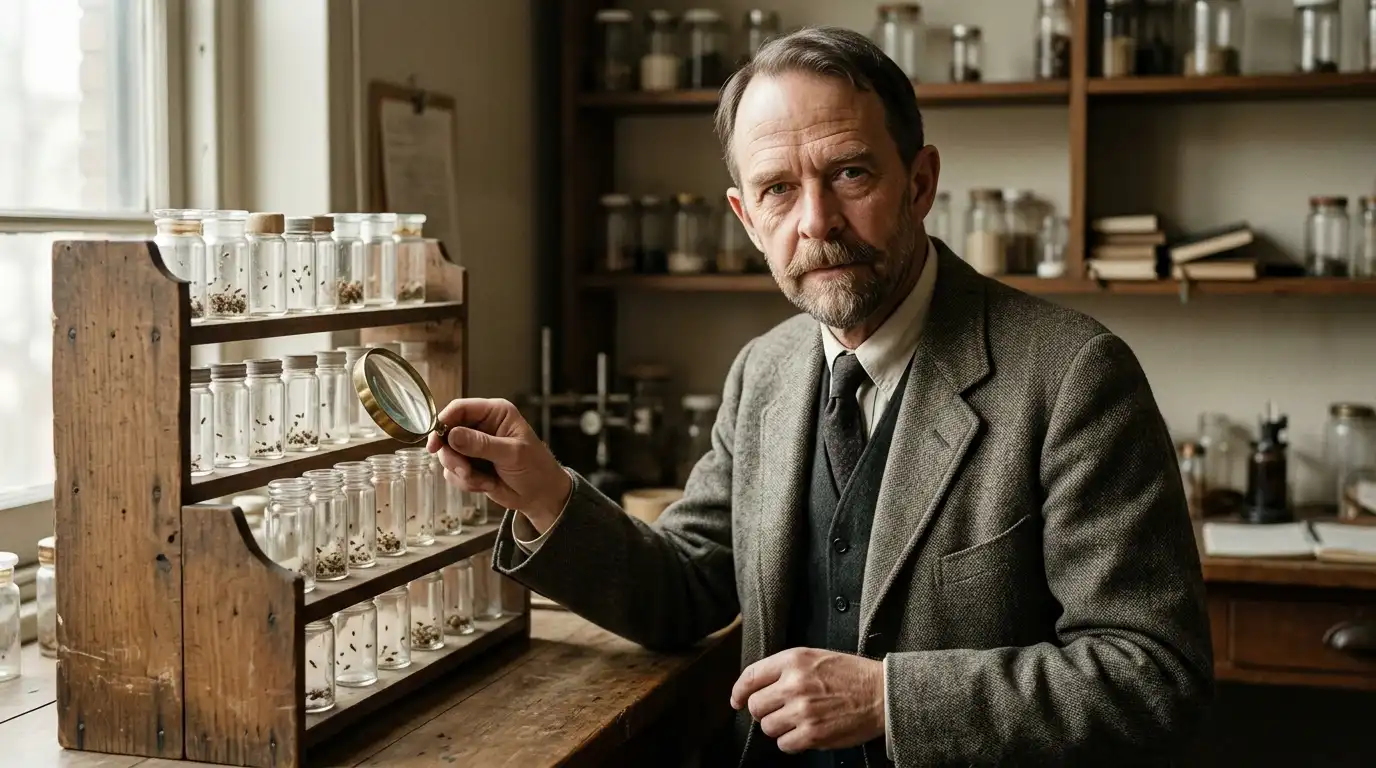
Wilhelm Johannsen introduced gene, genotype and phenotype and used bean breeding to separate inherited differences from ordinary variation.
Why is this scientist famous?
Wilhelm Johannsen distinguished genotype from phenotype, introduced the word gene and tested inheritance using pure lines of beans.
The distinction between an organism’s genetic constitution and its observable traits remains central to genetics, agriculture and medicine.
Wilhelm's story
From pharmacy to living plants
Wilhelm Ludvig Johannsen was born in Denmark on 3 February 1857. Instead of following a conventional university route, he trained as a pharmacist and developed experimental skills in chemistry. Work at Copenhagen’s Carlsberg Laboratory brought him close to practical problems in barley, plant physiology and brewing. These experiences helped shape an unusual approach to heredity: Johannsen wanted to measure what plants actually did, rather than rely on assumptions about how traits must pass between generations.
A puzzle hidden inside beans
When Johannsen grew self-fertilising lines of beans, he measured the size and weight of their seeds across generations. Even descendants with closely similar hereditary backgrounds differed in appearance. Selecting the heaviest seeds within the same stable line did not reliably produce progressively heavier descendants. His 1903 publication showed why an individual’s appearance is not a simple measure of its hereditary potential. Different pure lines could have inherited differences, while variation within a line might arise without corresponding hereditary change.
Three words that shaped genetics
Johannsen introduced the terms gene, genotype and phenotype in his 1909 book on exact heredity. A genotype refers to hereditary constitution; phenotype refers to the traits that can be observed, shaped by inherited factors and environmental conditions. The term gene supplied a deliberately cautious name for an inherited factor whose physical nature was not yet known. Johannsen was not claiming to have seen genes as pieces of DNA. His vocabulary helped future researchers ask sharper questions about the relation between inheritance and appearance.
The limitations of selection
The pure-line experiments were an important challenge to the idea that choosing unusually large or small individuals always produces permanent inherited change. Selection can be effective when genuine hereditary differences exist; it cannot simply turn every environmental fluctuation into an inherited characteristic. Johannsen also opposed vague explanations of life processes that could not be tested experimentally. He became professor of plant physiology at the University of Copenhagen in 1905 and later served as rector.
The language of modern biology
Geneticists still distinguish genotype and phenotype when studying why organisms with similar genes can develop differently, or why the same condition can affect individuals in different ways. Johannsen’s experiments predated knowledge of the structure of DNA, but his careful separation of concepts helped make that later research intelligible. He died in 1927; the language he established remains essential in classrooms and laboratories worldwide.
What did they discover?
Genotype and phenotype
Coined and distinguished terms for hereditary constitution and the observable characteristics of an organism.
Gene terminology
Popularised the term gene in 1909 without assuming that its physical nature was already known.
Pure-line breeding
Used controlled bean and barley experiments to separate heritable differences from variation within a genetically similar line.
Quantitative heredity
Helped make experimental measurement and careful statistical reasoning central to early genetics.
Amazing facts
He trained as a pharmacist rather than completing a conventional scientific university degree.
He worked at the Carlsberg Laboratory, associated with research on barley and brewing.
He investigated individual beans and their descendants over generations.
He published his influential pure-line experiments in 1903.
He introduced gene, genotype and phenotype in his 1909 book.
He distinguished inherited constitution from observed traits affected by environment.
He became a professor at the University of Copenhagen in 1905.
He served as rector of the University of Copenhagen in 1917.
Timeline
Born in Denmark.
Joined Copenhagen’s Carlsberg Laboratory.
Published his pure-line studies of heredity.
Became professor of plant physiology at the University of Copenhagen.
Introduced gene, genotype and phenotype in a textbook on heredity.
Served as rector of the University of Copenhagen.
Died in Copenhagen.
Related Super Scientists

Gregor Mendel
1822–1884 · Biologist & Augustinian Friar
Discovered the fundamental laws of genetic inheritance by studying pea plants.

Walter Sutton
1877–1916 · Chromosome theory of inheritance and cell biology
Walter Sutton connected the separation of chromosomes during meiosis to Mendel’s laws of inheritance, independently of related work by Theodor Boveri.
Theodor Boveri
1862–1915 · Experimental cell biology, embryology and chromosomes
Theodor Boveri showed why distinct chromosomes are essential for normal development and helped establish chromosome inheritance theory independently of Walter Sutton.