_(2).jpg)

Mendel found numerical patterns in pea plants. Later scientists connected those invisible hereditary factors with chromosomes and genes.
Children often resemble their parents.
A puppy may have its mother's colouring.
Seeds from one plant can grow into plants with similar flowers.
People had noticed inheritance for thousands of years, but noticing resemblance is not the same as understanding how it works.
By the nineteenth century, scientists still did not know about DNA, genes or chromosomes as we understand them today.
The breakthrough began with careful breeding experiments and counting.
Mendel counts peas
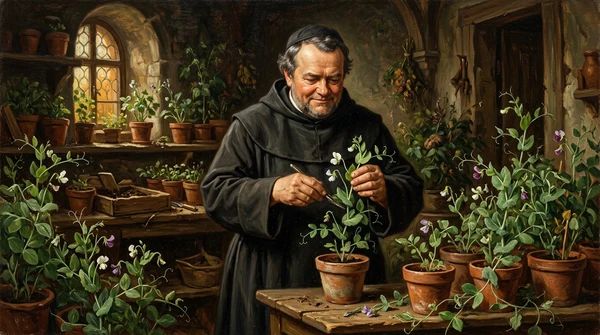
In the 1850s and 1860s, **Gregor Mendel** carried out breeding experiments with pea plants at the monastery where he lived and worked.
Peas were useful because they had characteristics that could be followed across generations.
Mendel studied features including flower colour, seed colour and plant height.
He established lines that reliably produced particular forms of a characteristic and then crossed them.
The results were striking.
When particular contrasting forms were crossed, one form could disappear in the first generation and then reappear in later offspring.
The numbers were not random.
For some crosses, Mendel observed ratios close to three offspring showing one form for every one showing the other.
Traits do not simply blend away
Mendel's work suggested that inheritance involved discrete hereditary factors.
Today we would describe many of these factors as genes, although Mendel did not use that word and did not know their physical nature.
He distinguished patterns we now call **dominant** and **recessive** inheritance.
A recessive form could apparently disappear in one generation without being destroyed, because it could reappear later.
This challenged the simple idea that parental traits must permanently blend together.
Mendel also recognised that different hereditary factors could be passed on independently in the combinations he studied.
Modern genetics later showed an important complication:
Genes do not always assort independently.
Genes located close together on the same chromosome can be inherited together.
That discovery would become one of the next chapters in the story.
A discovery that had to be rediscovered
Mendel presented his pea experiments in 1865 and published the work soon afterwards.
But his findings did not immediately transform biology.
Around 1900, several botanists working on inheritance drew scientific attention back to Mendel's results.
By then, another field had changed dramatically.
Scientists studying cells could see **chromosomes**.
During cell division, these structures behaved in ordered ways.
That created an exciting possibility.
Could the invisible hereditary factors described by Mendel have a physical connection with chromosomes?
Sutton watches chromosomes separate
American biologist **Walter Sutton** investigated chromosome behaviour in grasshopper cells.
During **meiosis**, the special form of cell division that produces eggs or sperm, chromosome pairs separate.
Each resulting reproductive cell receives only one chromosome from each pair.
Sutton noticed that this pattern resembled Mendel's rule that hereditary factors separate when reproductive cells are formed.
In 1902 and 1903 he argued that Mendelian hereditary factors were associated with chromosomes.
This offered a physical explanation for Mendel's numerical patterns.
Inheritance was becoming connected with something scientists could actually observe inside cells.
Boveri reaches a related conclusion
German biologist **Theodor Boveri** approached the problem through studies of chromosomes, fertilisation and early development.
His experiments showed that chromosomes were not simply interchangeable threads inside a cell.
Different chromosomes could make distinct contributions to normal development.
Sutton and Boveri worked independently, but their ideas became associated with what is now called the **Sutton-Boveri chromosome theory of inheritance**.
The theory proposed that chromosomes were the physical carriers of hereditary information.
It was an important step.
But scientists still needed clearer experimental evidence connecting particular inherited characteristics with particular chromosomes.
The word "gene" arrives
The language of inheritance was changing too.
In 1909 Danish botanist **Wilhelm Johannsen** introduced the word **gene** for Mendelian units of heredity.
He also helped establish two other important terms:
**genotype** — an organism's inherited genetic constitution
and
**phenotype** — the observable characteristics produced through the interaction of that genetic constitution with development and environment.
This distinction remains central to school genetics.
Having a particular genotype does not mean every characteristic can be predicted by one gene alone.
Many traits depend on several genes, environmental influences and interactions between them.
Even at the beginning of modern genetics, inheritance was becoming more complicated than a simple list of dominant and recessive characters.
Morgan turns to fruit flies
One of the most important experimental systems in genetics was an insect only a few millimetres long.
**Thomas Hunt Morgan** and his group studied the fruit fly *Drosophila melanogaster*.
Fruit flies are useful laboratory animals because they reproduce quickly and large numbers can be bred in a small space.
In 1910 Morgan studied a male fly with white eyes instead of the usual red eyes.
Breeding experiments showed that the white-eye characteristic had a special relationship with sex.
Morgan and his colleagues connected this **sex-linked inheritance** with the X chromosome.
The evidence helped establish that genes really were carried on chromosomes.
Morgan later received the 1933 Nobel Prize in Physiology or Medicine for discoveries concerning the role of chromosomes in heredity.
Some genes travel together
Fruit-fly experiments also exposed an apparent problem with simple independent assortment.
Some characteristics tended to be inherited together.
This made sense if their genes were located on the same chromosome.
Chromosomes could therefore contain many genes.
But could scientists work out where those genes were?
One of Morgan's students found an ingenious way.
Sturtevant makes a gene map
**Alfred Sturtevant** realised that linked genes did not always stay together.
During meiosis, paired chromosomes can exchange sections in a process now called **crossing over**.
The farther apart two genes are on a chromosome, the greater the chance that a crossover will occur between them.
Sturtevant recognised that recombination frequencies could therefore be used as a measure of relative distance.
In 1913 he produced the first genetic linkage map, arranging fruit-fly genes in a linear order along a chromosome.
Scientists still could not see individual genes directly.
But they could map where those genes must lie from the inheritance patterns they produced.
That was a remarkable example of discovering an invisible structure through indirect evidence.
The school science behind the story
Modern genetics gives us a much deeper molecular explanation.
A **gene** is a region of DNA that contributes to a functional biological product, usually through the production of RNA and often ultimately a protein.
DNA is packaged into chromosomes.
In sexually reproducing organisms, offspring inherit chromosome sets from their parents.
During meiosis, chromosome pairs separate and genetic material is reshuffled.
This helps explain segregation, independent assortment and recombination.
But school genetics diagrams are models.
Not every characteristic follows a simple dominant-versus-recessive pattern.
Some involve multiple genes.
Some show incomplete dominance or codominance.
Some are influenced strongly by environment.
Genes can also interact with one another.
Mendel discovered enormously important rules, but genetics did not stop with Mendel.
Why inheritance matters
Understanding inheritance connects many areas of biology.
It helps explain family resemblance and genetic disorders.
It allows plant and animal breeders to predict some outcomes of crosses.
It underpins modern genomics, genetic testing and much of biotechnology.
Inheritance is also essential to evolution.
Natural selection can only produce lasting evolutionary change when differences can be passed between generations.
The discovery of genes and chromosomes therefore connected cell biology, reproduction, evolution and medicine.
A theory built from different kinds of evidence
Mendel could not see genes.
He inferred hereditary factors from numbers.
Sutton and Boveri connected those factors with the visible behaviour of chromosomes.
Johannsen gave the new science some of its essential vocabulary.
Morgan's fruit flies provided experimental evidence linking genes to particular chromosomes.
Sturtevant mapped genes without ever seeing a DNA sequence.
Later scientists discovered what genes are made from and how DNA stores information.
The lesson is bigger than genetics.
Science can reveal things long before technology allows us to see them directly.
Patterns themselves can be evidence.