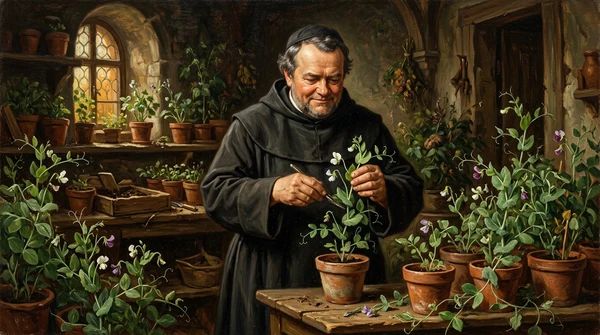
_(2).jpg)
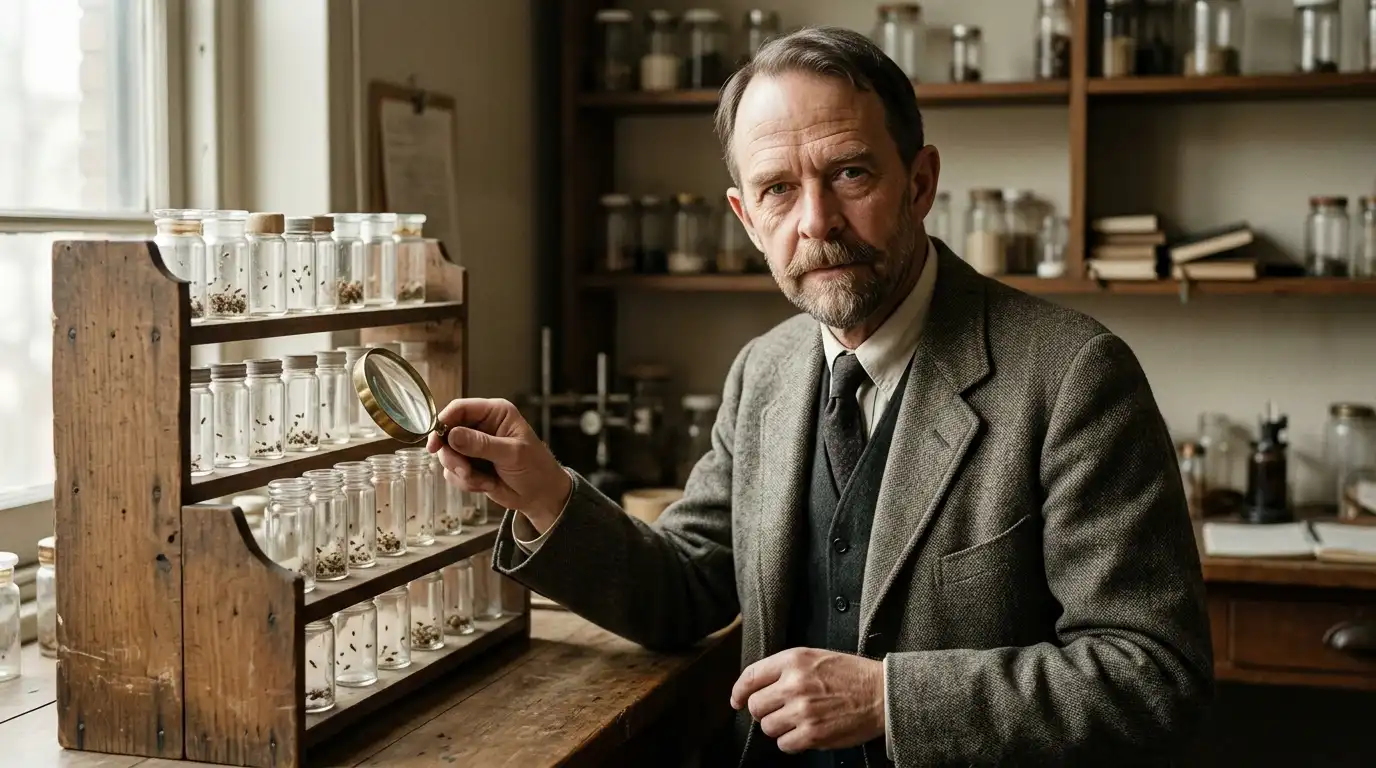
Thomas Hunt Morgan
1866–1945 · Experimental genetics and chromosome inheritance
Thomas Hunt Morgan used fruit fly experiments to establish the chromosome theory of inheritance and helped build experimental genetics.
Why is this scientist famous?
Thomas Hunt Morgan and his research group used fruit flies to provide compelling evidence that genes are carried on chromosomes.
His team’s work underlies genetic mapping, model-organism research and modern understanding of inherited traits and chromosome-linked disorders.
Thomas's story
From embryology to inheritance
Thomas Hunt Morgan was born in Lexington, Kentucky, on 25 September 1866. He studied natural history and zoology, earning a doctorate from Johns Hopkins University in 1890. He began his career investigating how embryos developed and was initially cautious about some claims made by early geneticists. After appointments at Bryn Mawr College and Columbia University, Morgan became interested in whether experiments could reveal how characteristics were passed between generations. Fruit flies offered a fast-breeding, inexpensive organism in which inherited changes could be watched.
A remarkable white-eyed fly
At Columbia, Morgan’s group bred Drosophila melanogaster, the small fruit fly familiar from overripe fruit. In 1910 Morgan identified a male fly with white eyes rather than the usual red. Carefully organised crosses showed that the unusual eye-colour trait was inherited in a way associated with the sex chromosomes. Here was evidence that an inherited factor, now called a gene, could have a definite position in the cell’s chromosome system. One fly did not settle every question, but it opened the door to a remarkable series of experiments.
The crowded Fly Room
Morgan worked with gifted colleagues including Alfred Sturtevant, Calvin Bridges and Hermann Muller. Together they built a substantial body of evidence for genes on chromosomes, linked inheritance and chromosome crossing-over. Sturtevant independently produced the first genetic linkage map in 1913, using the frequency with which traits were inherited together. Bridges later helped establish the consequences of chromosomes failing to separate normally. The work was a collective achievement, even though Morgan became its most famous representative.
A laboratory becomes a scientific school
In 1928 Morgan moved to the California Institute of Technology, where he organised its Biology Division. His interests returned partly to development, but the research tradition carried forward. In 1933 he received the Nobel Prize in Physiology or Medicine for discoveries concerning chromosomes and heredity. It was an award to Morgan, not a shared prize to the Fly Room, and it is important to name the collaborators whose experiments made the larger programme so powerful.
Why fruit flies still matter
Fruit flies remain essential in genetics because researchers can breed them rapidly and study many generations. Ideas that grew from Morgan’s laboratory help scientists investigate how genes are positioned, inherited and altered. Modern geneticists can read DNA sequences directly, but their experiments still build on the connection between observable traits and the physical behaviour of chromosomes. Morgan died in Pasadena on 4 December 1945.
What did they discover?
Sex-linked inheritance
Connected a white-eye mutation in fruit flies with inheritance involving sex chromosomes.
Chromosomal genes
Led an experimental programme that strongly established genes as hereditary units carried on chromosomes.
Genetic linkage
Helped develop understanding that genes on the same chromosome can be inherited together.
Experimental genetics
Built a collaborative fruit-fly laboratory that became a model for modern genetics research.
Amazing facts
He began his scientific life as an embryologist rather than a specialist in genetics.
He earned his doctorate at Johns Hopkins University in 1890.
His white-eyed fruit fly was identified in 1910.
Sex-linked eye colour offered evidence for genes on chromosomes.
His laboratory included Alfred Sturtevant, Calvin Bridges and Hermann Muller.
Sturtevant produced the first genetic linkage map while working in Morgan’s group.
Morgan helped establish Caltech’s Biology Division in 1928.
He received the Nobel Prize in Physiology or Medicine in 1933.
Timeline
Born in Lexington, Kentucky.
Completed his doctorate at Johns Hopkins University.
Joined Columbia University as professor of experimental zoology.
Identified a white-eyed fruit fly and developed sex-linked inheritance evidence.
His student Alfred Sturtevant published the first genetic linkage map.
Moved to Caltech to organise its Biology Division.
Received the Nobel Prize in Physiology or Medicine.
Received the Royal Society’s Copley Medal for his contributions to genetics.
Died in Pasadena, California.
Awards & honours
Related Super Scientists
Alfred Sturtevant
1891–1970 · Genetic linkage and chromosome mapping
Alfred Sturtevant used recombination frequencies from fruit fly experiments to make a pioneering map showing the relative positions of genes along a chromosome.
Walter Sutton
1877–1916 · Chromosome theory of inheritance and cell biology
Walter Sutton connected the separation of chromosomes during meiosis to Mendel’s laws of inheritance, independently of related work by Theodor Boveri.
Theodor Boveri
1862–1915 · Experimental cell biology, embryology and chromosomes
Theodor Boveri showed why distinct chromosomes are essential for normal development and helped establish chromosome inheritance theory independently of Walter Sutton.