_(2).jpg)
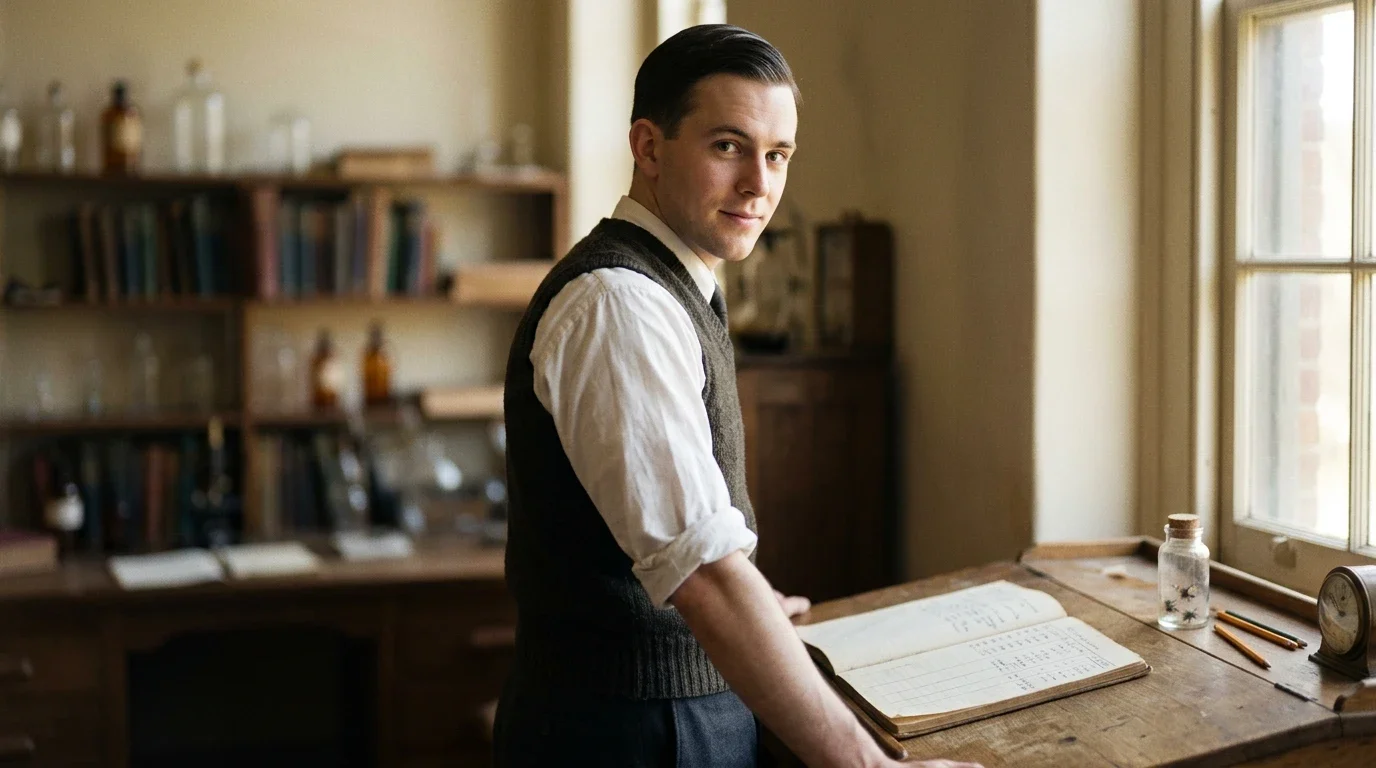
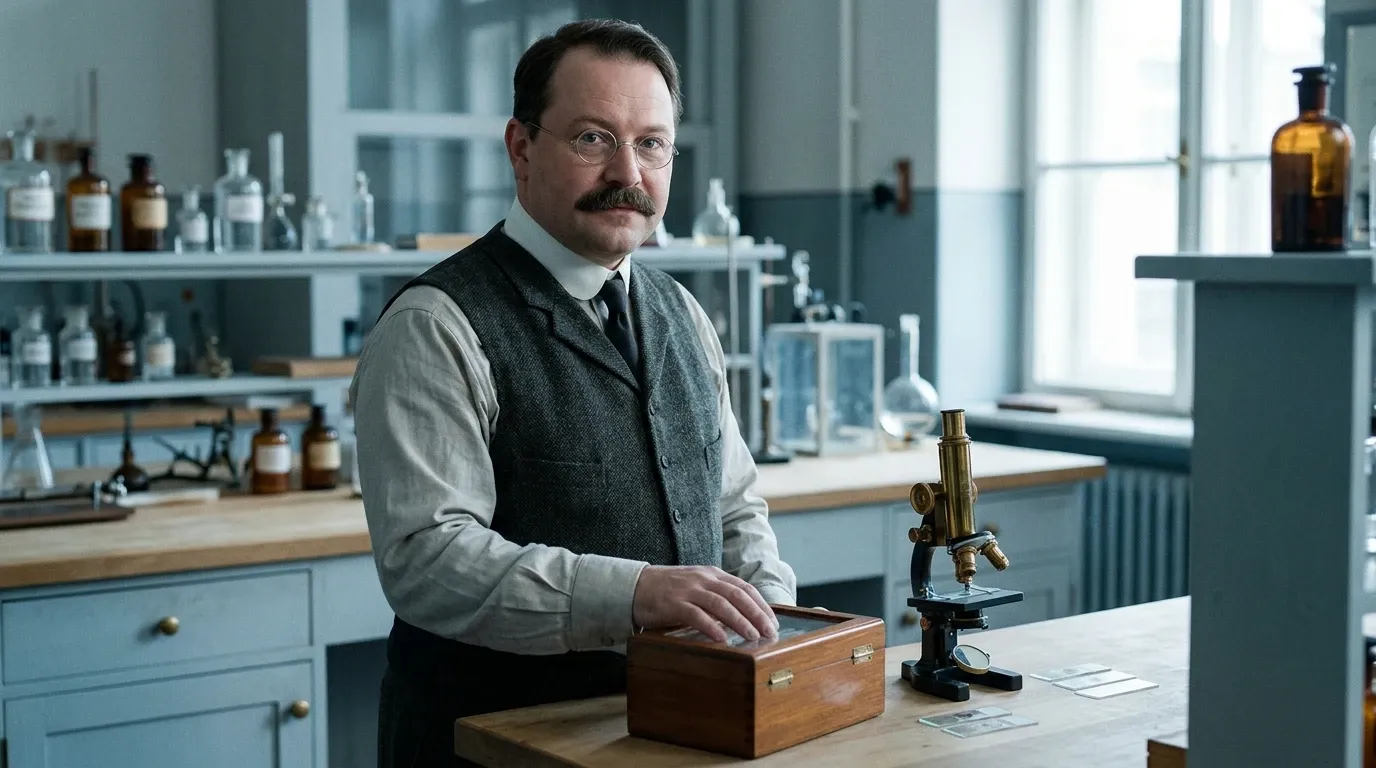
Alfred Sturtevant
1891–1970 · Genetic linkage and chromosome mapping
Alfred Sturtevant created the first genetic linkage map, using fruit fly crosses to infer the order and relative distances of genes.
Why is this scientist famous?
Alfred Sturtevant used recombination frequencies from fruit fly experiments to make a pioneering map showing the relative positions of genes along a chromosome.
Gene mapping grew from his insight that inheritance patterns can reveal chromosome arrangement, an idea foundational to genomics and medical genetics.
Alfred's story
A student with an unusual question
Alfred Henry Sturtevant was born in Illinois in 1891 and became interested in heredity while examining horse pedigrees. As an undergraduate at Columbia University he joined Thomas Hunt Morgan’s developing fruit-fly research group. The laboratory was studying visible inherited differences in Drosophila, such as unusual eye colours or wing shapes. Some pairs of traits appeared together more often than Mendel’s simple expectation of independent assortment. That puzzle became the starting point for Sturtevant’s most famous contribution.
Turning inheritance into a map
Sturtevant reasoned that genes located near each other on the same chromosome would tend to be inherited together. During reproduction, a process called crossing-over can exchange material between paired chromosomes. The more often two traits become separated by recombination, the farther apart their genes are likely to lie. By comparing frequencies from fruit-fly crosses, he could infer a relative order of genes and approximate distances between them, although he could not see the DNA itself.
The map appears in 1913
In 1913 Sturtevant published a genetic linkage map of fruit-fly genes, showing a way to reconstruct an invisible chromosome arrangement from breeding results. The map gave distances in units based on recombination percentages, not physical lengths measured with a ruler. It was a remarkable combination of simple counting and powerful reasoning. He did this in Morgan’s laboratory, but the mapping insight and calculation are specifically credited to Sturtevant.
More than one discovery
In 1925 Sturtevant published important research on fruit flies with unusual eye shapes. He showed that unequal crossing-over could remove or duplicate chromosome material. He also demonstrated that the arrangement of genetic material could affect eye shape, even when the total amount was the same. This became an important early example of what scientists call position effect. Sturtevant continued working on genetics after moving with Morgan’s group to the California Institute of Technology in 1928. He helped establish the mathematical and experimental study of gene order and was interested in the history of genetics itself. His 1965 book The History of Genetics explained earlier discoveries to new generations. He received the National Medal of Science for 1967, an honour recognising a long career of biological research.
Why the mapping idea matters
Today scientists can sequence chromosomes and count physical base pairs, but the logic of genetic linkage remains useful for understanding how characteristics and diseases pass through families. The method began when Sturtevant noticed information hidden in the frequency of inherited combinations. He died in Pasadena in April 1970. Published historical accounts disagree about his exact birth day, so this profile does not invent a precise birthday.
What did they discover?
First genetic map
Used recombination data to make a pioneering map of relative gene positions on a chromosome.
Linkage-based gene mapping
Used recombination frequencies between linked genes to estimate their relative positions along a chromosome.
Unequal crossing-over and position effect
Showed how unequal exchanges of chromosome material could alter eye shape in fruit flies, and demonstrated that the arrangement of genetic material could influence a trait.
History of genetics
Published an influential historical account of genetics in 1965.
Amazing facts
He became interested in inheritance through horse pedigrees.
He joined Thomas Hunt Morgan’s fruit-fly research group at Columbia.
He published his pioneering genetic linkage map in 1913.
The map used breeding statistics, not direct images of DNA.
In 1925 he showed how unequal crossing-over could change fruit-fly eye shape and helped establish the idea of position effect.
He moved to Caltech with Morgan’s group in 1928.
He published The History of Genetics in 1965.
He received the United States National Medal of Science for 1967.
Timeline
Born in Jacksonville, Illinois; exact birth day deliberately omitted because institutional records disagree.
Joined Morgan’s research group and published early work on horse heredity.
Published his genetic linkage map using fruit-fly recombination data.
Published important research demonstrating unequal crossing-over and position effect in fruit flies.
Moved with Morgan’s group to Caltech.
Published The History of Genetics and received the John J. Carty Award for the Advancement of Science.
Named a recipient of the 1967 National Medal of Science; the medal was presented in February 1968.
Died in Pasadena, California.
Awards & honours
Related Super Scientists
Thomas Hunt Morgan
1866–1945 · Experimental genetics and chromosome inheritance
Thomas Hunt Morgan and his research group used fruit flies to provide compelling evidence that genes are carried on chromosomes.
Walter Sutton
1877–1916 · Chromosome theory of inheritance and cell biology
Walter Sutton connected the separation of chromosomes during meiosis to Mendel’s laws of inheritance, independently of related work by Theodor Boveri.
Theodor Boveri
1862–1915 · Experimental cell biology, embryology and chromosomes
Theodor Boveri showed why distinct chromosomes are essential for normal development and helped establish chromosome inheritance theory independently of Walter Sutton.