_(2).jpg)
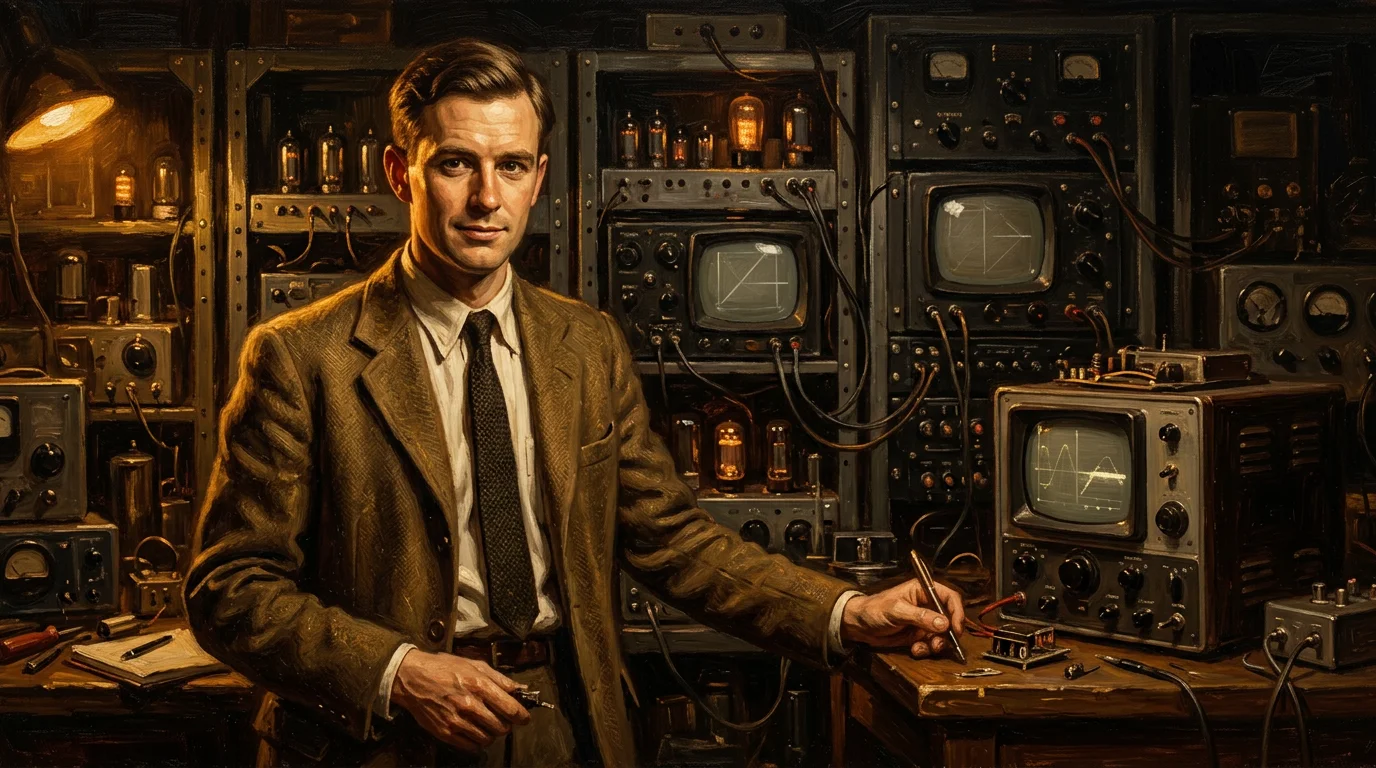
Tom Kilburn
1921–2001 · Computer Engineer
Tom Kilburn was a British computer engineer who co-developed the Williams-Kilburn memory, led the design of the Manchester Baby, wrote its first program, and later led major Manchester computer projects including Atlas.
“The important thing in science is not so much to obtain new facts as to discover new ways of thinking about them.”
Why is this scientist famous?
Co-developing the Williams-Kilburn electronic memory, leading the design and construction of the Manchester Baby, writing its first program, and later leading major Manchester computer projects including Atlas.
Tom's story
A Mathematician Who Became an Engineer
Tom Kilburn was born on 11 August 1921 in Dewsbury, Yorkshire, England. He studied mathematics at Cambridge University during the Second World War and graduated with first-class honours in 1942.
Although trained as a mathematician, Kilburn was sent into wartime electronics work at the Telecommunications Research Establishment (TRE). There he joined Frederic Williams's group and became an accomplished electronics engineer. The transition from pure mathematics to practical electronics would shape the rest of his career.
From Radar to Computer Memory
After the war, Williams moved to the University of Manchester and Kilburn joined him. They worked on a bold idea: storing binary information electronically using a cathode-ray tube, the same kind of tube used in radar displays.
Kilburn made major improvements to the technique during 1947. The resulting Williams-Kilburn tube became one of the first practical forms of electronic random-access computer memory. It could access different memory locations electronically rather than having to read through them sequentially — a crucial advantage for a computer that needed to fetch instructions and data at high speed.
The Manchester Baby
Kilburn led the detailed work designing and building the Small-Scale Experimental Machine — the Manchester Baby — to test the new CRT memory. Geoff Tootill worked closely with him, and Frederic Williams headed the wider research project.
Kilburn wrote the first program executed by the Baby. The program searched for the highest factor of a number. On 21 June 1948 it ran successfully — the first time an electronic digital computer had executed a program stored electronically in its own read-write memory.
The Baby was primarily an experiment to prove that the new memory worked. But its success opened the door to practical electronic computing. The achievement belonged to the three core team members: Williams, Kilburn and Tootill.
Atlas and Virtual Memory
Kilburn then became the principal driving force behind Manchester's computer-development programme. His teams worked on a sequence of pioneering machines, each more powerful than the last.
One of the most significant was Atlas, completed in the early 1960s. Atlas helped pioneer concepts including paging and virtual memory — techniques that allowed a computer to manage information between fast and slow storage in a way that made a larger apparent memory available to programs. These ideas became fundamental to modern computing. Atlas was a substantial team project, and Kilburn should not be described as inventing virtual memory entirely alone.
Building a Department and a Legacy
Kilburn became Professor of Computer Engineering at Manchester in 1960. In 1964 he became head of the new Department of Computer Science — one of the first such departments in the world. He remained a major figure in Manchester computing until retiring in 1981.
The University of Manchester records that Kilburn was a keen Manchester United supporter who enjoyed football, jazz and playing the piano. He never became known for owning or using a personal computer, despite having helped create the modern computing era.
Kilburn was elected a Fellow of the Royal Society in 1965, received a CBE in 1973, the Royal Medal in 1978, and the Eckert-Mauchly Award in 1983. He died on 17 January 2001 in Manchester.
What did they discover?
Williams-Kilburn CRT Memory
With Frederic Williams, Kilburn co-developed an early practical electronic random-access memory using cathode-ray tubes. Kilburn made major improvements to the technique during 1947.
The Manchester Baby — First Stored Program
Kilburn led the detailed design and construction of the Manchester Baby and wrote its first program. On 21 June 1948 the Baby became the first electronic digital computer to run a program stored in its electronic memory.
Atlas and Virtual Memory
Kilburn led the team that built Atlas, which helped pioneer paging and virtual memory — concepts fundamental to modern computing.
Amazing facts
He arrived at wartime electronics having originally trained as a mathematician.
He wrote the program that first ran successfully on the Baby — it searched for the highest factor of a number.
The Baby was primarily an experiment to test electronic memory.
Kilburn later led several generations of Manchester computers including Atlas.
He was a Manchester United supporter and enjoyed jazz.
He never became known for owning or using a personal computer despite helping create the modern computing era.
Timeline
Born in Dewsbury, Yorkshire, England.
Graduated in mathematics from Cambridge; entered wartime electronics research at TRE.
Joined Williams at the University of Manchester.
Developed the Williams-Kilburn CRT memory further.
Received PhD.
Manchester Baby ran its first stored program.
Became Professor of Computer Engineering at Manchester.
Became head of the new Department of Computer Science at Manchester.
Elected Fellow of the Royal Society.
Appointed CBE.
Received the Royal Medal of the Royal Society.
Retired.
Received the Eckert-Mauchly Award.
Died in Manchester, England.
Awards & honours
Related Super Scientists
Frederic C. Williams
1911–1977 · Electrical Engineer
Developing, with Tom Kilburn, an early practical cathode-ray-tube electronic computer memory and leading the Manchester team in which the Manchester Baby was created.
Geoff Tootill
1922–2017 · Computer Engineer
Being one of the three core engineers who built the Manchester Baby, the first electronic stored-program digital computer to run a program from electronic read-write memory.
Alan Turing
1912–1954 · Mathematician & Computer Scientist
Making foundational contributions to theoretical computer science and artificial intelligence, and playing a major role in Allied codebreaking during the Second World War.