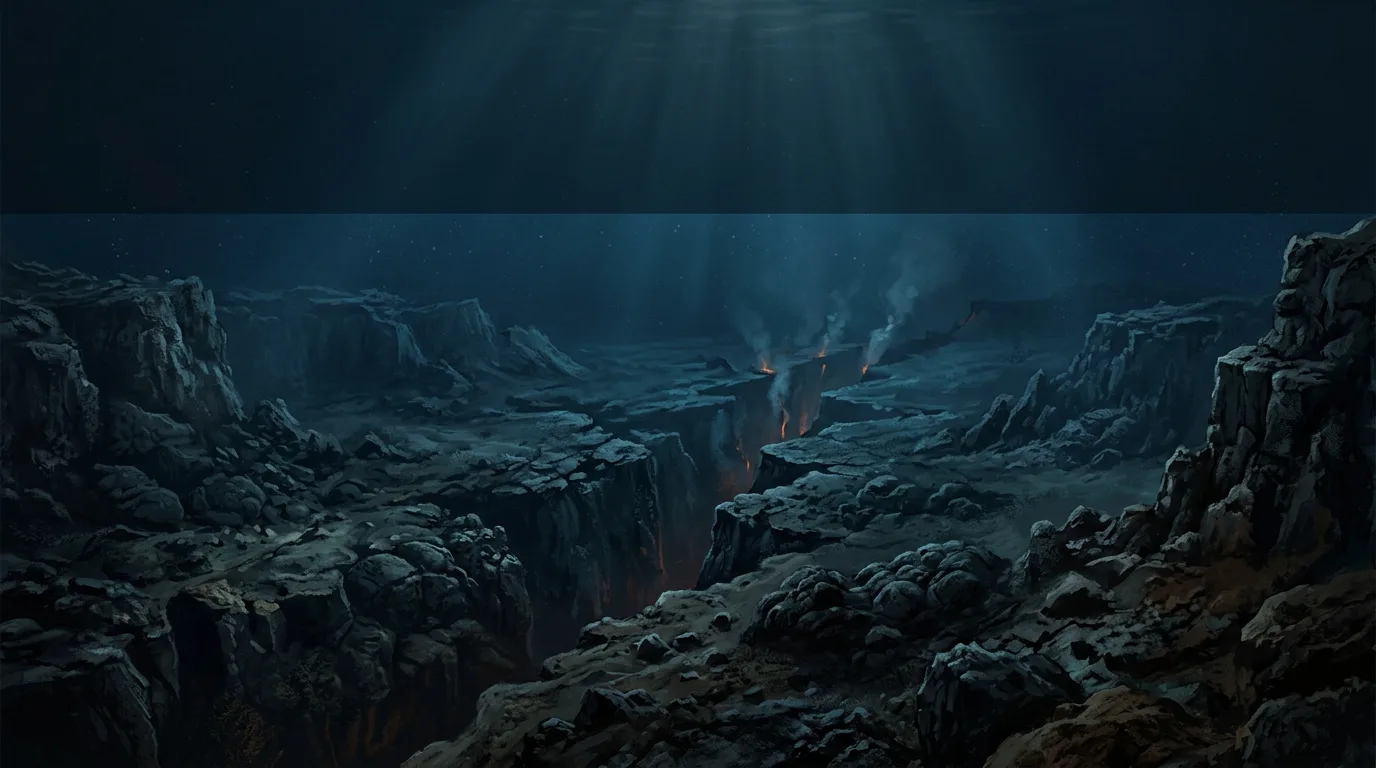
_(2).jpg)
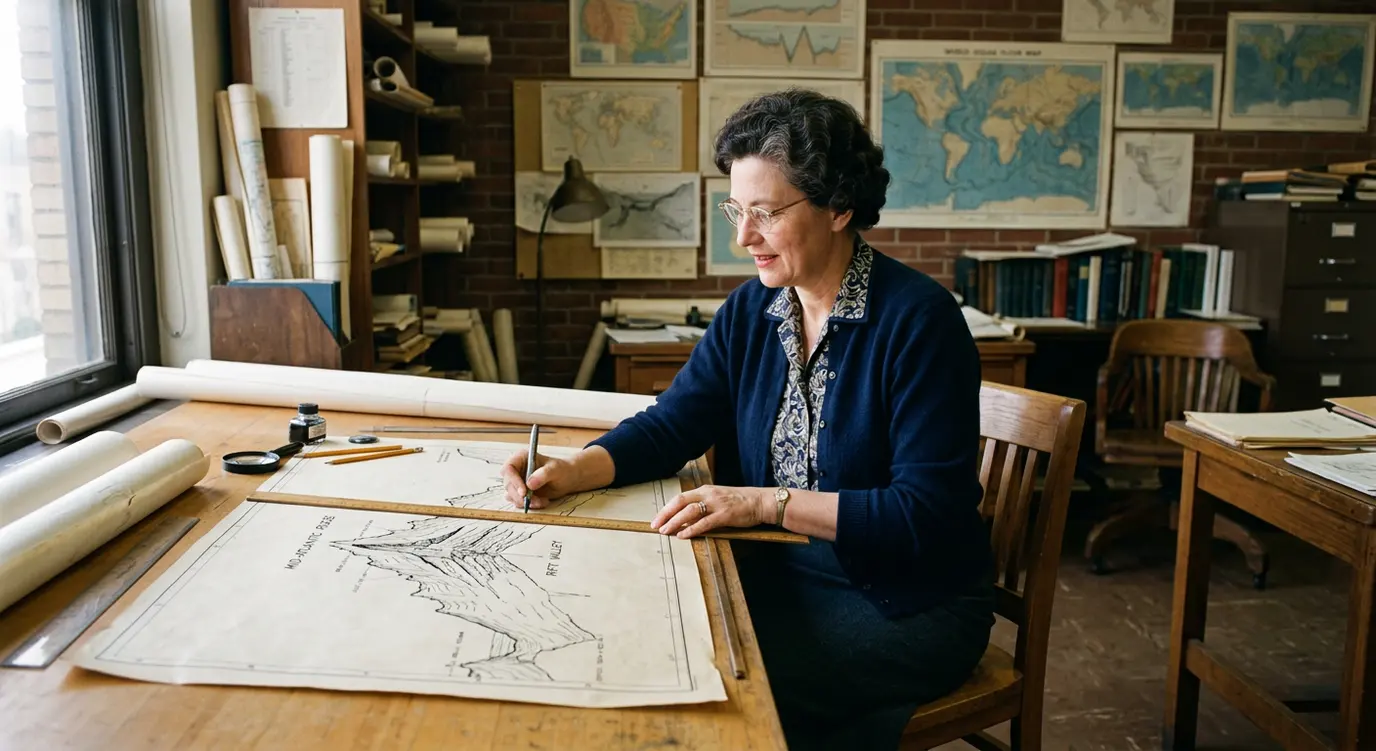
Marie Tharp
1920–2006 · Oceanographic cartography and geology
American geologist and mapmaker Marie Tharp charted the ocean floor and traced a rift valley along the Mid-Atlantic Ridge, providing vital evidence for a changing Earth.
Why is this scientist famous?
Her seafloor maps, made with colleague Bruce Heezen, revealed major underwater features and strengthened the case for continental movement and plate tectonics.
Tharp's maps changed the study of the oceans and helped make seafloor features visible to a wide audience, strengthening the case for plate tectonics.
Marie's story
From soil maps to the ocean floor
Marie Tharp was born on 30 July 1920 in Ypsilanti, Michigan. Her father, William Edgar Tharp, surveyed and mapped soils for the US Department of Agriculture, so maps were part of her early world. She first earned a bachelor's degree in English and music from Ohio University in 1943. She then turned to geology, earning a master's degree at the University of Michigan. She later studied mathematics at the University of Tulsa while working in the oil industry. In 1948 she joined Columbia University's Lamont Geological Laboratory, where she began a decades-long collaboration with marine geologist Bruce Heezen.
Reading the ocean floor
Heezen and other scientists gathered echo-sounding data aboard research vessels. Sonar readings — sending sound down to the seabed and timing its return — were used to infer underwater depth, not to photograph the bottom. Tharp used those measurements and other available soundings to draw and compare ocean-floor profiles. In 1952 she identified a recurring notch along the crest of the Mid-Atlantic Ridge and recognised a rift valley. Her mapping brought the feature into focus; she did not discover the entire Mid-Atlantic Ridge for the first time. Early findings met scepticism. Women were excluded from the research cruises during much of this period, so she did this important marine research from the laboratory rather than from a ship. She joined a research cruise in 1968.
Maps that changed geology
Tharp and Heezen's 1957 Atlantic seafloor map and their 1977 world-ocean-floor map helped reveal oceanic ridges and the seafloor's structure to a wide audience. Artist Heinrich Berann painted the 1977 world-ocean-floor panorama from Tharp and Heezen's mapping work. Her maps helped other scientists test and develop the picture of mobile plates; no single map alone proved the entire theory. Tharp and Heezen jointly received the National Geographic Society Hubbard Medal in 1978, after Heezen's death. Woods Hole Oceanographic Institution recognised her with the Mary Sears Woman Pioneer in Oceanography Award in 1999, and she received the Lamont-Doherty Heritage Award in 2001. She died on 23 August 2006.
What did they discover?
Rift valley along the Mid-Atlantic Ridge
By drawing and comparing ocean-floor profiles from echo-sounding data, Tharp identified a recurring notch along the ridge crest and recognised a rift valley.
1957 Atlantic seafloor map with Heezen
Their Atlantic map helped reveal major underwater features and the structure of the ocean floor.
1977 world-ocean-floor map with Heezen
Their world-ocean-floor map made seafloor features visible to a wide audience and helped scientists test and develop ideas about mobile plates.
Amazing facts
Her father made soil maps for the US Department of Agriculture.
She first earned a degree in English and music.
She turned shipboard depth measurements into drawn profiles and maps.
A repeated notch in those profiles pointed to a rift valley beneath the Atlantic.
She could do important marine research before she was permitted aboard a research cruise.
She finally joined a research cruise in 1968.
She and Heezen published a world-ocean-floor map in 1977.
They jointly received the Hubbard Medal in 1978, after Heezen's death.
Timeline
Born in Ypsilanti, Michigan
Earned a bachelor's degree in English and music from Ohio University
Joined Columbia University's Lamont Geological Laboratory
Noticed a recurring notch along the crest of the Mid-Atlantic Ridge and recognised a rift valley
Published the Atlantic seafloor map with Bruce Heezen
Joined a research cruise
Published the world-ocean-floor map with Heezen
Jointly received the National Geographic Society Hubbard Medal with Heezen (posthumously)
Received the Mary Sears Woman Pioneer in Oceanography Award from Woods Hole Oceanographic Institution
Received the Lamont-Doherty Heritage Award
Died
Awards & honours
Related Super Scientists
Harry Hammond Hess
1906–1969 · Geology and geophysics
His seafloor-spreading hypothesis connected ocean-floor observations to a mechanism that helped build plate tectonics.
Alfred Wegener
1880–1930 · Meteorologist & Geophysicist
Proposed the theory of continental drift, the foundation of modern plate tectonics.
Arthur Holmes
1890–1965 · Geology
Pioneered the use of radiometric dating of minerals to build an early numerical geological timescale, and proposed that mantle movement could help explain continental drift.