_(2).jpg)

Arthur Holmes
1890–1965 · Geology
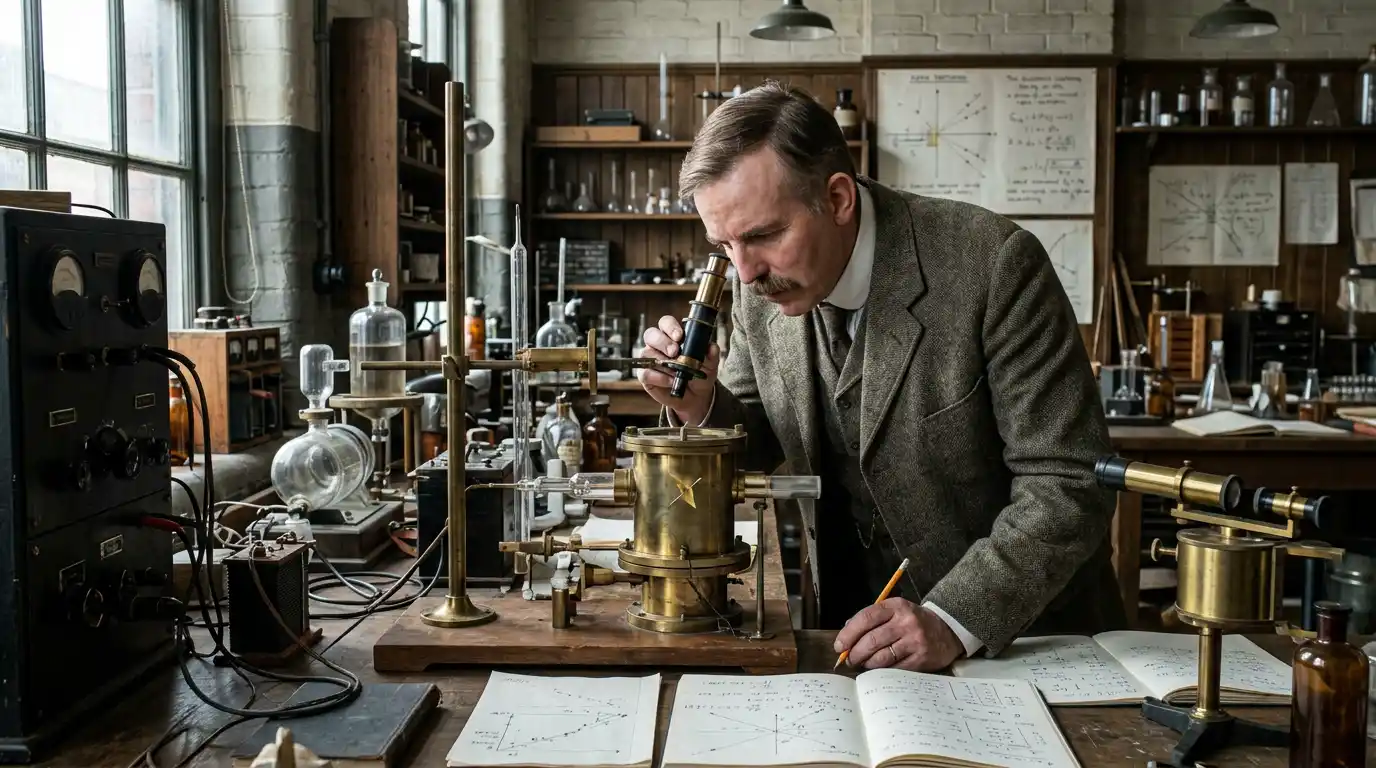
British geologist Arthur Holmes used radioactive decay to date minerals and build a geological timescale, and proposed mantle movement could drive continental drift.
Why is this scientist famous?
Pioneered the use of radiometric dating of minerals to build an early numerical geological timescale, and proposed that mantle movement could help explain continental drift.
Holmes helped make numerical geological dating a practical part of Earth science and advanced a possible mechanism for continental movement. His work linked physics, geology and the developing study of Earth's interior.
Arthur's story
From physics to geology
Arthur Holmes was born on 14 January 1890 in Hebburn, near Newcastle upon Tyne. He began by studying physics before turning to geology. He studied at what is now Imperial College London, graduating in 1910 and receiving a doctorate in 1917. Radioactivity was still a new area of science during his student years, and Holmes saw that it could provide a clock for measuring the ages of rocks.
Dating the Earth
Ernest Rutherford had earlier suggested that radioactive minerals could provide a clock. Holmes took up this idea and used radioactive decay to estimate the ages of minerals and build a numerical geological timescale. His 1913 book The Age of the Earth discussed evidence pointing to an Earth far older than Lord Kelvin's cooling estimates. An early figure associated with his work was about 1.6 billion years, which was revised as methods improved. His dating work put numbers alongside the relative order shown by rock layers. He did not establish the modern 4.54-billion-year figure, but he helped make numerical geological dating practical.
Mantle movement and continental drift
Alfred Wegener had proposed continental drift, but the mechanism was unclear. Holmes argued that slow movement within Earth's mantle — the layer between the crust and the core — could provide a physical mechanism relevant to moving continents. His ideas about mantle movement were proposals that later evidence helped develop. He did not prove plate tectonics, but his suggestion was an important step. His textbook Principles of Physical Geology appeared in 1944 and became widely used.
A career across Britain
Holmes worked at Imperial College, undertook geological fieldwork in Mozambique, and later worked in Burma (now Myanmar). He joined Durham University in 1924, where an isotope geology laboratory was later named after him. In 1943 he became Regius Professor of Geology at the University of Edinburgh, retiring in 1956. Doris Reynolds, his second wife, was also a geologist. He received the Murchison Medal (1940), the Wollaston Medal (1956), the Penrose Medal (1956) and the Vetlesen Prize (1964). He was elected a Fellow of the Royal Society in 1942. He died in Putney, London, on 20 September 1965.
What did they discover?
Radiometric dating of minerals
Holmes used radioactive decay to estimate the ages of minerals, building a numerical geological timescale that put numbers alongside the relative order shown by rock layers.
The Age of the Earth (1913)
His book argued that Earth was far older than Kelvin's cooling estimates, with an early figure of about 1.6 billion years that was later revised as methods improved.
Mantle convection as a mechanism for continental drift
Holmes proposed that slow movement within Earth's mantle could help move continents, offering a physical mechanism for Wegener's theory of continental drift.
Principles of Physical Geology (1944)
His widely used textbook helped educate generations of geology students.
Amazing facts
He began by studying physics before turning to geology.
Radioactivity was still a new area of science during his student years.
His dating work put numbers alongside the relative order shown by rock layers.
His early age estimates changed as measurements improved.
He investigated rocks during fieldwork in Mozambique.
He suggested that slow movement inside Earth could help move continents.
His geology textbook became widely used.
Durham named an isotope geology laboratory after him.
Timeline
Born in Hebburn, near Newcastle upon Tyne
Graduated from Imperial College London
Published The Age of the Earth
Received a doctorate
Joined Durham University
Elected Fellow of the Royal Society
Became Regius Professor of Geology at the University of Edinburgh
Published Principles of Physical Geology
Retired and received the Wollaston Medal
Died in Putney, London
Awards & honours
Related Super Scientists

James Hutton
1726–1797 · Geology
Helped establish the concept of deep time — that Earth's geological history extends far beyond ordinary human experience.
Ernest Rutherford
1871–1937 · Physicist
Discovering the nuclear structure of the atom and pioneering the field of nuclear physics.

Bertram Borden Boltwood
1870–1927 · Radiochemistry
Identified lead as the end product of uranium's radioactive decay and used the uranium-lead relationship to estimate mineral ages of billions of years.
Sources & references
- American Museum of Natural History — Arthur Holmes: Harnessing the Mechanics of Mantle Convection to the Theory of Continental Drift
- Edinburgh Geological Society — Arthur Holmes (1890–1965)
- Imperial College London — From Dating to Crustal Evolution, in Celebration of Arthur Holmes
- University of Edinburgh Archives — Holmes, Arthur, 1890–1965