_(2).jpg)
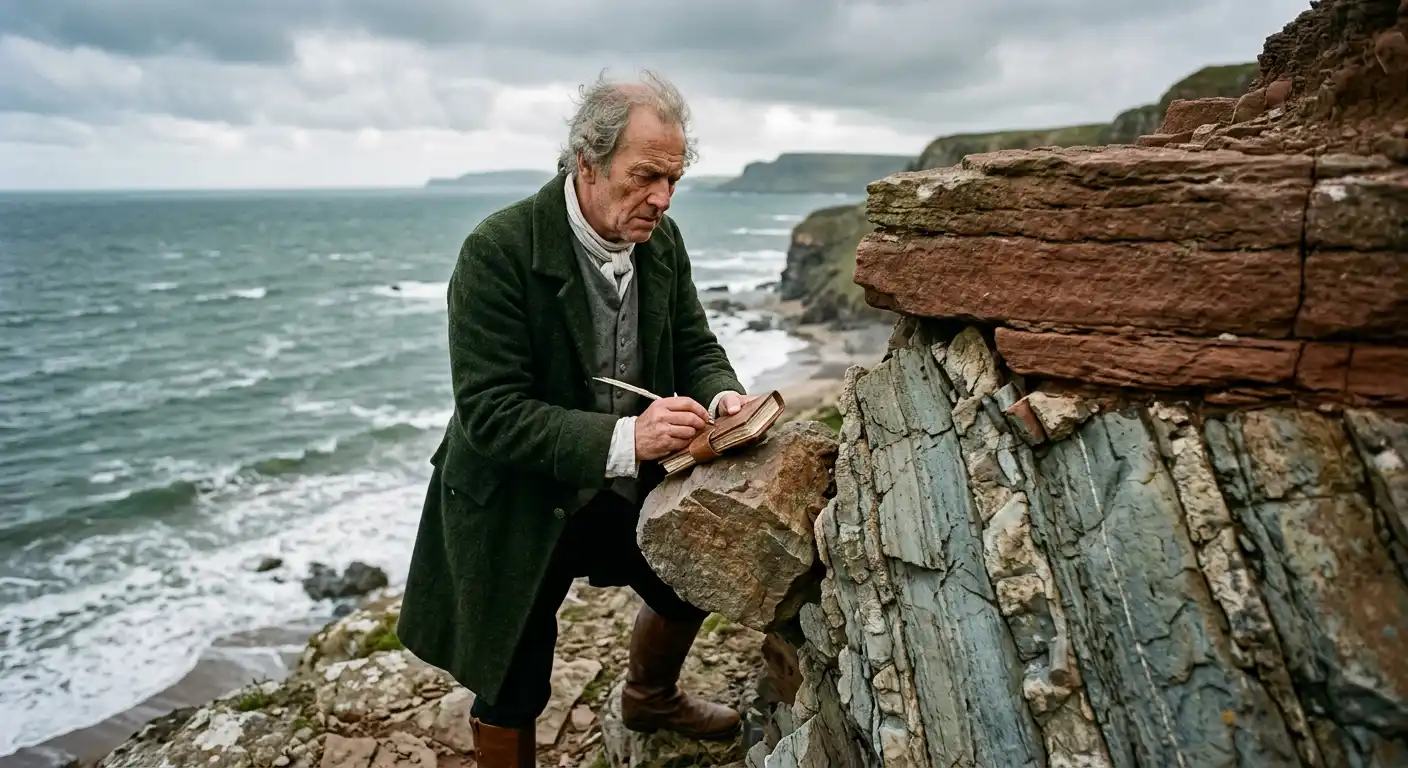
James Hutton
1726–1797 · Geology
Scottish geologist James Hutton argued that erosion and sediment deposition shaped Earth over immense spans of time, founding modern geology and the concept of deep time.
“no vestige of a beginning, no prospect of an end”
Why is this scientist famous?
Helped establish the concept of deep time — that Earth's geological history extends far beyond ordinary human experience.
His explanations of rock processes and deep time became foundations of geological reasoning. The sequence at Siccar Point remains a powerful way to teach how rocks record time.
James's story
A natural philosopher from Edinburgh
James Hutton was born on 3 June 1726 in Edinburgh, Scotland. He began university study there at about 14, an unusually early age. He studied chemistry and anatomy in Paris and gained a medical degree at Leiden in 1749. Though trained in medicine, Hutton's path would lead him to geology through practical experience on the land.
Farming and field observation
Hutton worked family farms in the Scottish Borders during the 1750s. He travelled to learn farming methods before applying them on his own land. Working farms helped him notice the slow movement of soil and sediment — how rock breaks down, how particles are carried away, how new layers form. These everyday observations of erosion and deposition shaped his thinking about Earth's history.
Theory of the Earth
Hutton argued that processes observable today, including erosion and sediment deposition, had shaped earlier landscapes over immense spans of time. He investigated places where older rocks had been tilted and worn down before younger layers formed over them. At Siccar Point on the Berwickshire coast, he found a clear contact where older tilted grey strata were overlain by younger red sandstone. That contact records several events: formation, tilting, erosion and later deposition. Hutton's theory was read before the Royal Society of Edinburgh in 1785 by his friend Joseph Black. It was published in 1788, and expanded into a book in 1795. He did not calculate Earth's numerical age.
Deep time and legacy
Hutton's famous phrase from his Theory of the Earth — no vestige of a beginning, no prospect of an end — expressed what he could discern from geological evidence: that Earth's history extends far beyond ordinary human experience. He did not claim to prove Earth is eternal. John Playfair and Sir James Hall accompanied Hutton to Siccar Point in 1788; Playfair later helped explain Hutton's work to a wider audience. James Davie was a friend and collaborator in earlier chemical ventures. Hutton died in Edinburgh on 26 March 1797. He is often called a founder of modern geology, and the James Hutton Institute carries his name today.
What did they discover?
The concept of deep time
Hutton argued that processes observable today — erosion, deposition, rock formation — have shaped Earth over immense spans of time far beyond human experience.
The unconformity at Siccar Point
At Siccar Point, Hutton found older tilted rock overlain by younger rock, revealing a long sequence of geological events including formation, tilting, erosion and later deposition.
Theory of the Earth
Hutton's theory was presented in 1785, published in 1788, and expanded in 1795, laying foundations for modern geology.
Amazing facts
He began university study at about 14.
He trained in medicine before becoming known for geology.
Working farms helped him notice the slow movement of soil and sediment.
He travelled to learn farming methods before applying them on his land.
At Siccar Point, older tilted rock is overlain by younger rock.
That contact records several events, including formation, tilting, erosion and later deposition.
His theory appeared in stages: presentation, initial publication and expanded book.
A present-day Scottish research institute carries his name.
Timeline
Born in Edinburgh
Gained a medical degree at Leiden
Farmed in the Scottish Borders and studied erosion, soil and rock
Hutton's theory was read before the Royal Society of Edinburgh by his friend Joseph Black
Published the theory and visited Siccar Point with Playfair and Hall
Published the expanded Theory of the Earth
Died in Edinburgh
Related Super Scientists
Arthur Holmes
1890–1965 · Geology
Pioneered the use of radiometric dating of minerals to build an early numerical geological timescale, and proposed that mantle movement could help explain continental drift.
John Perry
1850–1920 · Engineering and physics
Challenged Kelvin's cooling-based age of Earth by arguing that heat transfer within Earth's interior could change the calculation, years before radioactivity was discovered.