_(2).jpg)
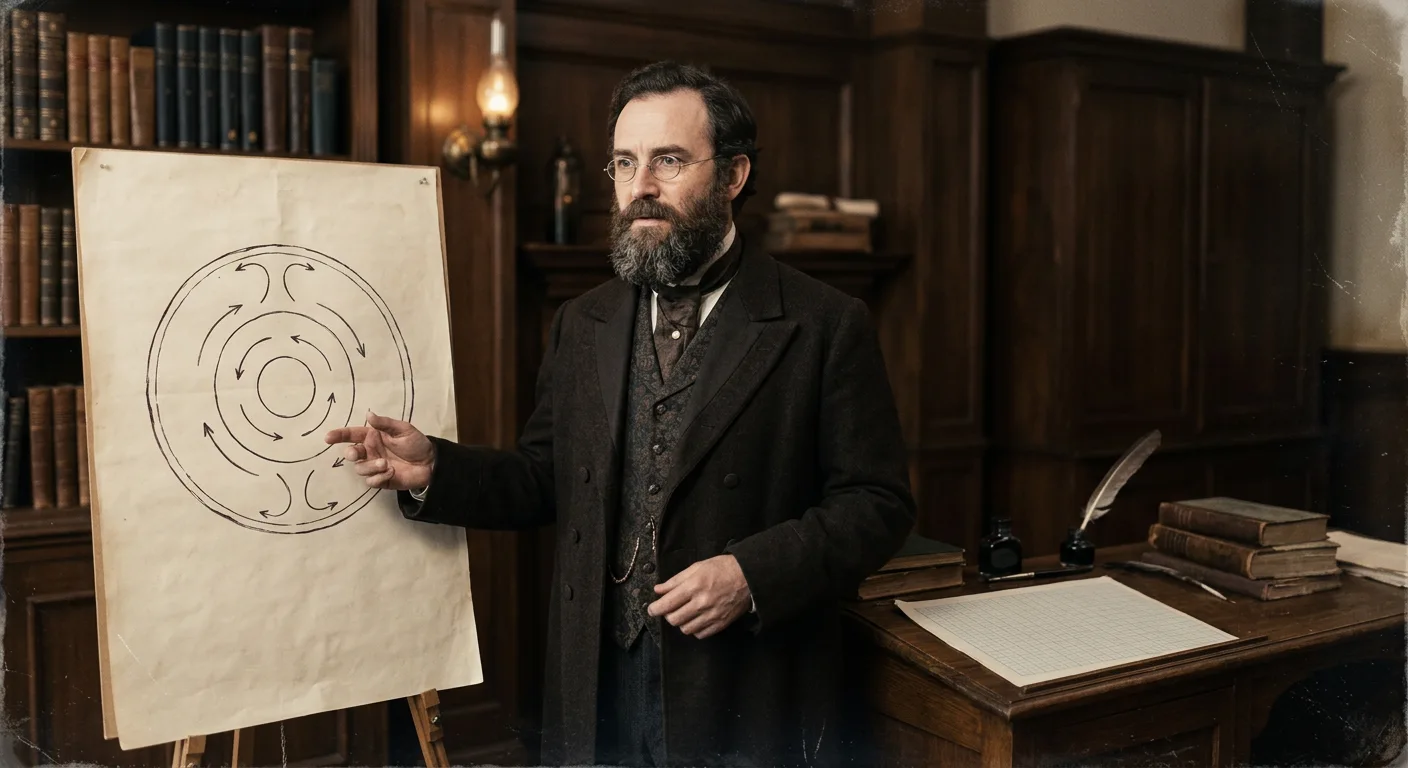
John Perry
1850–1920 · Engineering and physics
Irish engineer John Perry challenged Kelvin's cooling age of Earth, arguing that heat transfer within Earth's interior could change the calculation, before radioactivity.
Why is this scientist famous?
Challenged Kelvin's cooling-based age of Earth by arguing that heat transfer within Earth's interior could change the calculation, years before radioactivity was discovered.
Perry's neglected challenge helped clarify why Kelvin's cooling model could not securely set Earth's age. His practical approach also influenced engineering and mathematics education.
John's story
From foundry to university
John Perry was born on 14 February 1850 in Garvagh, County Londonderry, Ireland. He apprenticed at Belfast's Lagan Foundry while studying engineering at Queen's College, Belfast. He gained a first-class engineering degree and a gold medal in 1870, and received a Whitworth scholarship the same year. His sister helped read textbooks to him when overwork caused severe eyestrain. He taught mathematics and physics at Clifton College before holding university posts.
Working with Kelvin and teaching in Japan
In 1874 Perry became an assistant to William Thomson, later Lord Kelvin, at Glasgow. From 1875 to 1879 he taught engineering in Tokyo alongside William Edward Ayrton. Perry and Ayrton promoted squared paper for teaching and recording measurements, and they worked together on electrical measurement instruments. Perry later taught at Finsbury Technical College and became professor of mathematics and mechanics at London's Royal College of Science in 1896. He was elected a Fellow of the Royal Society in 1885.
Challenging Kelvin's age of Earth
Kelvin had estimated Earth's age from how quickly a cooling body should lose heat. In writings of 1894 and 1895, Perry challenged a key assumption in that calculation. He argued that movement of material within Earth's interior — convection, the same process that carries heat in a pot of boiling water — could transfer heat and change what the observed surface temperature tells us about the planet's age. This argument came before the discovery of radioactivity. Perry did not use radioactive dating and did not calculate the modern 4.54-billion-year result. His contribution was to question the cooling model's assumptions.
Practical mathematics and legacy
Perry promoted practical teaching of mathematics, including graphs and squared paper, and argued for making mathematics useful to engineers through practical examples. He had once assisted Kelvin before challenging an assumption in Kelvin's Earth-age calculation. His criticism preceded the discovery of radioactivity and was largely neglected at the time, but it helped clarify why Kelvin's cooling model could not securely set Earth's age. He died in London on 4 August 1920.
What did they discover?
Challenge to Kelvin's cooling age of Earth
Perry argued that convection within Earth's interior could transfer heat, invalidating a key assumption in Kelvin's estimate of Earth's age from cooling.
Practical mathematics education
Perry promoted graphs, squared paper and practical examples in mathematics teaching, arguing for making mathematics useful to engineers.
Electrical measurement instruments
Perry and Ayrton worked together on electrical measurement instruments and teaching methods in Tokyo and London.
Amazing facts
He trained in a working foundry while studying engineering.
His sister helped read textbooks to him when overwork caused severe eyestrain.
He taught mathematics and physics at a school before holding university posts.
He taught engineering in Japan for four years.
Perry and Ayrton promoted squared paper for teaching and recording measurements.
He argued for making mathematics useful to engineers through practical examples.
He had once assisted Kelvin before challenging an assumption in Kelvin's Earth-age calculation.
His criticism preceded the discovery of radioactivity.
Timeline
Born in Garvagh, County Londonderry
Gained a first-class engineering degree and gold medal, and received a Whitworth scholarship
Became an assistant to William Thomson (Lord Kelvin) at Glasgow
Taught engineering in Tokyo with William Edward Ayrton
Appointed at Finsbury Technical College
Elected Fellow of the Royal Society
Published his challenge to Kelvin's age-of-Earth calculation
Became professor of mathematics and mechanics at the Royal College of Science, London
Died in London
Awards & honours
Related Super Scientists

James Hutton
1726–1797 · Geology
Helped establish the concept of deep time — that Earth's geological history extends far beyond ordinary human experience.
Arthur Holmes
1890–1965 · Geology
Pioneered the use of radiometric dating of minerals to build an early numerical geological timescale, and proposed that mantle movement could help explain continental drift.