_(2).jpg)
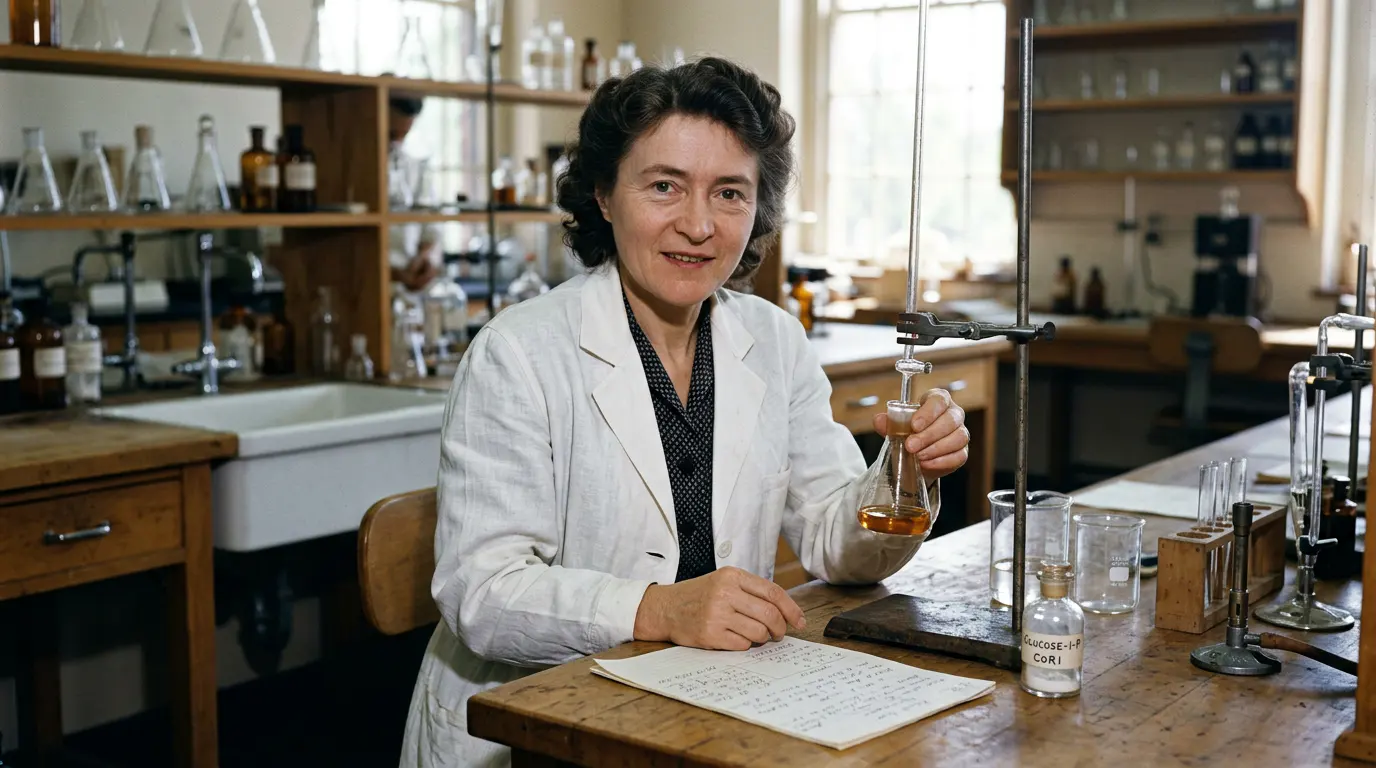
Gerty Theresa Cori
1896–1957 · Biochemistry and carbohydrate metabolism
Biochemist Gerty Cori helped reveal how the body stores and releases glucose through glycogen metabolism, work recognised by the 1947 Nobel Prize.
Why is this scientist famous?
With Carl Cori, explained key steps in how the body stores and releases glucose through glycogen metabolism, including the Cori cycle.
Understanding glycogen metabolism is fundamental to biochemistry, exercise physiology and metabolic disease, and the Coris’ work helped establish modern enzyme research.
Gerty's story
From Prague medical student to research scientist
Gerty Theresa Radnitz was born in Prague on 15 August 1896, when the city was part of Austria-Hungary. At sixteen she decided she wanted to study medicine and had to make up subjects that had not been available in her earlier schooling. She entered the German University in Prague in 1914, where she met Carl Cori. They both received medical degrees in 1920, married that year and began a scientific partnership that would continue for decades.
A partnership studying sugar
After early medical work in Vienna, Gerty Cori moved to the United States in 1922 and joined Carl at the New York State Institute for the Study of Malignant Diseases in Buffalo. They became U.S. citizens in 1928. Their research increasingly focused on how the body uses carbohydrates. In 1931 Carl moved to Washington University School of Medicine in St Louis, while Gerty was initially given a much lower-ranked and poorly paid research position despite their shared scientific programme.
Following glycogen through the body
The Coris traced how glycogen, the body’s stored form of glucose, is broken down and rebuilt. Their work helped explain the cycle linking glycogen in muscle, lactic acid and glucose produced by the liver, now known as the Cori cycle. They also discovered glucose-1-phosphate, sometimes called the Cori ester, and identified enzymes involved in glycogen metabolism. These discoveries helped turn carbohydrate metabolism into a detailed biochemical pathway rather than a vague description of energy use.
Nobel recognition and work through illness
Gerty Cori became a professor of biological chemistry at Washington University in 1947. Later that year she and Carl Cori shared half of the Nobel Prize in Physiology or Medicine for discovering the course of the catalytic conversion of glycogen; Bernardo Houssay received the other half of the prize. Cori continued investigating enzymes and metabolic diseases even after developing myelofibrosis. She remained scientifically active until shortly before her death on 26 October 1957.
What did they discover?
The Cori cycle
Gerty and Carl Cori clarified how lactate produced by muscle can be converted in the liver and returned to the body as glucose, linking tissues in carbohydrate metabolism.
Glucose-1-phosphate
The Coris discovered glucose-1-phosphate, an important intermediate in the biochemical breakdown and formation of glycogen.
Enzymes of glycogen metabolism
Their laboratory isolated and studied enzymes involved in glycogen breakdown and synthesis, helping establish how metabolic pathways are controlled.
Amazing facts
At sixteen she decided to become a doctor and had to rapidly study subjects such as Latin, mathematics, physics and chemistry to qualify for medical school.
She met her future husband and scientific collaborator Carl Cori while they were medical students in Prague.
The Coris became naturalised United States citizens in 1928.
At Washington University she initially received a much lower salary and rank than Carl despite working on the same research programme.
Glucose-1-phosphate became known as the Cori ester in recognition of the Coris’ work.
In 1947 she became the first woman to receive the Nobel Prize in Physiology or Medicine.
She published close to 150 scientific papers during her career.
She continued laboratory research for years after developing myelofibrosis, a serious disease of the bone marrow.
Timeline
Born in Prague, then part of Austria-Hungary.
Enters medical school at the German University in Prague.
Receives a medical degree and marries fellow researcher Carl Cori.
Moves to the United States and begins research in Buffalo, New York.
Becomes a naturalised United States citizen.
Moves to Washington University School of Medicine in St Louis.
The Coris discover glucose-1-phosphate, an important intermediate in glycogen metabolism.
Becomes a professor and shares the Nobel Prize in Physiology or Medicine with Carl Cori.
Receives the Garvan Medal of the American Chemical Society.
Dies after continuing research through a long illness.
Awards & honours
Related Super Scientists
Marie Maynard Daly
1921–2003 · Biochemistry, proteins and cardiovascular research
Marie Maynard Daly became the first Black woman in the United States to earn a chemistry doctorate and made important discoveries about proteins, cells and heart disease.
Gertrude Belle Elion
1918–1999 · Pharmacology and medicinal chemistry
Helped pioneer rational drug design and developed important medicines for leukemia, organ transplantation, gout and viral infections.
Linus Pauling
1901–1994 · Chemist
Transforming understanding of chemical bonding and molecular structure, major work on protein structure, and winning both the 1954 Nobel Prize in Chemistry and the 1962 Nobel Peace Prize.