_(2).jpg)
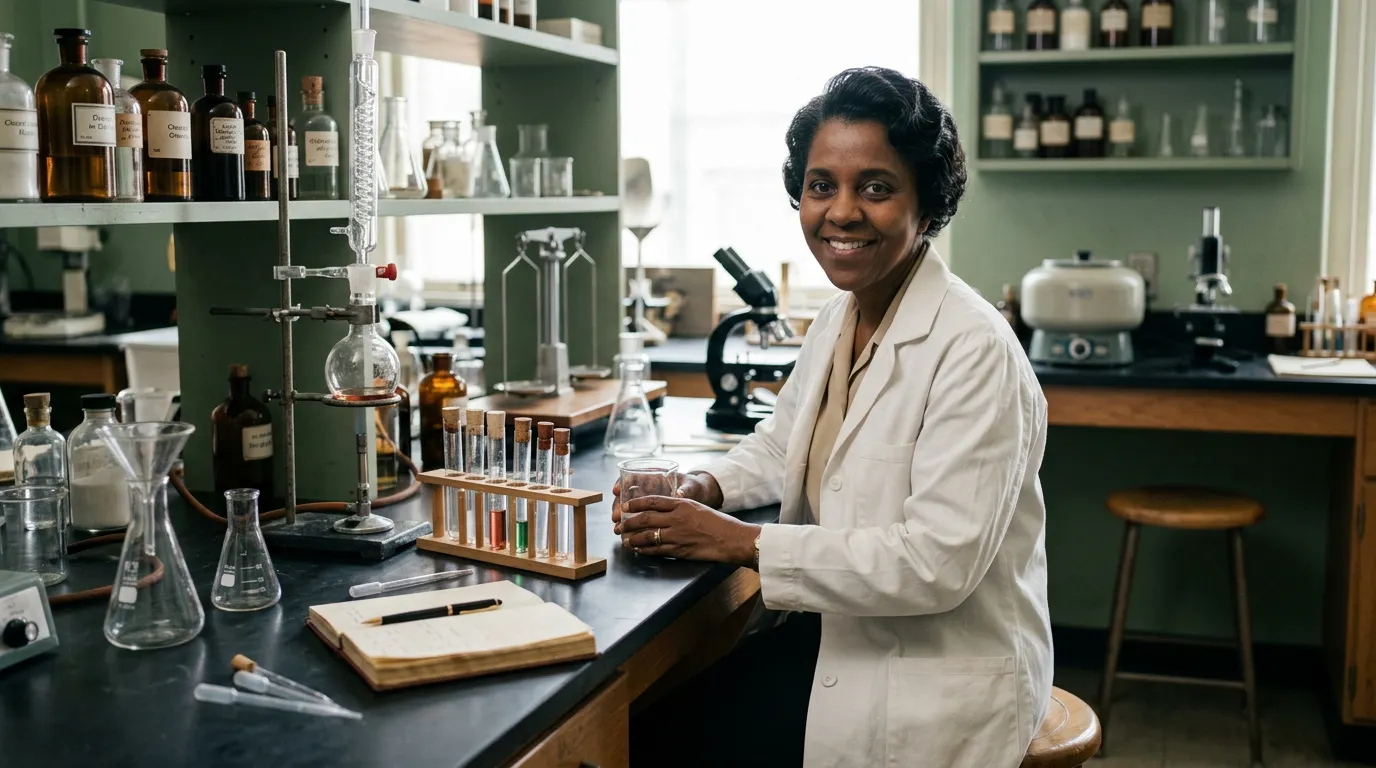
Marie Maynard Daly
1921–2003 · Biochemistry, proteins and cardiovascular research
Marie Maynard Daly investigated proteins and cholesterol, helping reveal how chemistry inside cells relates to disease and the health of blood vessels.
“"In those days, it was common for a woman to be addressed as 'Miss' even though she had earned a Ph.D. degree."”
Why is this scientist famous?
Marie Maynard Daly became the first Black woman in the United States to earn a chemistry doctorate and made important discoveries about proteins, cells and heart disease.
Research on proteins, RNA, diet and cholesterol helps scientists investigate disease and explain the chemistry of living cells.
Marie's story
A chemist from Queens
Marie Maynard Daly was born on 16 April 1921 and grew up in Queens, New York City. Her father, Ivan Daly, had hoped to study chemistry but could not afford to finish university; his interest in the subject helped inspire her. Daly studied chemistry at Queens College and graduated in 1942, then earned a master’s degree at New York University in 1943. At Columbia University she investigated how the enzyme pancreatic amylase breaks down starch, working under chemist Mary Letitia Caldwell. In 1947 she became the first Black American woman to earn a doctorate in chemistry in the United States.
What is happening inside a cell?
After her doctorate, Daly taught at Howard University before receiving support from the American Cancer Society for further research. At the Rockefeller Institute she worked with Alfred Mirsky and other scientists investigating substances found inside cells. She studied histones, the proteins associated with DNA, and collaborated on research into the chemistry of the cell nucleus. With Vincent Allfrey and Mirsky, she contributed to a 1953 study connecting ribonucleic acid, or RNA, with the production of proteins. These studies helped researchers understand how cells organise and use the materials needed for life.
From molecules to heart disease
Daly later worked at Columbia University’s medical school and researched the chemicals involved in blood vessels and heart health. With physician-researcher Quentin Deming and others, she investigated how cholesterol, diet and high blood pressure affect the circulatory system. Their experiments provided evidence linking chemical changes in blood vessels to conditions that raise the risk of heart disease. Her work did not show that all heart attacks have one simple cause; it helped reveal the many biological factors researchers needed to study. Daly was interested in the bridge between chemistry observed in a laboratory and problems faced by patients.
Building a career despite barriers
In 1960 Daly moved with colleagues to the Albert Einstein College of Medicine in New York. She became an associate professor there in 1971 and continued conducting research and teaching. As a Black woman scientist, she had worked in institutions where racism and sexism could limit opportunities and recognition. Daly also supported students from groups historically excluded from science and helped encourage access to medical and graduate study. She retired from Einstein in 1986 after decades of laboratory and classroom work.
A legacy beyond the laboratory
In 1988 Daly established a scholarship at Queens College in memory of her father, helping students pursue scientific education. Her career has since been recognised by institutions that study the history of chemistry. In 2023 the American Chemical Society designated her achievements a National Historic Chemical Landmark at Columbia University. Daly died on 28 October 2003, but the questions she investigated remain central to biochemistry and medical research. Her story shows how careful experiments about tiny molecules can help answer questions affecting millions of people.
What did they discover?
Historic doctorate in chemistry
Daly became the first Black American woman to earn a PhD in chemistry in the United States in 1947, after researching the breakdown of starch by an enzyme.
Proteins, histones and RNA
She collaborated on studies of nuclear proteins and the role of RNA in protein production, helping strengthen the emerging picture of how cells operate.
Cholesterol and blood vessels
Her collaborative research explored how cholesterol and high blood pressure are connected to changes in blood vessels and cardiovascular disease.
Scientific opportunity for students
Her mentoring and the scholarship she established at Queens College helped widen access to science education.
Amazing facts
Her father, Ivan Daly, left chemistry studies at Cornell University because his family could not afford to keep him there.
She graduated magna cum laude from Queens College, an academic honour recognising her excellent undergraduate results.
Her doctoral supervisor, Mary Letitia Caldwell, was Columbia University’s only woman chemistry professor at that time.
Her thesis focused on pancreatic amylase, a digestive enzyme that breaks starch into smaller sugars.
Histones, among the proteins she studied, help package long strands of DNA inside the nucleus of a cell.
Her 1953 paper with Vincent Allfrey and Alfred Mirsky was later cited in James Watson’s Nobel Prize lecture.
She began a scholarship in 1988 at Queens College in memory of her father and his interrupted scientific education.
In 2023 the American Chemical Society honoured her career with a National Historic Chemical Landmark at Columbia University.
Timeline
Born in Queens, New York City, United States.
Earned her chemistry bachelor’s degree from Queens College.
Completed a master’s degree in chemistry at New York University.
Earned a chemistry doctorate at Columbia University, a historic first for a Black American woman.
Received American Cancer Society fellowship support for research at the Rockefeller Institute.
Co-authored research on RNA and protein production with Vincent Allfrey and Alfred Mirsky.
Joined the Albert Einstein College of Medicine with colleagues.
Became an associate professor at Albert Einstein College of Medicine.
Retired from Albert Einstein College of Medicine.
Founded a scholarship at Queens College in memory of her father.
Died in New York City.
Related Super Scientists
Mary-Claire King
1946–present · Human genetics and cancer genetics
Mary-Claire King mapped the inherited breast-cancer susceptibility region later named BRCA1 and used genetics to help reunite separated families.
Alice Hamilton
1869–1970 · Occupational medicine and public health
Alice Hamilton investigated dangerous chemicals in American workplaces and helped establish occupational medicine in the United States.