_(2).jpg)
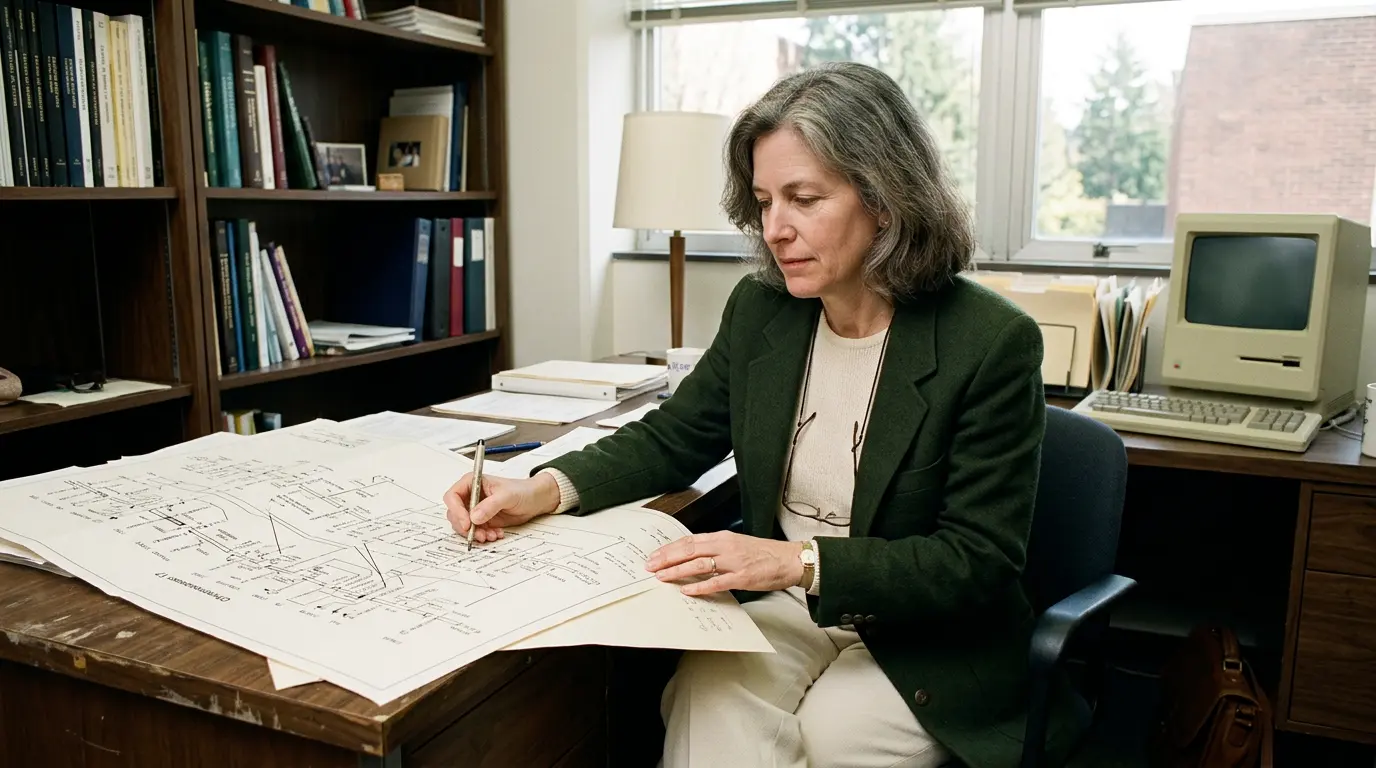
Mary-Claire King
1946–present · Human genetics and cancer genetics
Mary-Claire King showed that inherited changes can raise breast-cancer risk in some families and used DNA evidence to help reunite missing children with relatives.
“Science is fun. Genetics is enormous fun.”
Why is this scientist famous?
Mary-Claire King mapped the inherited breast-cancer susceptibility region later named BRCA1 and used genetics to help reunite separated families.
Genetic counselling, inherited-cancer risk assessment and investigations to identify missing people have all benefited from work she pioneered.
Mary-Claire's story
A mathematician finds genetics
Mary-Claire King was born in 1946 and grew up near Chicago in the United States. She studied mathematics at Carleton College, then moved to the University of California, Berkeley for graduate research. At Berkeley she worked with the evolutionary biologist Allan Wilson and earned a doctorate in genetics in 1973. Mathematics became one of her most powerful scientific tools: she used patterns in data to answer biological questions. With Wilson, she helped demonstrate how closely related the protein-coding sequences of humans and chimpanzees are.
Could cancer run in families?
Some families seemed to have many relatives affected by breast cancer, but researchers needed evidence that inherited changes could explain part of the pattern. King began studying that question in the 1970s, using family histories and careful statistical reasoning. By analysing large numbers of families, her team found evidence for a major inherited factor in some cases. In 1990 King and colleagues mapped a region on chromosome 17 linked to early-onset breast cancer in particular families. The suspected gene became known as BRCA1, but mapping its location was not the same as isolating the gene itself, which other researchers accomplished later.
What the discovery changed
A harmful inherited change in BRCA1 can greatly increase the risk of certain cancers, especially breast and ovarian cancer. It does not mean that everyone carrying such a change will develop cancer. The mapping work helped open the way to identifying particular gene variants and offering genetic counselling and testing to people with strong family histories. These medical advances grew out of work by many teams, not one person alone. King continued researching the genetics of cancers and other serious conditions.
DNA helps families find answers
King also used genetic methods to help investigate human rights abuses. In Argentina, children had been taken from families during the military dictatorship, leaving relatives searching for evidence of who they were. Working with others, she helped develop ways to compare inherited biological information between children and possible relatives. She later used mitochondrial DNA, passed along maternal lines, to support identification when ordinary documents were missing. Related approaches have helped identify human remains and answer difficult questions for families.
A scientist with several missions
King taught at the University of California, Berkeley before joining the University of Washington in 1995. Her research has also explored inherited hearing loss, neurological conditions and other human genetic disorders. She received the Lasker–Koshland Special Achievement Award in Medical Science in 2014 and was presented with the 2014 United States National Medal of Science in 2016. Her work shows that genetics can help solve both medical and humanitarian problems. She also demonstrates how a useful scientific question may take many years and many collaborators to answer.
What did they discover?
Mapping a breast-cancer susceptibility region
King and her collaborators showed that inherited risk for early-onset breast cancer in some families was linked to a region of chromosome 17, later associated with the BRCA1 gene.
Statistical study of inherited cancer risk
By studying family patterns and applying mathematical models, she helped establish that some breast cancers have a strong inherited component.
Human and chimpanzee genetic similarity
With Allan Wilson, she published research showing striking similarity in the protein-coding sequences of humans and chimpanzees, while discussing evolutionary differences.
Using genetics in human-rights investigations
She helped develop genetic approaches, including maternal-line DNA comparisons, that can link missing people or unidentified remains to their families.
Amazing facts
Her undergraduate degree was in mathematics, not medicine.
She studied human and chimpanzee genetics with evolutionary biologist Allan Wilson.
Her team investigated family histories involving more than 1,500 families in its search for inherited cancer risk.
The BRCA1 search took years before her team identified a linked region on chromosome 17 in 1990.
A gene can affect someone’s chance of developing a disease without making the disease inevitable.
Mitochondrial DNA can help trace biological relationships through a person’s maternal line.
King’s human-rights research included ways of extracting genetic evidence from teeth.
Her research at the University of Washington also investigates the causes of inherited hearing loss.
Timeline
Born in the United States and grew up near Chicago.
Earned a bachelor’s degree in mathematics from Carleton College.
Completed a doctorate in genetics at the University of California, Berkeley.
Published research with Allan Wilson on human and chimpanzee evolutionary genetics.
Published evidence supporting inherited risk of breast cancer in some families.
With collaborators, mapped a breast-cancer susceptibility region on chromosome 17.
Joined the faculty of the University of Washington.
Was elected to the United States National Academy of Sciences.
Received the Lasker–Koshland Special Achievement Award in Medical Science.
Was presented with the 2014 United States National Medal of Science by President Barack Obama.