_(2).jpg)
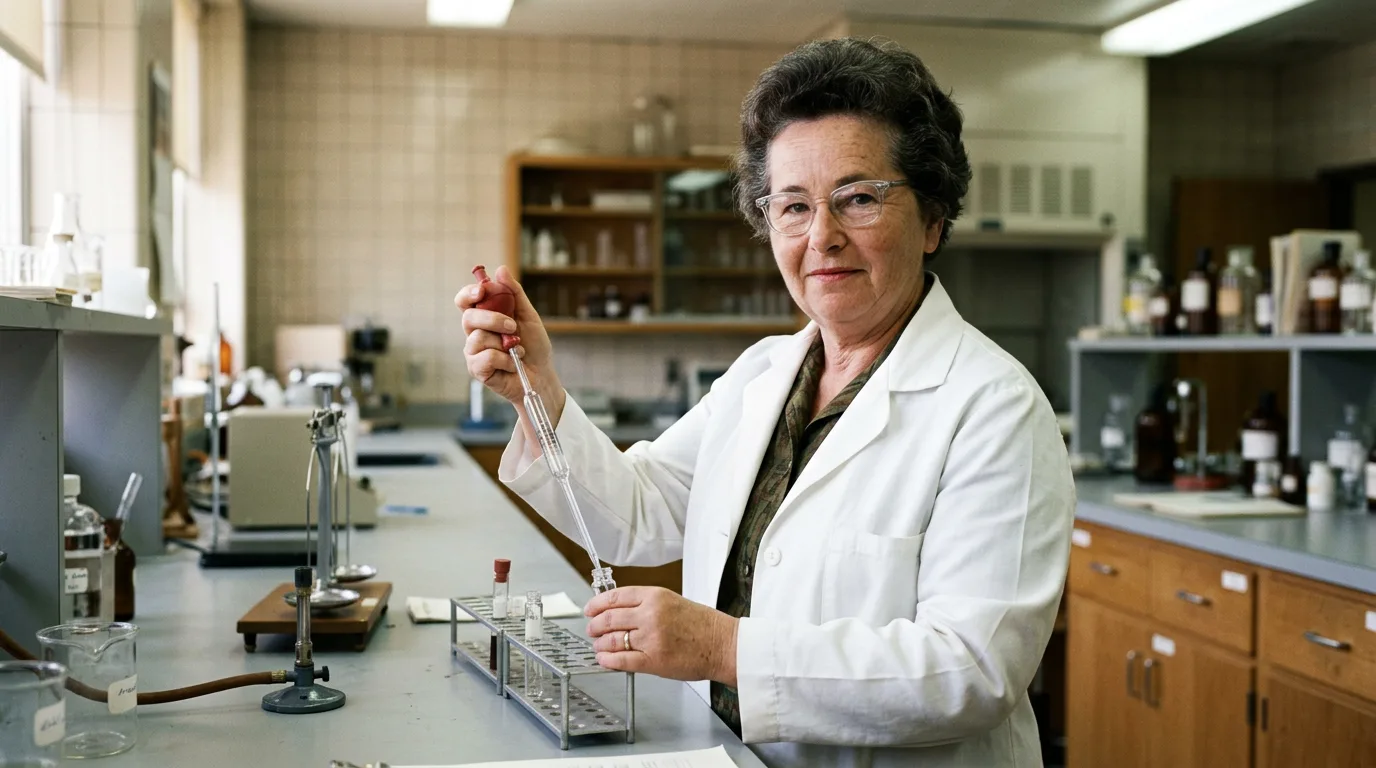
Gertrude Belle Elion
1918–1999 · Pharmacology and medicinal chemistry
Gertrude Elion helped pioneer rational drug design and developed medicines for leukemia, transplant rejection, gout and viral infections.
“In my day I was told women didn’t go into chemistry. I saw no reason why we couldn’t.”
Why is this scientist famous?
Helped pioneer rational drug design and developed important medicines for leukemia, organ transplantation, gout and viral infections.
Her targeted approach to drug development helped shape modern medicinal chemistry and produced treatments whose descendants remain important in cancer, transplantation and antiviral medicine.
Gertrude's story
A chemist determined to do useful research
Gertrude Belle Elion was born in New York City on 23 January 1918. When she was fifteen, her grandfather died from stomach cancer, an experience that strengthened her determination to study science and seek better treatments for disease. She entered Hunter College in 1933 and graduated in 1937 with a degree in chemistry. During the Depression, research jobs and financial support for graduate study were especially difficult for women to obtain, so she worked in several temporary and teaching roles while continuing her education.
Graduate study and Burroughs Wellcome
Elion began graduate work at New York University in 1939 and earned a master’s degree in chemistry in 1941 while teaching science. In 1944 she joined Burroughs Wellcome and became an assistant to biochemist George Hitchings. Instead of relying mainly on trial and error, their programme compared the chemistry of normal cells with cancer cells and disease-causing organisms. They focused particularly on purines, molecules related to the building blocks used in DNA and other essential cell processes.
Designing drugs to interrupt disease
Elion and Hitchings used this knowledge to develop compounds that could interfere with crucial chemical pathways. One of Elion’s major early successes was 6-mercaptopurine, or 6-MP, which helped put children with acute leukemia into remission and became an important part of combination treatment. Further work led to azathioprine, an immunosuppressive drug that helped prevent rejection of transplanted organs, and allopurinol for gout. Elion and her colleagues later developed the antiviral drug acyclovir, showing that antiviral medicines could selectively attack virus-related processes without simply poisoning all cells.
A Nobel Prize for principles of drug treatment
In 1967 Elion became head of Burroughs Wellcome’s Department of Experimental Therapy and continued leading research until her retirement in 1983. She remained active afterwards as a scientist emeritus and consultant and also taught and conducted research at Duke University. In 1988 she shared the Nobel Prize in Physiology or Medicine with George Hitchings and James W. Black for discoveries of important principles for drug treatment. She received the National Medal of Science in 1991, became the first woman inducted into the National Inventors Hall of Fame that year, and continued encouraging young scientists until her death in 1999.
What did they discover?
Rational drug design
Elion and Hitchings helped pioneer a more systematic way to develop medicines by exploiting biochemical differences between normal human cells and disease-causing cells or organisms.
6-mercaptopurine for leukemia
Elion developed 6-mercaptopurine, a purine analogue that became an important treatment for acute leukemia and helped establish new approaches to combination chemotherapy.
Azathioprine and transplantation
Work on a derivative of 6-mercaptopurine produced azathioprine, an immunosuppressive medicine that helped make organ transplantation from unrelated donors more practical.
Acyclovir and antiviral therapy
Elion’s later research helped produce acyclovir, a selective antiviral drug that transformed treatment of herpesvirus infections and demonstrated that effective antiviral chemotherapy was possible.
Amazing facts
She entered Hunter College at age fifteen and graduated four years later with a chemistry degree.
She earned her master’s degree at New York University while teaching chemistry, physics and general science in New York schools.
She did not complete a PhD because continuing her research with George Hitchings mattered more to her than leaving the laboratory for full-time doctoral study.
Her research ranged across chemistry, biochemistry, pharmacology, immunology and virology rather than staying inside one scientific speciality.
She published about 225 scientific papers during her career.
She was named on more than 45 patents connected with medicines and drug-development research.
In 1991 she became the first woman inducted into the National Inventors Hall of Fame.
She received the 1991 National Medal of Science for research that advanced both chemistry and medicine.
Timeline
Born in New York City, United States.
Graduates from Hunter College with a degree in chemistry.
Earns a master’s degree in chemistry from New York University.
Joins Burroughs Wellcome and begins working with George Hitchings.
Develops 6-mercaptopurine, a major early success in leukemia drug research.
Becomes head of Burroughs Wellcome’s Department of Experimental Therapy.
Retires from department leadership and continues as a scientist emeritus and consultant.
Shares the Nobel Prize in Physiology or Medicine with George Hitchings and James W. Black.
Receives the National Medal of Science and is inducted into the National Inventors Hall of Fame.
Dies in the United States.