Fritz London
1900–1954 · Quantum chemistry, molecular forces and superconductivity
Fritz London helped explain covalent bonding with quantum mechanics in 1927 and later advanced the physics of molecular forces and superconductors.
“where quantum mechanics would directly reach into the macroscopic world.”
Why is this scientist famous?
Fritz London co-developed the first influential quantum explanation of a covalent bond with Walter Heitler in 1927 and later made major contributions to molecular forces and superconductivity.
London’s ideas underpin quantum accounts of chemical bonds and dispersion forces, as well as technologies that rely on superconductivity and extremely cold matter.
Fritz's story
From philosophy to the new physics
Fritz Wolfgang London was born on 7 March 1900 in Breslau, Germany, a city now called Wrocław in Poland. He grew up in an academic family and studied mathematics and philosophy in German universities. In 1921 he completed an early doctorate at Munich. But a revolution was taking place in physics, as scientists developed quantum mechanics to explain atoms. London turned towards this new subject and worked in the scientific circles of Max Born, Arnold Sommerfeld and Erwin Schrödinger. His broad interests would help him see connections between chemistry, atomic physics and the behaviour of matter at very low temperatures.
A hydrogen molecule gives up its secret
In Zürich in 1927, London and Walter Heitler investigated how two hydrogen atoms form a molecule. Chemists already had models of electron sharing, but a convincing explanation using quantum mechanics was still missing. Their paper showed how the wave-like behaviour of electrons and the quantum rules governing their exchange can produce a stable covalent bond in the hydrogen molecule. The work is usually called the Heitler–London approach. It was a joint achievement: London should no more be credited alone than Heitler. The breakthrough helped launch modern quantum chemistry, allowing researchers to connect the idea of shared electrons with mathematical descriptions of matter.
Even uncharged molecules can attract
London continued exploring interactions between atoms and molecules. Not every attraction involves ions with opposite charges, or a shared pair of electrons making a familiar chemical bond. Even electrically neutral atoms and molecules can attract because the distribution of their electrons fluctuates. London developed a quantum explanation of this weak attraction, now called London dispersion forces. These forces help explain why gases can become liquids and why non-polar molecules can stay close together. Although each interaction is usually weak, huge numbers of them can matter greatly in liquids, solids and biological materials.
Cold materials and a forced journey
In 1933 Nazi racial laws forced London to leave his University of Berlin post. He worked in Britain and France before emigrating to the United States in 1939 and joining Duke University. During the 1930s he also investigated superconductivity, the remarkable phenomenon in which some materials have no electrical resistance below a critical temperature. Working with his brother Heinz, he developed a theory expressed in the London equations, describing important electromagnetic behaviour of superconductors. His studies of extremely cold helium also helped develop explanations of superfluidity, when a liquid moves with extraordinarily little internal friction. These later achievements made his contributions important far beyond chemical bonding.
A remarkable legacy at Duke
At Duke University London taught advanced quantum chemistry and physics, and in 1949 held a joint appointment in both subjects. In 1953 he received the Lorentz Medal from the Royal Netherlands Academy of Sciences. He died in Durham, North Carolina, on 30 March 1954. A memorial lecture at Duke and an international prize now carry his name. His career began with questions about why hydrogen atoms bond and expanded to the way molecules attract and how materials behave when they become extraordinarily cold. All three fields still depend on quantum physics, the scientific language he helped bring into chemistry.
What did they discover?
Heitler–London theory (1927)
With Walter Heitler, provided a quantum-mechanical account of the covalent bond in the hydrogen molecule.
London dispersion forces
Developed the quantum explanation for weak attractions between neutral atoms and molecules due to fluctuating electron distributions.
London equations of superconductivity
With his brother Heinz, formulated equations describing the electromagnetic response of superconductors.
Superfluidity and quantum fluids
Made important theoretical contributions to understanding unusual behaviour of helium and other matter at very low temperatures.
Amazing facts
London was born in Breslau, a German city that is now Wrocław in Poland.
He completed a doctorate in Munich at only 21 before moving into the fast-changing field of quantum physics.
In 1927 he and Walter Heitler explained bonding in the hydrogen molecule using the new wave mechanics.
He developed the explanation of weak attractions between neutral atoms and molecules now named London dispersion forces.
In 1933 he lost his Berlin university position because of Nazi persecution and continued working abroad.
He collaborated with his brother Heinz on the London equations describing superconductivity.
He joined Duke University in the United States in 1939 and later taught in both chemistry and physics.
He received the Lorentz Medal in 1953 for outstanding contributions to theoretical physics.
Timeline
Born in Breslau, Germany, now Wrocław, Poland.
Completed his early doctorate at Munich.
Published with Walter Heitler a quantum explanation of the covalent bond in hydrogen.
Was developing his quantum account of the forces between neutral atoms and molecules.
Forced to leave his academic position in Berlin after Nazi persecution.
Published work with his brother Heinz on the electromagnetic theory of superconductors.
Emigrated to the United States and joined Duke University.
Received a joint university appointment in physics and chemistry at Duke.
Received the Lorentz Medal.
Died in Durham, North Carolina.
Awards & honours
Related Super Scientists
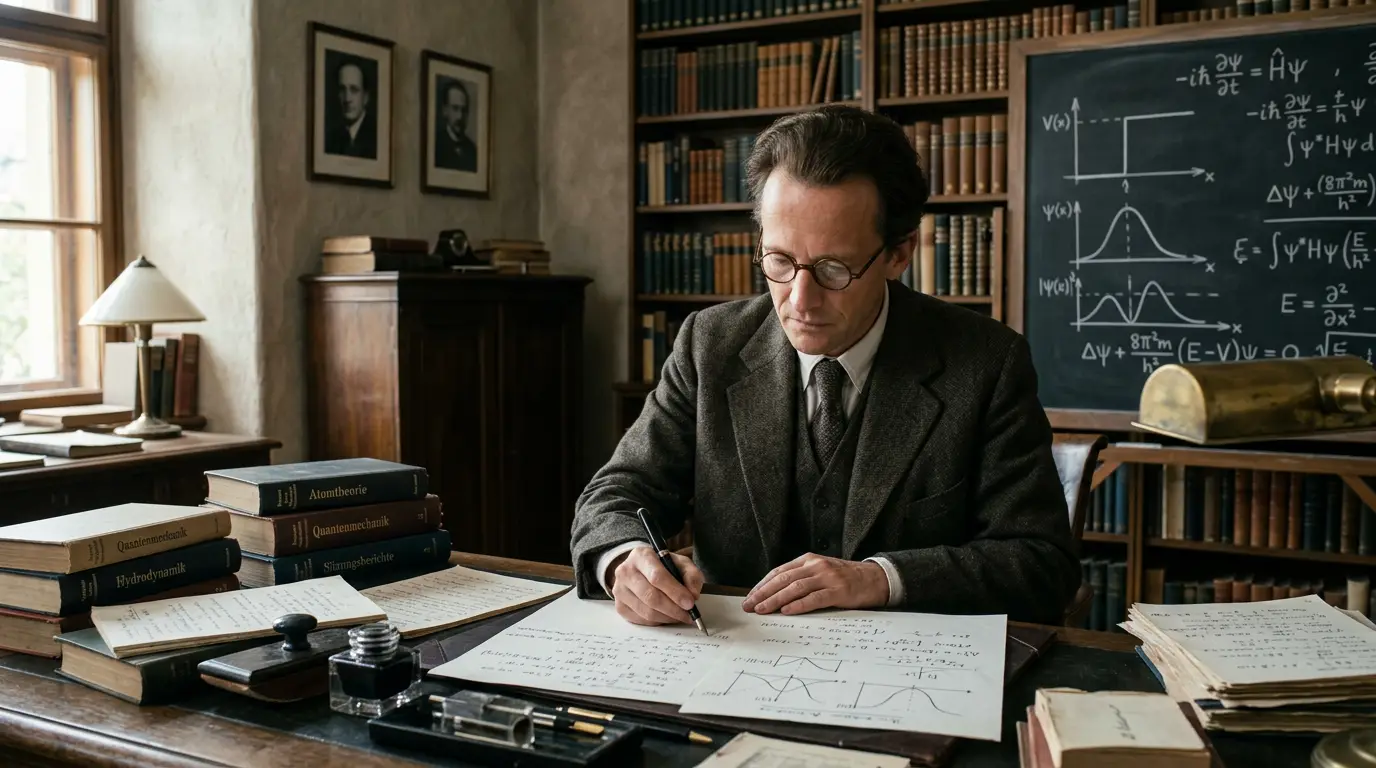
Erwin Schrödinger
1887–1961 · Theoretical Physicist
Developing wave mechanics and formulating the Schrödinger equation in 1926. He shared the 1933 Nobel Prize in Physics with Paul Dirac.

Max Born
1882–1970 · Theoretical Physicist
Making fundamental contributions to quantum mechanics, including the probabilistic interpretation of the wavefunction known as the Born rule, and helping develop matrix mechanics. He received the 1954 Nobel Prize in Physics.
Linus Pauling
1901–1994 · Chemist
Transforming understanding of chemical bonding and molecular structure, major work on protein structure, and winning both the 1954 Nobel Prize in Chemistry and the 1962 Nobel Peace Prize.