Wilhelm Conrad Röntgen
1845–1923 · Experimental physics and X-ray science
Wilhelm Conrad Röntgen discovered X-rays in 1895, revealing hidden bones and objects and opening the way to medical radiography and X-ray science.
Why is this scientist famous?
Röntgen discovered X-rays in November 1895 while investigating electrical discharges in glass tubes. He followed a mysterious fluorescent glow to a previously unknown, penetrating form of radiation and tested it with unusually careful experiments.
His discovery gave doctors a way to see bones and foreign objects inside the body without surgery. X-rays also became essential to later research into the structure of materials, while modern CT scanning uses X-ray measurements to build cross-sectional images.
Wilhelm's story
From the Netherlands to Zurich
Wilhelm Conrad Röntgen was born in Lennep in 1845 and grew up mainly in the Netherlands after his family moved to Apeldoorn. His education was not a simple march towards a physics professorship. Problems at an Utrecht technical school left him without the usual certificate needed for university examinations. He nevertheless studied at Utrecht as a non-examination student, then entered the Federal Polytechnic Institute in Zurich. He completed a mechanical-engineering diploma in 1868 and earned a doctorate from the University of Zurich in 1869. The practical training stayed with him: he became an exceptionally careful designer of experiments.
A physicist who trusted experiments
Röntgen worked with August Kundt and pursued research on gases, heat, pressure and the electrical properties of substances. His academic posts took him through Strasbourg and Giessen to Würzburg, where he became professor of physics in 1888. Colleagues knew him as someone who preferred patient measurements to dramatic claims. He was skilled at making and adjusting apparatus himself, a useful talent when electrical discharge tubes were difficult to control. By 1895, many physicists were studying cathode-ray effects in low-pressure discharge tubes. Their nature was still debated; scientists only later established that cathode rays consist of electrons.
The glow that should not have appeared
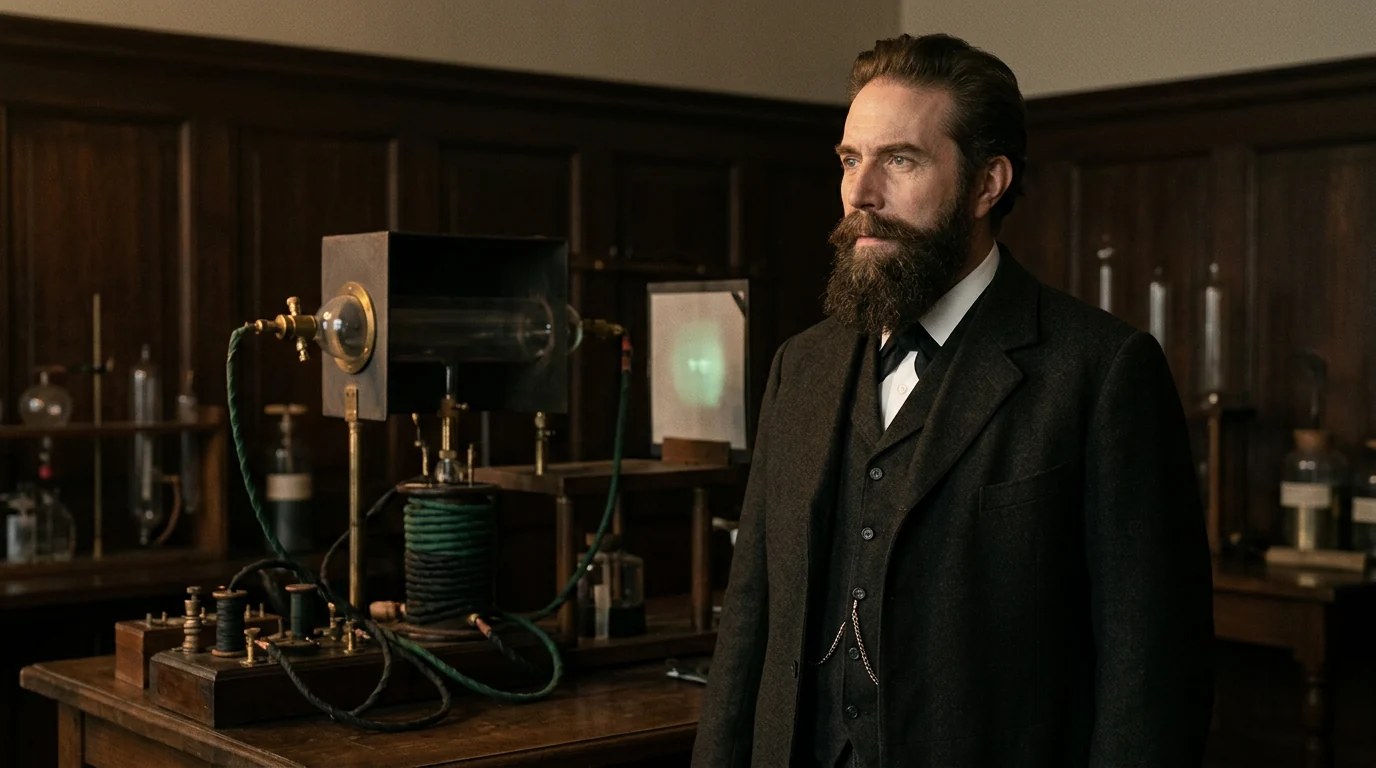
On 8 November 1895, Röntgen was working with a shielded discharge tube when he noticed a nearby screen coated with barium platinocyanide glowing. Light from the tube should not have reached it. Further tests showed that something invisible could travel through air and some solid materials, yet was more strongly stopped by dense objects. He called the unknown radiation X-rays. Today we understand that X-rays can be produced when fast electrons are abruptly slowed or deflected. Röntgen did not assume he knew the mechanism; he tested what the new rays could actually do.
A hand, a ring and worldwide astonishment
Röntgen discovered that photographic plates could record the different amounts of radiation passing through flesh and bone. In December 1895 he made the famous radiograph of his wife Anna Bertha’s hand, showing the bones and her ring. He submitted a paper on the new rays in late December, and copies of the images helped other scientists check his extraordinary claim. Doctors soon investigated how to locate broken bones and foreign objects. Early enthusiasts did not yet understand the full dangers of repeated radiation exposure, an important limitation of the first medical applications.
Fame without a patent
Röntgen moved to the University of Munich in 1900 and received the inaugural Nobel Prize in Physics in 1901. He chose not to patent the discovery, believing that scientific advances of this kind should be widely available. Röntgen remained personally reserved and enjoyed the outdoors, despite becoming internationally famous. He died in Munich in February 1923. Radiography and computed tomography still use X-rays, while other techniques, such as magnetic resonance imaging, rely on different physics; his direct legacy lies in the use of penetrating electromagnetic radiation.
What did they discover?
Discovery of X-rays
Identified a previously unknown type of penetrating radiation during experiments with discharge tubes in 1895.
Experimental characterisation
Showed that the rays caused fluorescence, affected photographic plates and penetrated materials differently depending on their properties.
First influential radiographs
Produced striking early images, including a hand whose bones and ring were visible, demonstrating the rays’ diagnostic possibilities.
Foundations of radiography
Published findings that enabled doctors and physicists worldwide to investigate X-ray imaging without waiting for a patented device.
Amazing facts
He entered Zurich’s Polytechnic despite not possessing the usual school-leaving qualification, after an unconventional route through education.
He originally earned a mechanical-engineering diploma before gaining his doctorate in physics.
He was so adept at apparatus-making that he often constructed or modified equipment himself.
The tell-tale glow came from a screen coated with barium platinocyanide, not from the covered glass tube itself.
The famous radiograph of Anna Bertha’s hand revealed her bones and the ring on her finger.
The letter X in “X-rays” reflected his uncertainty about the mysterious radiation’s nature.
He chose not to patent X-rays, even though the discovery became immediately valuable.
In 1888 he declined Utrecht University’s invitation to succeed Buys Ballot, remaining in Germany instead.
His rays were soon demonstrated in medical settings, but also appeared in commercial exhibitions and shops before their hazards were fully appreciated.
Timeline
Born in Lennep, Prussia.
Attended Utrecht as a non-examination student and subsequently entered Zurich Polytechnic.
Completed his engineering diploma in Zurich.
Received a doctorate from the University of Zurich.
Became professor of physics at Würzburg.
Discovered X-rays while experimenting with an electrical discharge tube.
Submitted his first scientific report describing the new rays.
Moved to the University of Munich.
Received the first Nobel Prize in Physics.
Died in Munich on 10 February.
Awards & honours
Related Super Scientists
Henri Becquerel
1852–1908 · Experimental physicist
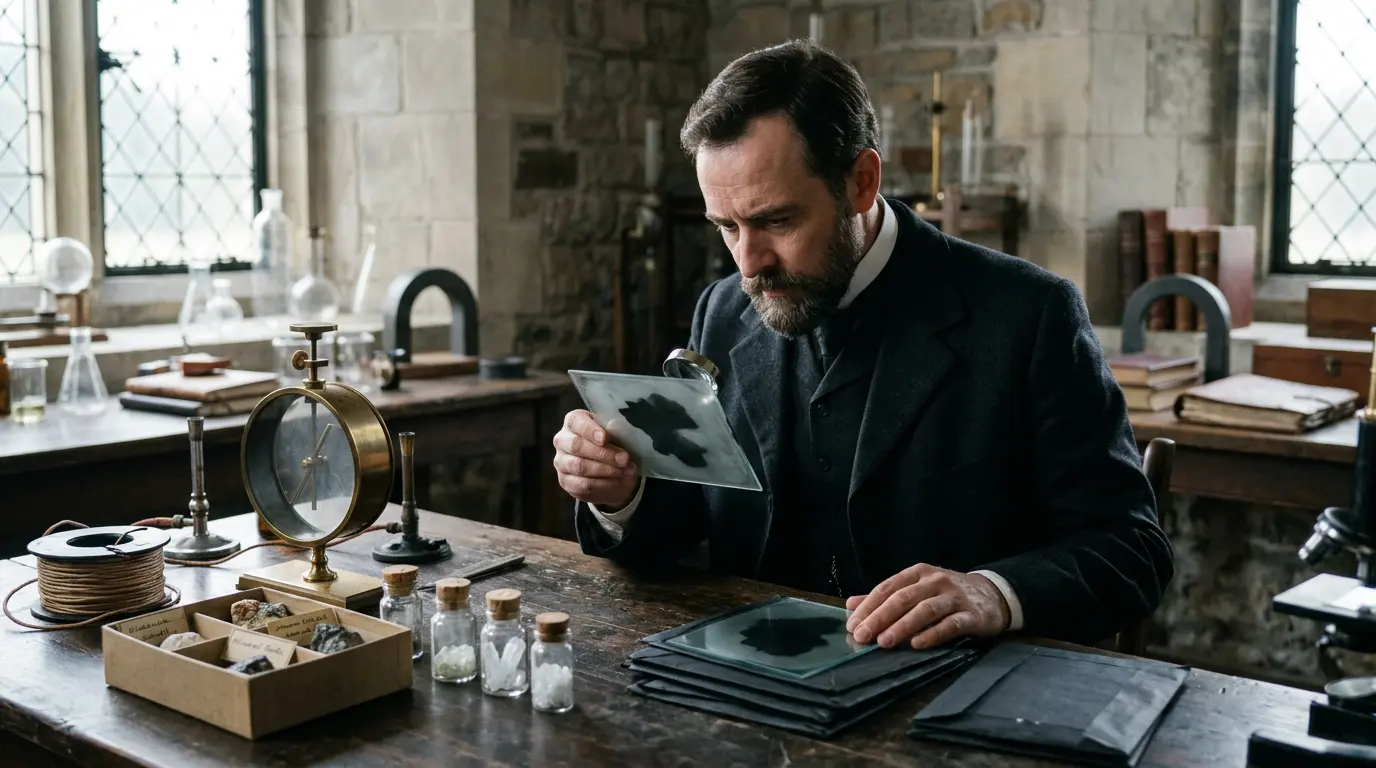
Henri Becquerel discovered that uranium emitted penetrating radiation spontaneously, providing the starting point for the scientific study of natural radioactivity.
J. J. Thomson
1856–1940 · Atomic physics, electricity and cathode-ray research
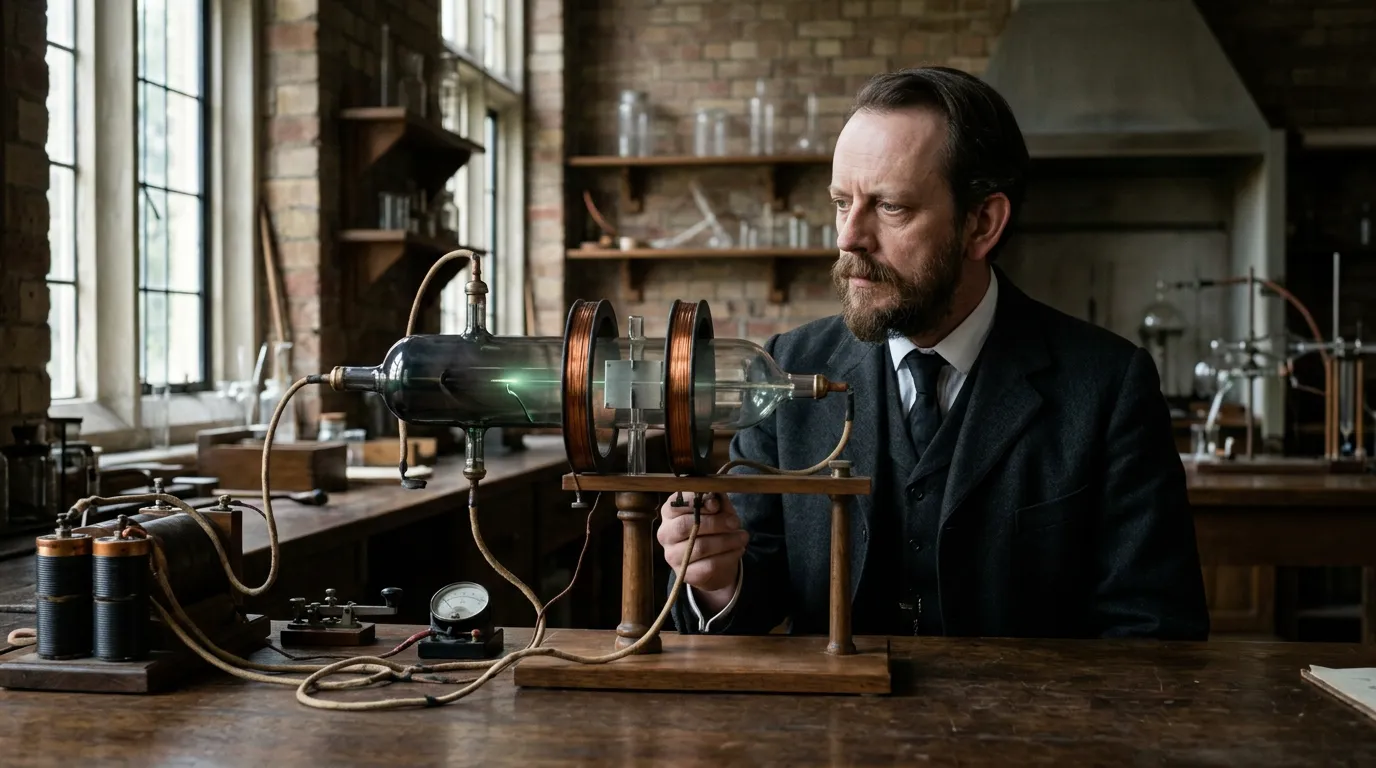
A British physicist who discovered the electron and led the Cavendish Laboratory at Cambridge.
Marie Curie
1867–1934 · Physicist & Chemist
Pioneering the study of radioactivity and discovering the elements polonium and radium with Pierre Curie.