Walther Kossel
1888–1956 · Atomic physics, ionic bonding and X-ray crystallography
Walther Kossel helped explain ionic bonding through electron transfer in 1916 and later studied X-ray interference patterns inside crystals.
Why is this scientist famous?
Walther Kossel developed an important electron-transfer account of ionic bonding in 1916 and later investigated distinctive X-ray patterns produced by crystals.
Kossel’s electron-transfer picture remains a starting point for understanding salts and charged ions, while Kossel lines contribute to modern X-ray studies of crystals.
Walther's story
A scientist growing up among scientific ideas
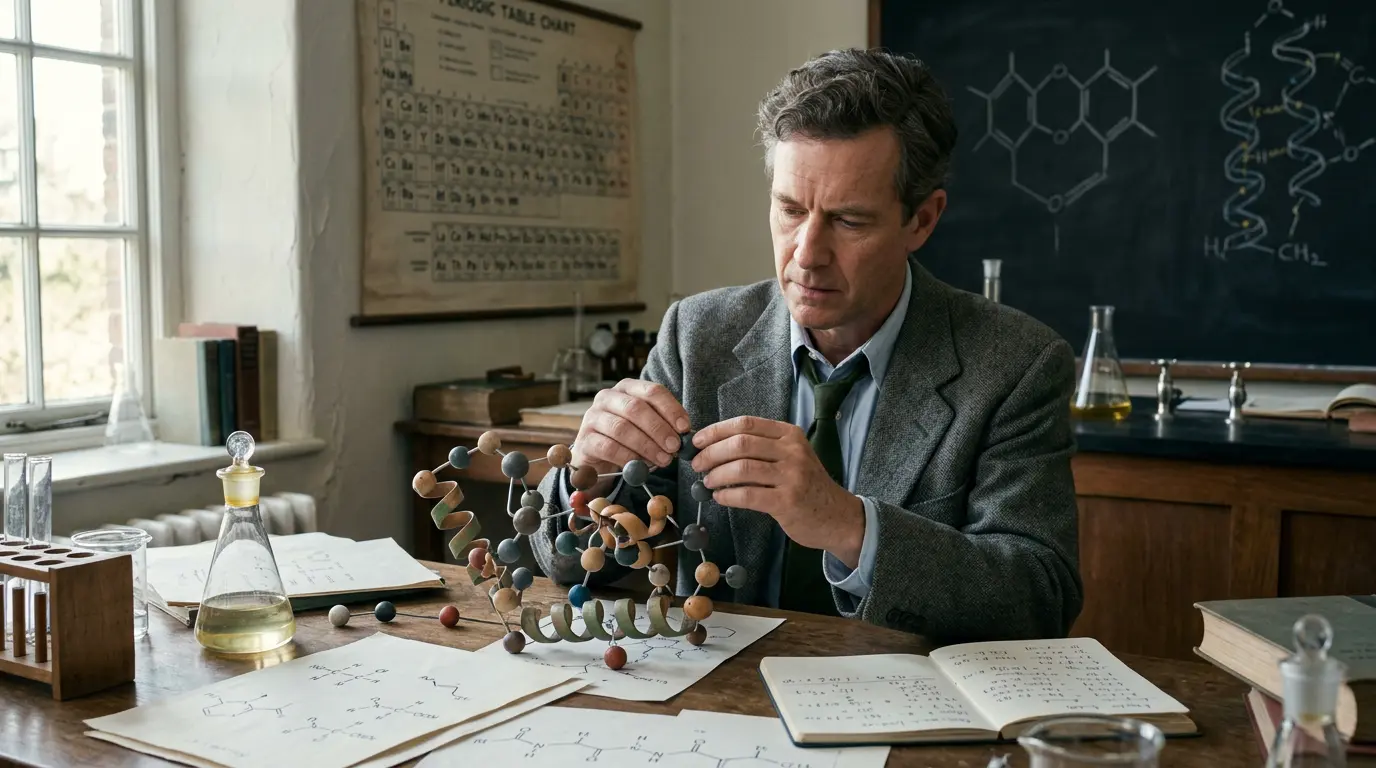
Walther Kossel was born in Berlin on 4 January 1888. His father, Albrecht Kossel, was a biochemist who later won the 1910 Nobel Prize in Physiology or Medicine for research on the chemistry of cell nuclei. Walther chose physics rather than following exactly the same path. He studied in Heidelberg and Berlin, and in 1911 completed his doctorate in physics at Heidelberg under Philipp Lenard. Later he worked in Munich in the scientific circle around Arnold Sommerfeld. This was a time when new discoveries about electrons and the internal structure of atoms were changing how physicists and chemists understood matter.
Why atoms form salts
By 1916 researchers knew that atoms contained negatively charged electrons, but chemists were still working out how those electrons help hold substances together. In his lengthy 1916 paper on molecule formation and atomic structure, Kossel described a model of ionic bonding. An atom that loses an electron becomes positively charged; one that gains an electron becomes negatively charged. Opposite electric charges attract, so the resulting ions can form a stable compound. Sodium chloride, ordinary table salt, gives a familiar example of this kind of attraction. Kossel also connected the behaviour of atoms to especially stable outer-electron arrangements. His account did not claim that all chemical bonds involve complete electron transfer.
A shared breakthrough, not a single inventor
In the same year, Gilbert Newton Lewis developed his important explanation of chemical bonds, including electron pairs shared between atoms. The two scientists made overlapping but different contributions to the emerging picture of valence, the ways in which atoms combine. Kossel is especially associated with the electron-transfer, or ionic, model. Lewis’s shared-electron idea helped explain covalent bonding, which an ionic model alone could not explain. Later work by Irving Langmuir and quantum physicists refined these pictures further. Kossel’s achievement belongs in this wider scientific conversation rather than in a story about one person discovering every kind of chemical bond.
From electrons in atoms to X-rays in crystals
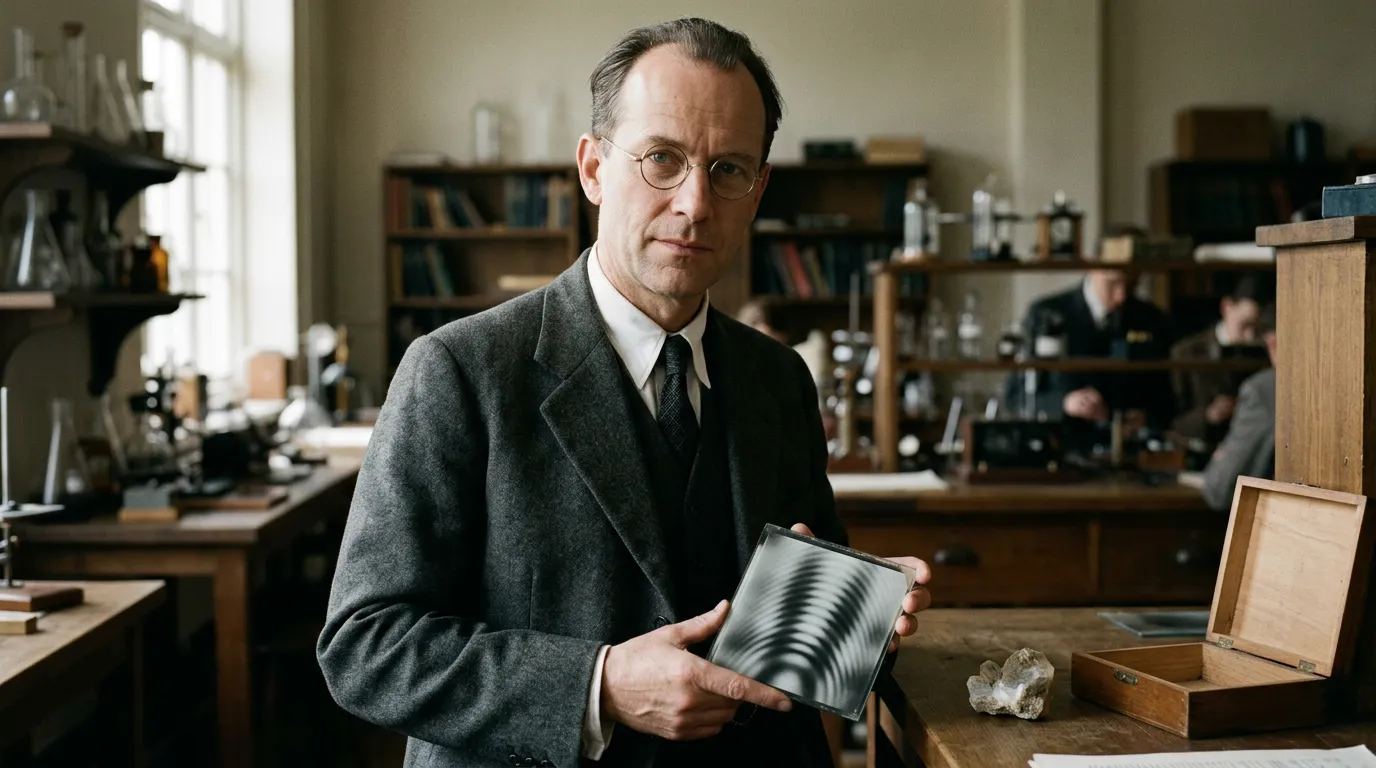
Kossel became a professor at the University of Kiel in 1921 and later worked at the Technical University in Danzig, now Gdańsk in Poland. His interests extended into the physics of X-rays and solids. In 1935, Kossel and colleagues observed characteristic patterns formed when X-rays produced within a crystal interact with that crystal’s repeating atomic arrangement. These patterns became known as Kossel lines. They carry information about the orderly arrangement of atoms inside crystalline materials. Researchers working with X-ray diffraction still study related effects, and the original observations are remembered as another important part of his scientific career.
Two scientific ideas with lasting value
After the Second World War Kossel taught physics at the University of Tübingen. He died on 22 May 1956; the German national biographical record gives Kassel as his place of death. His work connects two powerful ideas: the behaviour of electrons helps explain why atoms bond, and the behaviour of X-rays helps scientists explore the structure of solid matter. The simplified ionic model is still taught in chemistry because it makes the attraction between charged particles understandable. Modern bonding theories and crystal studies are more sophisticated, but Kossel helped open both paths.
What did they discover?
Ionic bonding model (1916)
Explained the attraction between atoms after electron transfer leaves them carrying opposite electrical charges.
Outer-electron arrangements
Linked chemical combining behaviour with the organisation of electrons around atomic nuclei and particularly stable arrangements.
X-ray crystal studies
Worked with colleagues to observe in 1935 X-ray interference patterns now called Kossel lines.
Connecting physics and chemistry
Helped show how new ideas about atomic structure could explain familiar chemical properties.
Amazing facts
Kossel’s father Albrecht won the 1910 Nobel Prize in Physiology or Medicine, while Walther pursued physics.
He studied physics in both Heidelberg and Berlin before completing a Heidelberg doctorate in 1911.
In Munich he worked in the circle of theoretical physicist Arnold Sommerfeld.
His 1916 paper on how atoms make molecules filled more than 100 pages in Annalen der Physik.
His ionic-bonding theory focused on attraction between oppositely charged ions after electron transfer.
His contribution complemented, rather than replaced, Gilbert Newton Lewis’s 1916 shared-electron bonding idea.
He held a physics professorship at Kiel before working in Danzig, now Gdańsk.
In 1935 he and colleagues observed distinctive X-ray interference patterns inside crystals, later called Kossel lines.
Timeline
Born in Berlin, Germany.
His father, biochemist Albrecht Kossel, received the Nobel Prize in Physiology or Medicine.
Completed a doctorate in physics at Heidelberg University under Philipp Lenard.
Joined the Munich circle of Arnold Sommerfeld.
Published a substantial paper explaining a model of ionic bonding using atomic electron arrangements.
Became a professor of theoretical physics at Kiel.
Began a professorship at the Technical University in Danzig.
With colleagues, observed crystal-generated X-ray interference patterns called Kossel lines.
Began teaching physics at the University of Tübingen.
Died in Kassel, Germany, according to the German national biographical record.
Related Super Scientists
Gilbert Newton Lewis
1875–1946 · Chemical bonding, thermodynamics and acids and bases
Gilbert N. Lewis developed the electron-pair model of covalent bonding and Lewis structures, transforming how chemists explain atoms sharing electrons.
Niels Bohr
1885–1962 · Physicist
Developed the Bohr model of the atom and made foundational contributions to quantum mechanics.
Henry Moseley
1887–1915 · Physicist
Establishing atomic number as the fundamental basis for ordering the chemical elements through X-ray spectroscopy in 1913–1914.