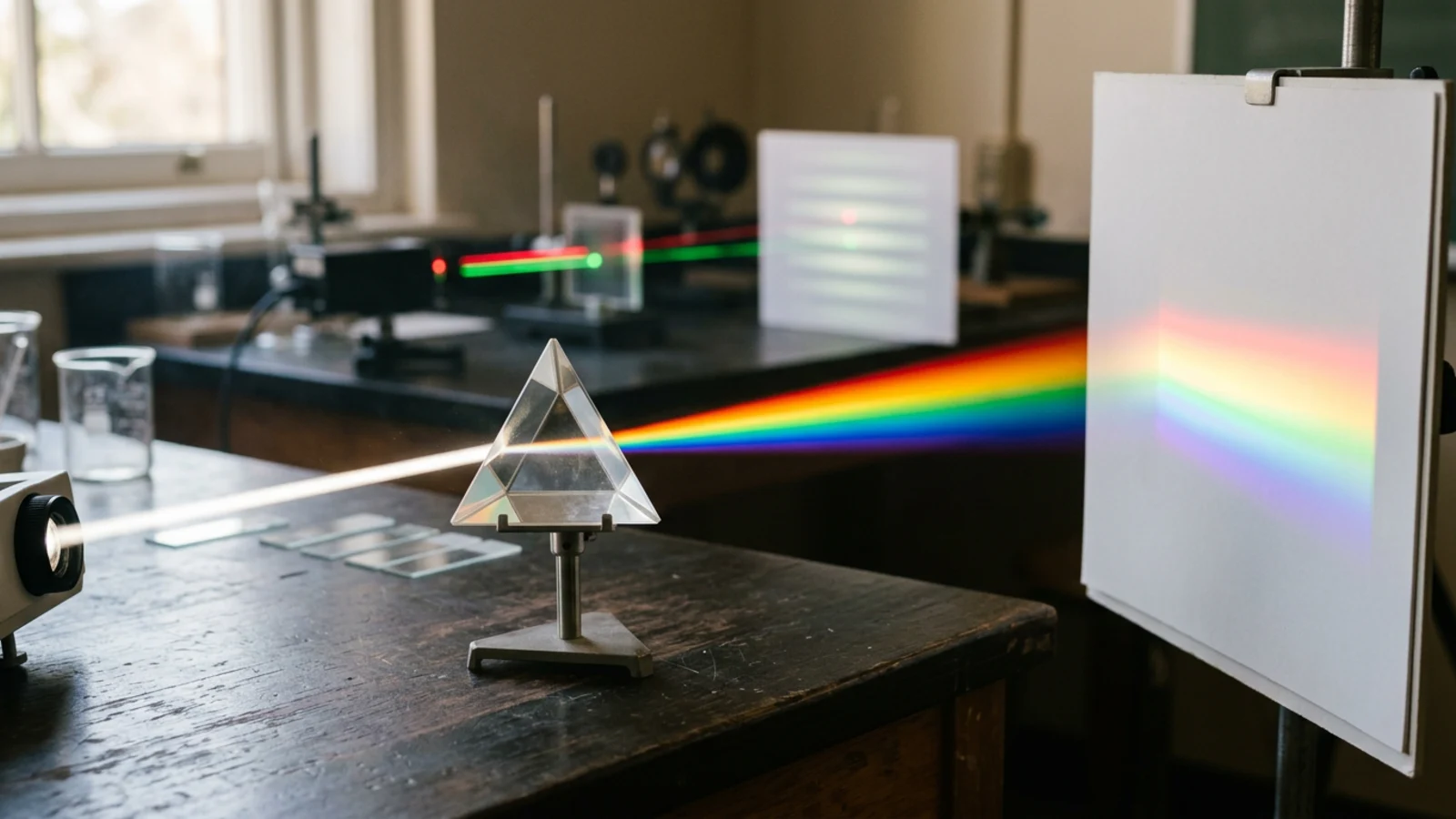
_(2).jpg)
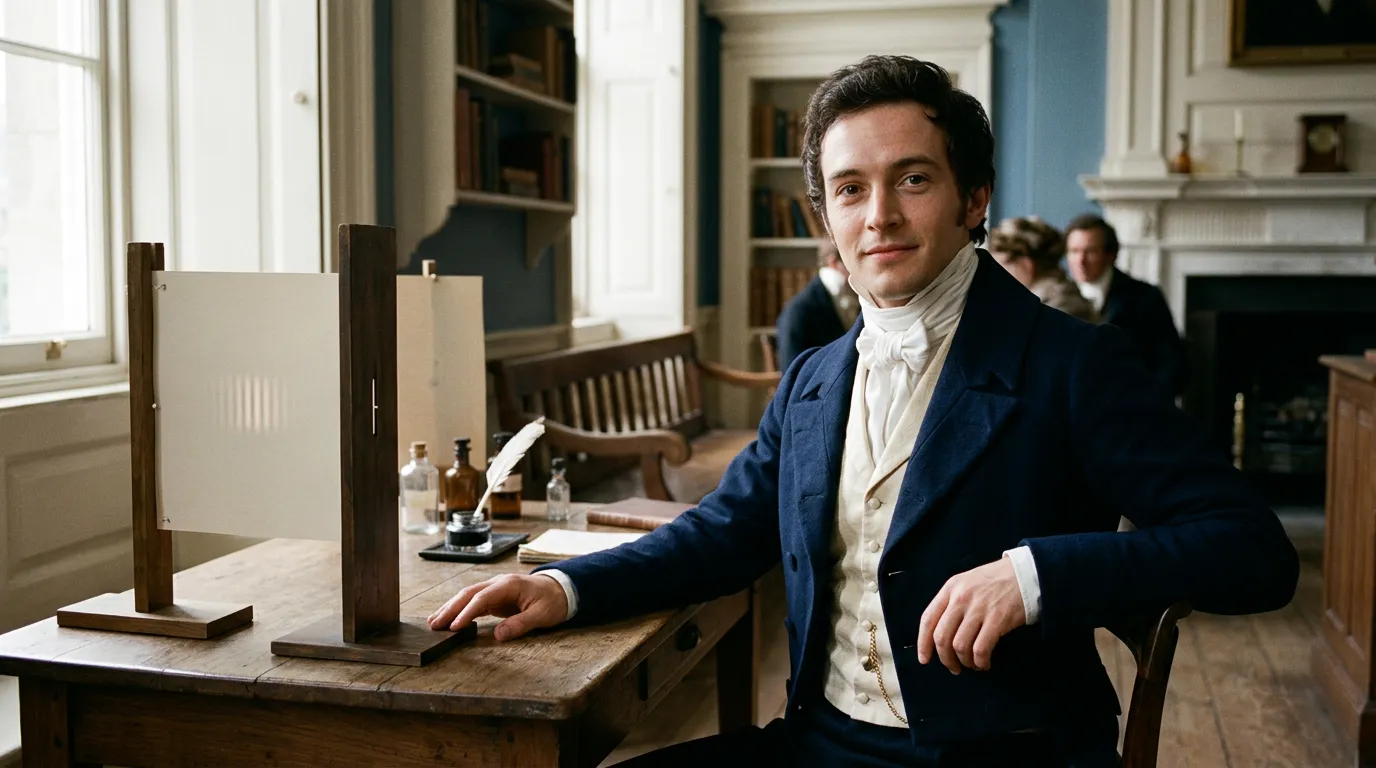
Thomas Young
1773–1829 · Wave optics, vision and elasticity
Thomas Young showed how light waves interfere, explored colour vision and studied elasticity, helping establish wave optics and quantitative physics.
Why is this scientist famous?
Thomas Young explained the interference of light using wave ideas, advanced the study of colour vision, and gave his name to a measure of material stiffness.
Interference is fundamental to modern optics, imaging and measurement; colour-vision science and Young’s modulus remain important in biology and engineering.
Thomas's story
A doctor who asked many questions
Thomas Young was born in Milverton, Somerset, on 13 June 1773. He studied medicine and became a physician, but he also pursued mathematics, sound, language and the behaviour of light. His broad interests earned him a reputation for exceptional range. By the early nineteenth century, many physicists still favoured Isaac Newton’s account of light as particles. Young did not reject Newton’s achievements: he asked whether wave behaviour could explain observations that particle arguments handled less easily.
When light waves meet
Young studied the coloured patterns that appear when light passes through narrow openings or interacts with thin films. He argued that waves can reinforce each other or cancel depending on how their peaks and troughs meet. This is interference. His early experiments and papers published in 1802 and 1804 gave striking support to light’s wave properties. The familiar classroom double-slit experiment is associated with Young, although his actual historical demonstrations and later textbook arrangements should not be treated as identical apparatus.
Seeing colours, not just brightness
Young also proposed that colour vision depends on responses to different parts of the visible spectrum, an important predecessor of modern three-receptor colour theory. He studied accommodation, the eye’s ability to focus at different distances. His work did not reveal all the biological mechanisms of the retina; later scientists, including Hermann von Helmholtz, developed and tested related ideas. What mattered was that Young turned questions about sight into problems that could be investigated with physical reasoning and careful observation.
A name used by engineers
He examined the stretching and compression of materials and helped establish a quantitative way to express stiffness, now called Young’s modulus. He lectured at the Royal Institution and was also involved in scholarship on Egyptian scripts, helping analyse how writing systems worked. These projects were different, but Young approached each by comparing evidence and looking for underlying patterns. His contributions crossed boundaries that now separate medicine, physics, engineering and historical linguistics.
The long reach of a wave
Young died in London on 10 May 1829. His wave explanations did not immediately win universal agreement; Augustin-Jean Fresnel and other investigators later strengthened optical wave theory. The modern explanation of light uses quantum physics as well as wave phenomena. Nevertheless, interference remains directly visible in laboratory demonstrations, and Young’s broader work reminds students that testing an idea can change how people understand ordinary experiences such as colour and brightness.
What did they discover?
Optical interference
Explained how overlapping light waves produce alternating reinforcement and cancellation.
Colour vision
Advanced an early theory of different spectral responses in human vision.
Young’s modulus
Helped formalise a measure of how strongly a material resists elastic stretching.
Interdisciplinary investigation
Applied physical and mathematical reasoning to sight, sound and language.
Amazing facts
He was a practising doctor as well as a physicist.
He lectured on natural philosophy at the Royal Institution in 1802–1803.
His interference work helped explain bright and dark light patterns.
His historical light demonstrations were not necessarily the same as today’s textbook two-slit arrangements.
He explored the way the human eye changes focus.
He proposed an early explanation of colour vision based on different responses to light.
A measure of material stiffness is named Young’s modulus.
He also made contributions to interpreting ancient Egyptian writing.
Timeline
Born in Milverton, Somerset, England.
Appointed professor of natural philosophy at the Royal Institution.
Published On the Theory of Light and Colours, developing wave ideas about light.
Presented experiments and calculations on physical optics to the Royal Society; the paper was published in 1804.
Published A Course of Lectures on Natural Philosophy and the Mechanical Arts.
Died in London.
Related Super Scientists
Isaac Newton
1643–1727 · Physicist & Mathematician
Formulating the laws of motion and universal gravitation.
James Clerk Maxwell
1831–1879 · Physicist & Mathematician
Developing the classical theory of electromagnetism, showing mathematically that electricity, magnetism and light are connected, and making major contributions to kinetic theory, colour science and the understanding of Saturn's rings.
Heinrich Hertz
1857–1894 · Physicist
Experimentally demonstrated electromagnetic waves in the late 1880s, confirming key predictions of James Clerk Maxwell's electromagnetic theory. The unit hertz (Hz) is named after him.