Thomas Martin Lowry
1874–1936 · Physical chemistry, acid–base theory and optical activity
Thomas Martin Lowry independently developed proton-transfer acid–base theory in 1923 and investigated how molecules rotate light.
“A base is best described as an acceptor of hydrogen nuclei.”
Why is this scientist famous?
Thomas Martin Lowry independently advanced a proton-based definition of acids and bases in 1923, helping explain chemical reactions far beyond water solutions.
The Brønsted–Lowry definition helps chemists explain proton-transfer reactions, buffer solutions and changes in acidity in living cells and industrial processes.
Thomas's story
From Yorkshire to the chemistry laboratory
Thomas Martin Lowry was born on 26 October 1874 at Low Moor, near Bradford, in Yorkshire. He attended Kingswood School in Bath and then studied at the Central Technical College in South Kensington, London. There he worked with chemist Henry Edward Armstrong. Lowry became Armstrong’s assistant in 1896, beginning a long period of practical chemical research. Instead of focusing on one narrow subject, he investigated how substances change during reactions, how electrical conduction reveals dissolved particles and how some materials affect light. These varied interests would eventually help him rethink the meaning of an acid or a base.
Molecules that turn light
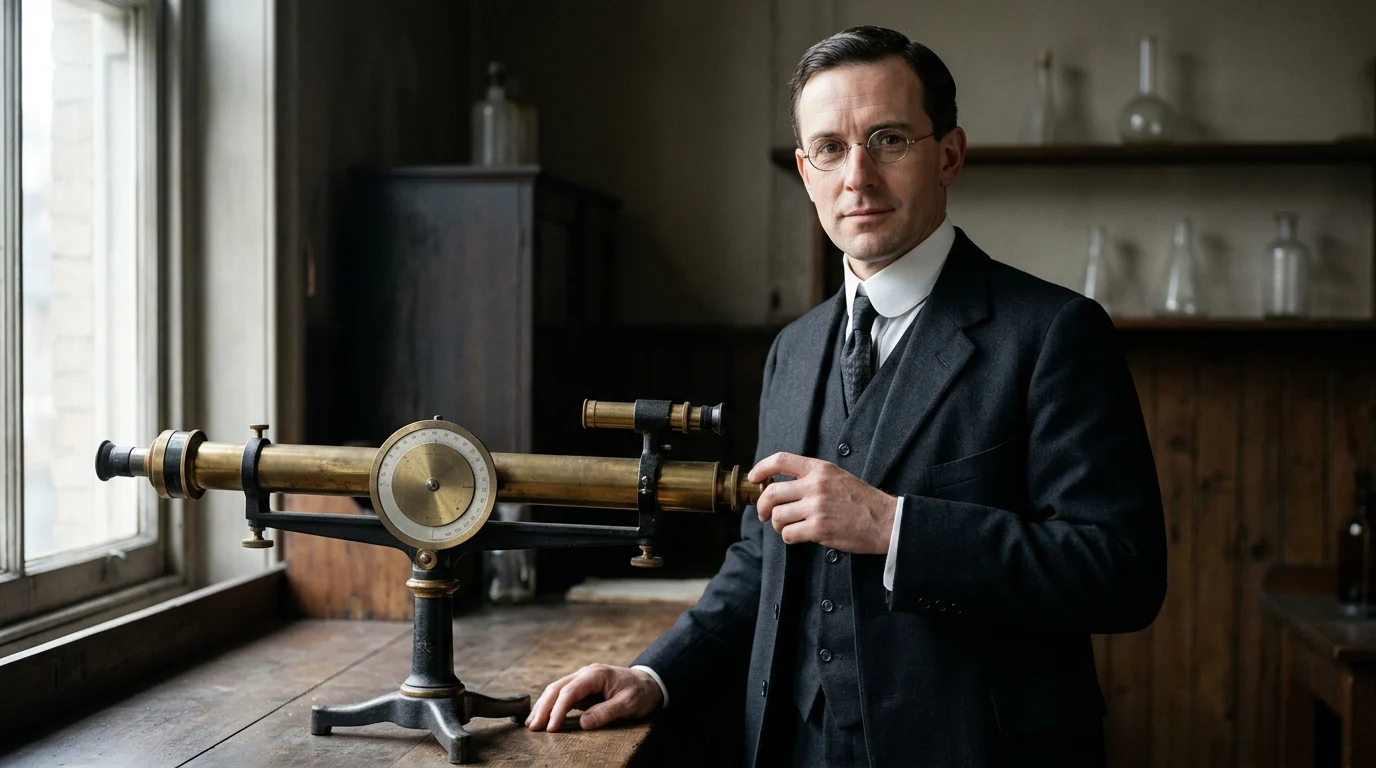
One of Lowry’s early specialties was optical activity. When plane-polarised light passes through certain substances, the direction of its polarisation rotates. Some substances also change this rotation as a reaction proceeds. Lowry investigated these changing measurements in camphor derivatives and sugars, including the process known as mutarotation. In simple terms, a change in the rotation of light can reveal that molecules are rearranging even when the liquid still looks exactly the same. His studies connected careful laboratory measurements with questions about what molecules are doing during reactions. This research was important in its own right, rather than merely a stepping stone to his more famous acid–base theory.
A professor asking a bigger question
In 1913 Lowry became head of chemistry at Guy’s Hospital Medical School in London. The Royal Society elected him a Fellow in 1914 in recognition of his investigations in several branches of chemistry. In 1920 he became the first professor of physical chemistry at the University of Cambridge. Physical chemistry uses the principles of physics to explain why chemical changes happen. As he studied reactions that acids and bases speed up, Lowry recognised that focusing only on particular dissolved substances did not capture the full picture. A more general explanation could describe what changes hands between reacting particles.
The proton idea of 1923
In his paper “The Uniqueness of Hydrogen”, published in January 1923, Lowry presented the idea that acid–base behaviour could be understood through the transfer of a hydrogen ion, or proton. In this approach, an acid donates a proton and a base accepts one. For example, when hydrogen chloride reacts with water, it passes a proton to a water molecule, producing a hydronium ion and a chloride ion. Johannes Brønsted, working in Denmark, independently developed a closely related proton-based interpretation in the same year. That is why the concept is called Brønsted–Lowry acid–base theory. It broadened the earlier picture that treated acids chiefly as substances releasing hydrogen ions in water. Importantly, neither scientist should be described as the sole inventor of the idea.
A wider scientific legacy
Lowry continued studying optical rotation, molecular structure and the mechanisms of chemical reactions. He served as president of the Faraday Society from 1928 to 1930, and his book Optical Rotatory Power appeared in 1935. He had been appointed an Officer of the Order of the British Empire in 1918 and a Commander in 1920. Lowry died in Cambridge on 2 November 1936. Today his name appears beside Brønsted’s in chemistry classrooms because the movement of a tiny proton explains a remarkably wide range of reactions. His earlier work also shows how much information scientists can uncover by carefully measuring something as subtle as the rotation of light.
What did they discover?
Brønsted–Lowry acid–base theory
Independently proposed in 1923 that acids donate protons and bases accept them, providing a broader account of acid–base reactions.
Acid–base catalysis
Investigated the way acids and bases influence the speed and mechanism of chemical reactions, connecting measurements with chemical explanation.
Optical activity and mutarotation
Studied changes in the rotation of polarised light as substances changed their molecular form, particularly in sugars and camphor derivatives.
Physical chemistry at Cambridge
Became the university’s first professor of physical chemistry in 1920 and taught the use of physics to understand chemistry.
Amazing facts
Lowry was born at Low Moor near Bradford but went to school at Kingswood School in Bath.
He studied chemistry under Henry Edward Armstrong at London’s Central Technical College.
His research investigated how a substance can rotate the direction of polarised light.
He studied mutarotation, in which the observed optical rotation changes as a mixture approaches equilibrium.
The Royal Society elected him a Fellow in 1914, nine years before his famous proton-theory paper.
Cambridge appointed him its first professor of physical chemistry in 1920.
His influential proton-transfer explanation appeared in a paper called “The Uniqueness of Hydrogen” on 19 January 1923.
He served as president of the Faraday Society from 1928 to 1930 and published Optical Rotatory Power in 1935.
Timeline
Born at Low Moor, near Bradford, Yorkshire.
Began work as an assistant to Henry Edward Armstrong.
Became head of the chemistry department at Guy’s Hospital Medical School, London.
Elected Fellow of the Royal Society.
Appointed an Officer of the Order of the British Empire.
Appointed Cambridge’s first professor of physical chemistry and made a Commander of the Order of the British Empire.
Published “The Uniqueness of Hydrogen”, advancing a proton-based acid–base theory independently of Johannes Brønsted.
Began his term as president of the Faraday Society.
Published Optical Rotatory Power.
Died in Cambridge, England.
Awards & honours
Related Super Scientists
Svante Arrhenius
1859–1927 · Physical chemistry, electrolytes and early climate science
Svante Arrhenius explained how dissolved substances produce ions, developed chemical kinetics concepts and calculated how atmospheric carbon dioxide might affect climate.
Gilbert Newton Lewis
1875–1946 · Chemical bonding, thermodynamics and acids and bases
Gilbert N. Lewis developed the electron-pair model of covalent bonding and Lewis structures, transforming how chemists explain atoms sharing electrons.
Søren Peter Lauritz Sørensen
1868–1939 · Chemistry, pH and acidity measurement
Søren Sørensen introduced the pH scale, giving chemists a simple way to express how acidic or alkaline a solution is.