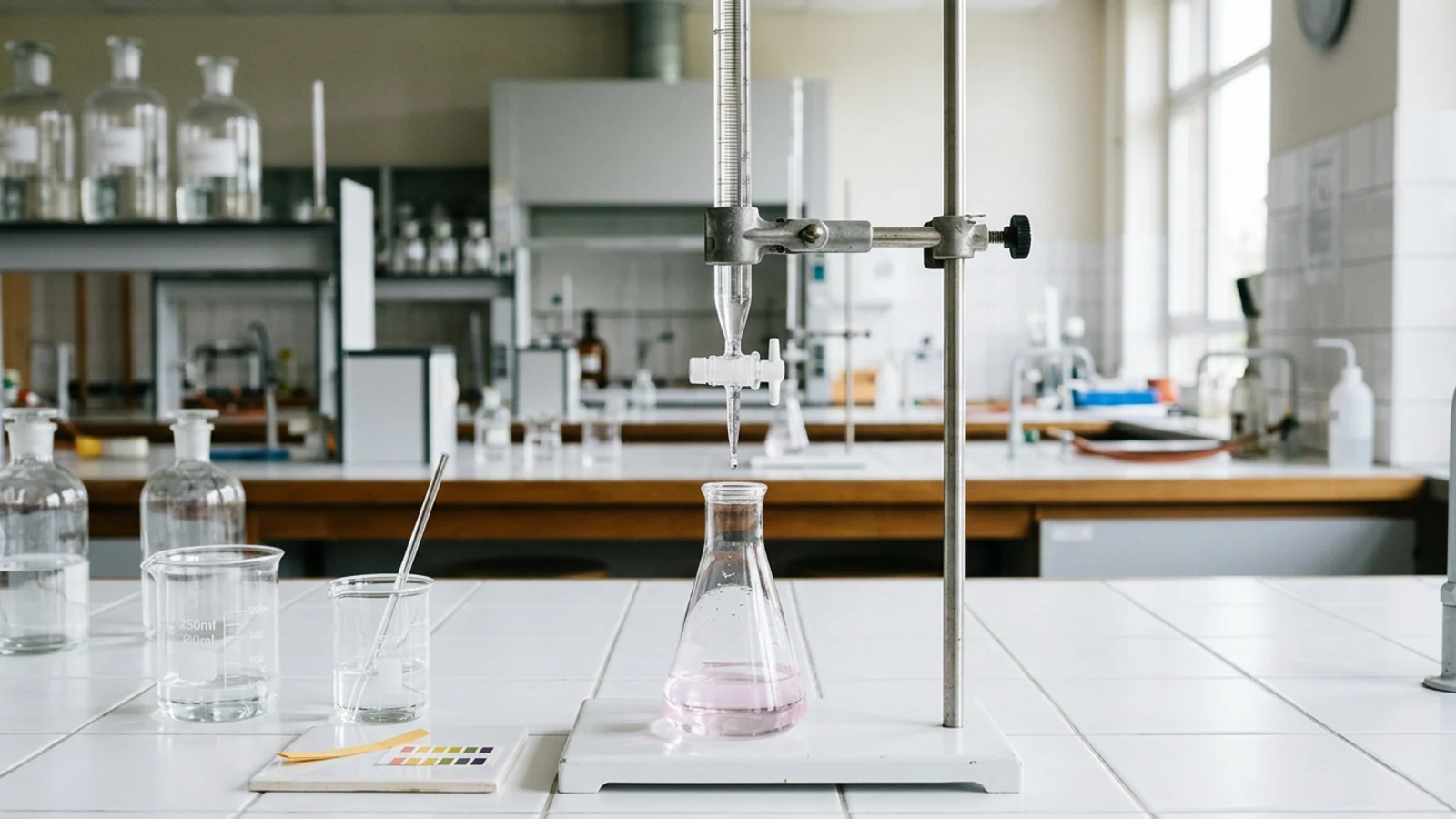
_(2).jpg)
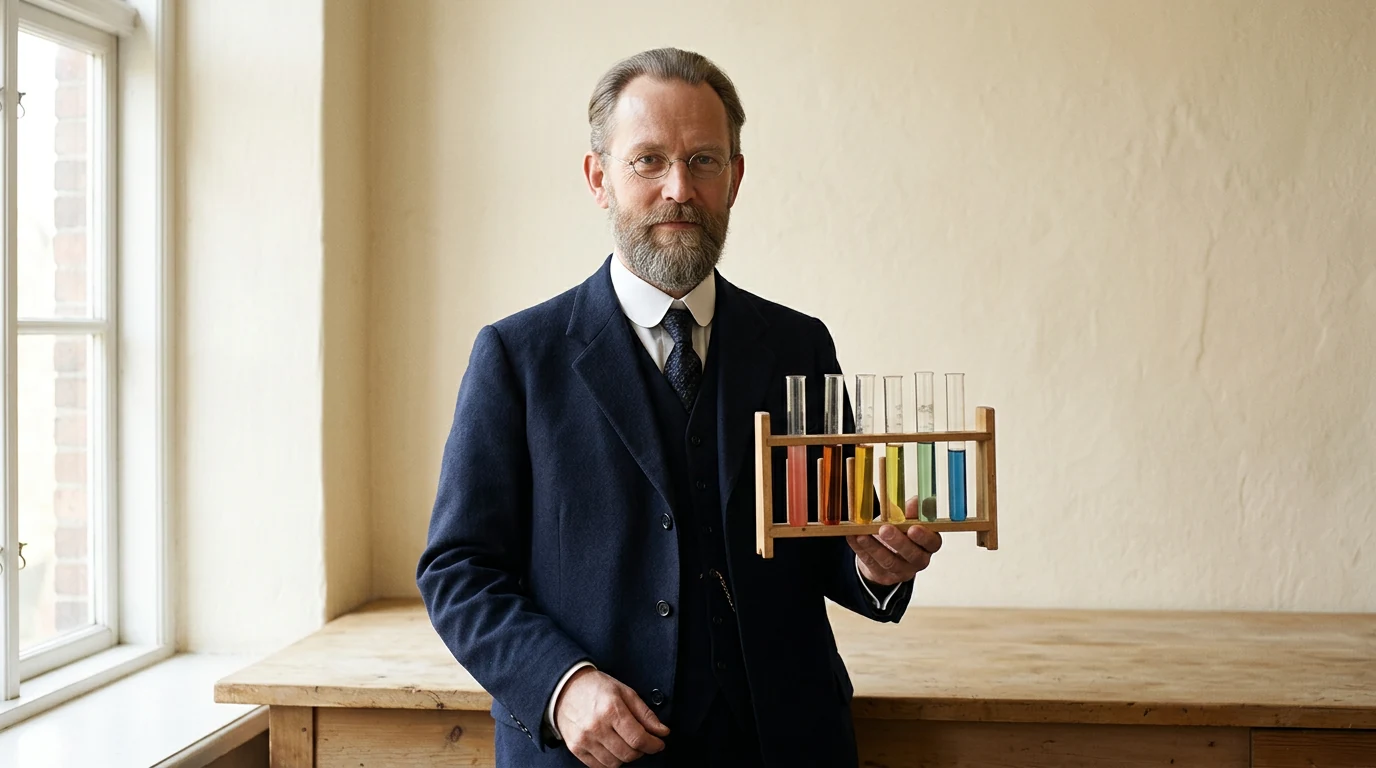
Søren Peter Lauritz Sørensen
1868–1939 · Chemistry, pH and acidity measurement
Søren Sørensen invented the pH scale at Copenhagen’s Carlsberg Laboratory in 1909, giving science a simple way to measure acidity and alkalinity.
Why is this scientist famous?
Søren Sørensen introduced the pH scale, giving chemists a simple way to express how acidic or alkaline a solution is.
The pH scale is used everywhere today, from swimming pools and soil testing to medicine, food safety and environmental monitoring.
Søren's story
A student who changed direction
Søren Peter Lauritz Sørensen was born on 9 January 1868 in Havrebjerg, Denmark, in a farming family. With help from adults who recognised his talent, he attended Sorø Academy before entering the University of Copenhagen in 1886. He initially studied medicine, but chemistry soon captured his interest and he changed direction. In 1889 he earned a university gold medal for a study of the history of chemical ideas, and he completed his advanced chemistry qualification in 1891. His doctorate, awarded in 1899, concerned compounds of cobalt rather than the acids and bases for which he would become famous.
From metal compounds to the brewing laboratory
Sørensen worked as an assistant to chemist Sophus Mads Jørgensen at Copenhagen’s Polytechnic College, studying and analysing inorganic compounds. In 1901 he became head of the chemistry department of the Carlsberg Laboratory, succeeding Johan Kjeldahl, whose methods had helped chemists measure nitrogen in substances. The laboratory was linked to brewing, but its researchers investigated questions far beyond making beer. Sørensen shifted towards proteins, the substances that are broken down and changed by enzymes in living systems. In 1907 he described a method called formol titration, which helped chemists measure amino acids produced as proteins were broken apart.
Putting acidity into a simple number
Chemists already knew that dissolved hydrogen ions were important in acids, but very small concentrations were awkward to compare. In 1909 Sørensen introduced the pH concept in his research on enzymes, expressing acidity on a convenient logarithmic scale. For many familiar water-based solutions, a change of one pH unit corresponds to a tenfold change in hydrogen-ion activity: lower pH generally means greater acidity. He described both electrical measurements using electrodes and comparisons using colour indicators to determine acidity. The scale is often taught using numbers from 0 to 14, but those are not absolute limits for every solution. Later scientists refined the formal definition of pH, so the modern measurement is not exactly identical to his original concentration-based formulation.
Why enzymes need the right conditions
Sørensen was interested in pH because changing acidity could alter how enzymes worked. His experiments helped show that the speed of enzyme-driven reactions, including the breakdown of sugar, depends strongly on the surrounding solution. He also gave practical recipes for buffer solutions, which resist large pH changes when small amounts of acid or base are added. His research extended to the structure and behaviour of proteins, not simply to inventing a convenient number. Among the scientists contributing to the laboratory’s protein research was Margrethe Høyrup Sørensen, a qualified researcher and his collaborator as well as his wife. Their work helped bring careful physical measurements into the study of living molecules.
A laboratory idea used around the world
Sørensen received the Ørsted Medal in 1909 for his enzyme research and later earned other honours for his contributions to chemistry. The pH concept spread from biochemical laboratories into fields such as farming, medicine, food production and water treatment. He retired from the Carlsberg Laboratory in 1938 and became president of the Royal Danish Academy of Sciences and Letters that year. He died in Charlottenlund, near Copenhagen, on 12 February 1939. Today, a simple pH test can reveal something important about a swimming pool, a garden soil sample or a laboratory reaction, even though the science behind the number is more sophisticated than a colour chart alone suggests.
What did they discover?
The pH concept
Introduced the logarithmic pH measure in 1909, making acidity easier to express and compare. The modern scientific definition was refined after his original formulation.
Methods for measuring acidity
Described electrical and colour-indicator methods for determining the acidity of solutions in his enzyme research.
Acidity and enzyme activity
Showed the importance of hydrogen-ion conditions for enzyme-driven reactions and for understanding biochemical behaviour.
Buffer solutions
Provided formulations for solutions that help hold acidity comparatively steady during experiments, building on earlier work on buffers.
Protein analysis
Developed formol titration in his 1907 enzyme studies and contributed to precise measurement of amino acids and proteins.
Amazing facts
He first entered the University of Copenhagen to study medicine before switching to chemistry.
His 1889 university gold medal rewarded an essay about the changing meaning of chemical radicals.
His 1899 doctorate investigated cobalt compounds, long before his famous work on pH.
In 1907 he described formol titration, a way to help measure amino acids during protein breakdown.
His 1909 pH research described both electrode measurements and colour-indicator comparisons.
The 1909 paper introducing pH appeared in Danish, French and German versions.
Margrethe Høyrup Sørensen was a scientific collaborator in his protein research, not simply a laboratory visitor.
He became president of the Royal Danish Academy of Sciences and Letters in 1938, the year he retired from Carlsberg.
Timeline
Born in Havrebjerg, Denmark.
Entered the University of Copenhagen, initially to study medicine before changing to chemistry.
Received a University of Copenhagen gold medal for a study of chemical ideas.
Completed his advanced qualification in chemistry at the University of Copenhagen.
Received his doctorate for research on cobalt compounds.
Became head of the chemistry department at the Carlsberg Laboratory.
Published enzyme studies describing formol titration for amino-acid analysis.
Introduced the pH concept in his enzyme research and received the Ørsted Medal.
Received an honorary doctorate from Lund University.
Received the Scheele Medal.
Retired from Carlsberg and became president of the Royal Danish Academy of Sciences and Letters.
Died in Charlottenlund, Denmark.
Awards & honours
Related Super Scientists
Svante Arrhenius
1859–1927 · Physical chemistry, electrolytes and early climate science
Svante Arrhenius explained how dissolved substances produce ions, developed chemical kinetics concepts and calculated how atmospheric carbon dioxide might affect climate.

Wilhelm Johannsen
1857–1927 · Genetics, heredity and plant physiology
Wilhelm Johannsen distinguished genotype from phenotype, introduced the word gene and tested inheritance using pure lines of beans.
Gilbert Newton Lewis
1875–1946 · Chemical bonding, thermodynamics and acids and bases
Gilbert N. Lewis developed the electron-pair model of covalent bonding and Lewis structures, transforming how chemists explain atoms sharing electrons.