_(2).jpg)
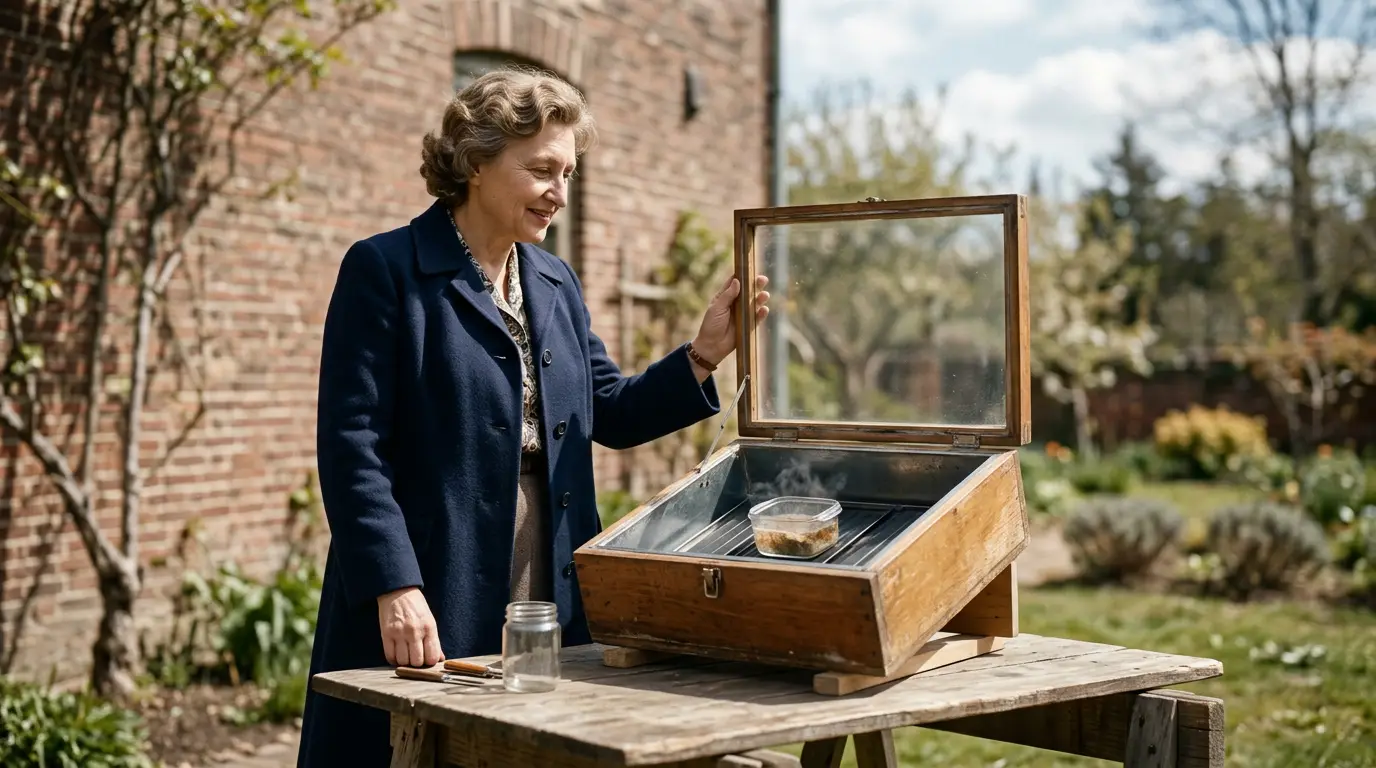
Mária Telkes
1900–1995 · Solar energy engineering and thermal storage
Mária Telkes pioneered ways of storing solar heat, helped develop the Dover Sun House and designed practical devices powered by sunlight.
“Sunlight will be used as a source of energy sooner or later anyway. Why wait?”
Why is this scientist famous?
Mária Telkes developed ways to collect and store solar heat, helped create an experimental solar-heated house and invented a solar-powered water still.
Modern solar heating, thermal-energy storage and off-grid water treatment share engineering ideas that Telkes helped develop.
Mária's story
A scientist fascinated by sunlight
Mária Telkes was born in Budapest, then part of Austria-Hungary, on 12 December 1900. She studied physical chemistry at the University of Budapest and completed a doctorate in 1924. A year later she moved to the United States and began working as a biophysicist at the Cleveland Clinic Foundation. She explored how physical processes could be made useful in medicine and technology. In 1937 she joined Westinghouse Electric, where she investigated converting heat into electrical energy.
Can sunshine be stored?
In 1939, Telkes joined a solar-energy research project at the Massachusetts Institute of Technology, usually called MIT. She wanted to solve a central problem with using sunlight for heat: what happens at night or when clouds cover the Sun? She explored materials that absorb heat while changing from a solid into a liquid and release it again when they solidify. One material, Glauber's salt, could act like a rechargeable store of warmth. This was thermal storage, not a modern solar cell producing electricity.
A house warmed by the Sun
In 1948 Telkes collaborated with architect Eleanor Raymond on the Dover Sun House in Massachusetts, supported by patron Amelia Peabody. The experimental home used glass-covered solar collectors on its south-facing wall, with a system designed by Telkes to store the collected heat. Fans moved warmed air through the building when it was needed. The house was an ambitious real-world test, rather than proof that solar heating would be easy under every condition. Problems with its storage system later showed how difficult it can be to turn a laboratory idea into a dependable building technology.
Solar power away from home
Telkes also designed a portable solar still for making fresh water from seawater, work connected with wartime survival needs. A solar still lets sunlight evaporate water, then gathers the condensed fresh water while leaving most dissolved salts behind. In the early 1950s she explored simple solar cookers that could work without electricity or ordinary fuel. At New York University she continued investigating how solar energy might help people in different settings. These inventions showed that useful solar engineering involves collecting, transforming and storing energy, not just generating electricity.
The Sun Queen
Telkes spent later decades developing solar technologies in universities and industry, including work at the University of Delaware. She received the Society of Women Engineers Achievement Award in 1952 and a major solar-energy honour in 1977. Her energetic advocacy of sunlight as a useful power source helped earn her the nickname the Sun Queen. She died in Budapest on 2 December 1995 and was inducted into the National Inventors Hall of Fame in 2012. Long before solar heating was familiar, she had been testing practical ways to make renewable energy useful in daily life.
What did they discover?
Solar thermal heat storage
Telkes investigated phase-change materials such as Glauber's salt, which absorb energy as they melt and release it again as they solidify.
Dover Sun House heating system
Working with architect Eleanor Raymond and others, she designed a solar heat-collection and storage system for an experimental house built in 1948.
Solar-powered fresh-water still
She developed a device using sunlight to evaporate salt water and condense drinkable fresh water, with applications in emergency survival.
Solar cooking systems
She developed designs for solar ovens and cookers using concentrated or trapped sunlight rather than ordinary cooking fuel.
Amazing facts
She became an American citizen in 1937, the same year she joined Westinghouse as a research engineer.
Before solar heating became her main interest, she worked as a biophysicist at the Cleveland Clinic Foundation.
Glauber's salt can store heat during melting and give it back during solidification, making it useful in thermal-storage experiments.
The Dover Sun House included eighteen south-facing upper-level windows in a distinctive wedge-shaped building.
Architect Eleanor Raymond designed the Dover Sun House, while Amelia Peabody provided financial support.
A wartime solar still could make fresh water without needing an electrical supply or a conventional fuel-powered boiler.
She received the first Society of Women Engineers Achievement Award in 1952.
She entered the National Inventors Hall of Fame in 2012, seventeen years after her death.
Timeline
Born in Budapest, then part of Austria-Hungary.
Completed a doctorate in physical chemistry at the University of Budapest.
Moved to the United States and worked at the Cleveland Clinic Foundation.
Joined Westinghouse Electric as a research engineer.
Began solar-energy work with the Massachusetts Institute of Technology.
Worked with Eleanor Raymond on the solar-heated Dover Sun House.
Received the Society of Women Engineers Achievement Award.
Developed further solar cooking projects while working at New York University.
Received the Charles Greeley Abbot Award for solar-energy achievements.
Died in Budapest, Hungary.
Awards & honours
Related Super Scientists
Beatrice Shilling
1909–1990 · Aeronautical and mechanical engineering
Beatrice Shilling devised a small fuel-flow restrictor that helped Rolls-Royce Merlin aircraft engines keep running during steep wartime manoeuvres.
Katharine Burr Blodgett
1898–1979 · Surface physics, thin films and optics
Katharine Burr Blodgett developed methods for building molecularly thin coatings and made glass that reflected remarkably little light.