_(2).jpg)
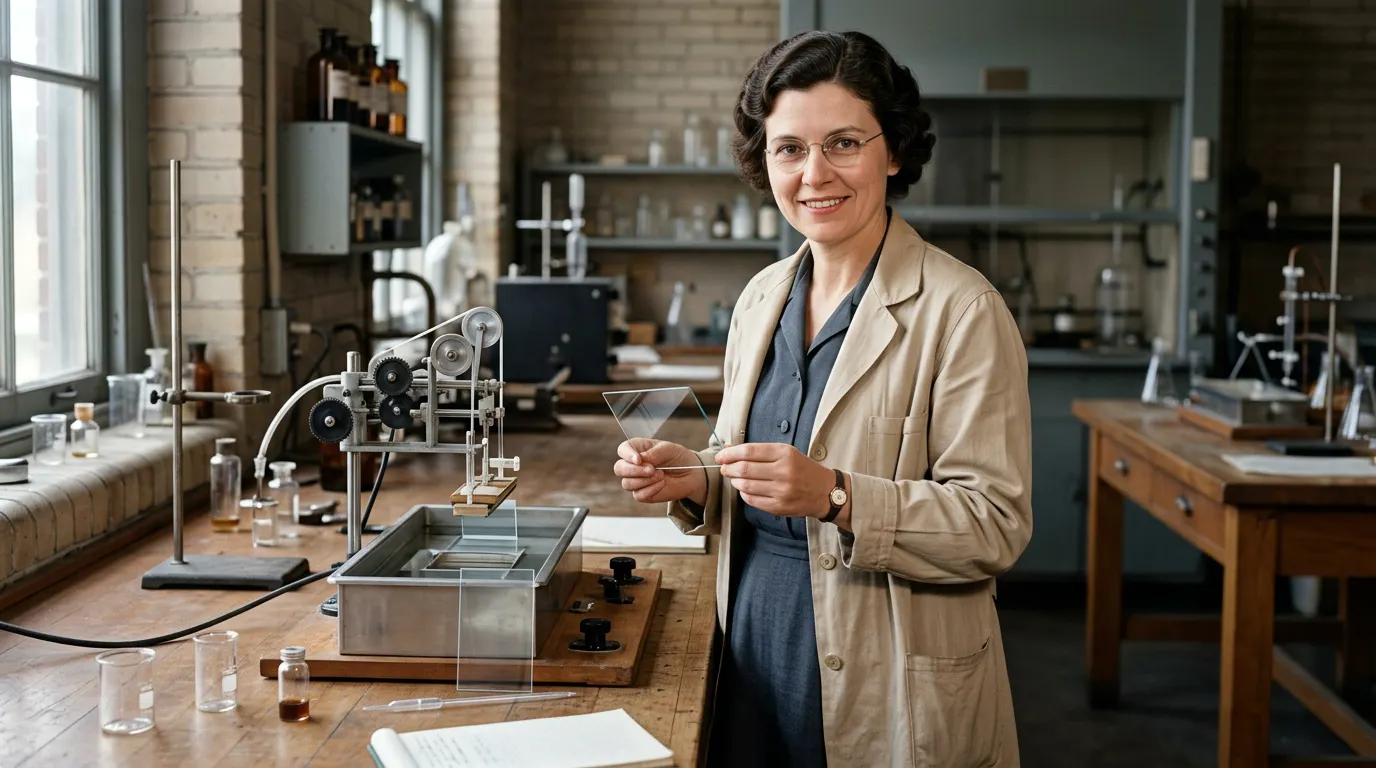
Katharine Burr Blodgett
1898–1979 · Surface physics, thin films and optics
Katharine Burr Blodgett made glass far less reflective by building up films just one molecule thick, transforming the study of surfaces and optical coatings.
Why is this scientist famous?
Katharine Burr Blodgett developed methods for building molecularly thin coatings and made glass that reflected remarkably little light.
Modern optics and surface-science laboratories still use ideas developed through Langmuir–Blodgett films to control very thin coatings.
Katharine's story
The scientist who made reflections disappear
Katharine Burr Blodgett was born in Schenectady, New York, on 10 January 1898. She grew up in a family that moved between the United States and France, and she became interested in learning how the physical world worked. At Bryn Mawr College she studied chemistry and graduated in 1917. A visit to the General Electric research laboratories introduced her to scientist Irving Langmuir, who encouraged her to continue studying. After earning a master’s degree from the University of Chicago in 1918, she joined General Electric as its first female research scientist.
Returning to university
Blodgett did not regard her laboratory job as the end of her education. She spent time at the University of Cambridge, where she investigated electrons moving through mercury vapour at the Cavendish Laboratory. In 1926 she became the first woman to earn a doctorate in physics from Cambridge. Her work there required careful experiments with unfamiliar equipment and exact measurements. She then returned to General Electric to continue researching the behaviour of extremely thin layers of matter.
Building films a molecule at a time
Langmuir had shown how a film only one molecule thick could form on a water surface and be transferred to a solid object. Blodgett extended this approach so successive layers could be deposited, building a controlled coating one layer at a time. Scientists call these structures Langmuir–Blodgett films in recognition of both researchers’ contributions. She used such films to change how light reflected from glass, producing surfaces that appeared almost invisible because unwanted reflections were greatly reduced. The glass itself was still present: the remarkable change was in the light bouncing off it.
From laboratories to cinema
An ordinary window reflects some of the light that reaches it, sometimes hiding what lies on the other side. Blodgett’s coatings helped reduce that problem in optical equipment such as lenses and viewing devices. Her non-reflecting glass was used during production of the 1939 film Gone with the Wind, according to historical accounts of the technology. Wartime uses included optical components for viewing instruments, while her research also addressed other practical problems. She later developed a colour-based method for measuring the thickness of thin films.
An enduring scientific toolkit
Blodgett continued working at General Electric until retiring in 1963. The American Chemical Society honoured her with the Francis P. Garvan Medal in 1951, and she received further recognition for her work on photography and optics. She died in 1979 after helping establish methods that researchers still use to arrange materials in precise thin layers. Her achievement was not to invent glass, but to find ways of controlling an astonishingly thin surface coating. Sometimes changing a surface by only a few molecules can change how the whole object behaves.
What did they discover?
Langmuir–Blodgett multilayer films
Building on Irving Langmuir’s work with single molecular layers, Blodgett demonstrated how successive thin films could be transferred to solid surfaces with precise control over thickness.
Anti-reflective glass
She used carefully arranged thin coatings to greatly reduce reflections from glass, improving the clarity of optical surfaces.
Measuring film thickness by colour
She developed a colour-based gauge that helped scientists judge the thickness of extremely thin surface coatings.
Practical optical applications
Her work supported improvements to camera lenses, viewing devices and other instruments where unwanted reflections interfere with what can be seen.
Amazing facts
Blodgett became the first female research scientist employed at General Electric.
Before studying thin films, her master’s research contributed to materials used for filtering gases in protective masks.
Her Cambridge doctorate investigated the motion of electrons in mercury vapour rather than glass coatings.
A coating just one molecule thick can be transferred from water to a solid surface.
By adding one molecular layer after another, her method allowed scientists to build films with carefully controlled thickness.
Her non-reflective glass was used in work on the 1939 film Gone with the Wind.
The American Chemical Society recognised her achievements with its Francis P. Garvan Medal in 1951.
She was inducted into the National Inventors Hall of Fame in 2007, many years after her death.
Timeline
Born in Schenectady, New York, United States.
Graduated from Bryn Mawr College.
Earned a master’s degree at the University of Chicago and began work at General Electric.
Became the first woman to earn a physics doctorate from the University of Cambridge.
Extended surface-film techniques to deposit successive molecular layers.
Patented a technique for making layered films.
Her anti-reflective glass was used in work on Gone with the Wind.
Received the Francis P. Garvan Medal.
Retired from General Electric.
Died in Schenectady, New York.
Awards & honours
Related Super Scientists
George Eastman
1854–1932 · Inventor and Entrepreneur
Developing practical roll-film systems and the Kodak camera, helping make photography accessible to ordinary people and contributing to the rise of motion pictures.
Ernest Rutherford
1871–1937 · Physicist
Discovering the nuclear structure of the atom and pioneering the field of nuclear physics.