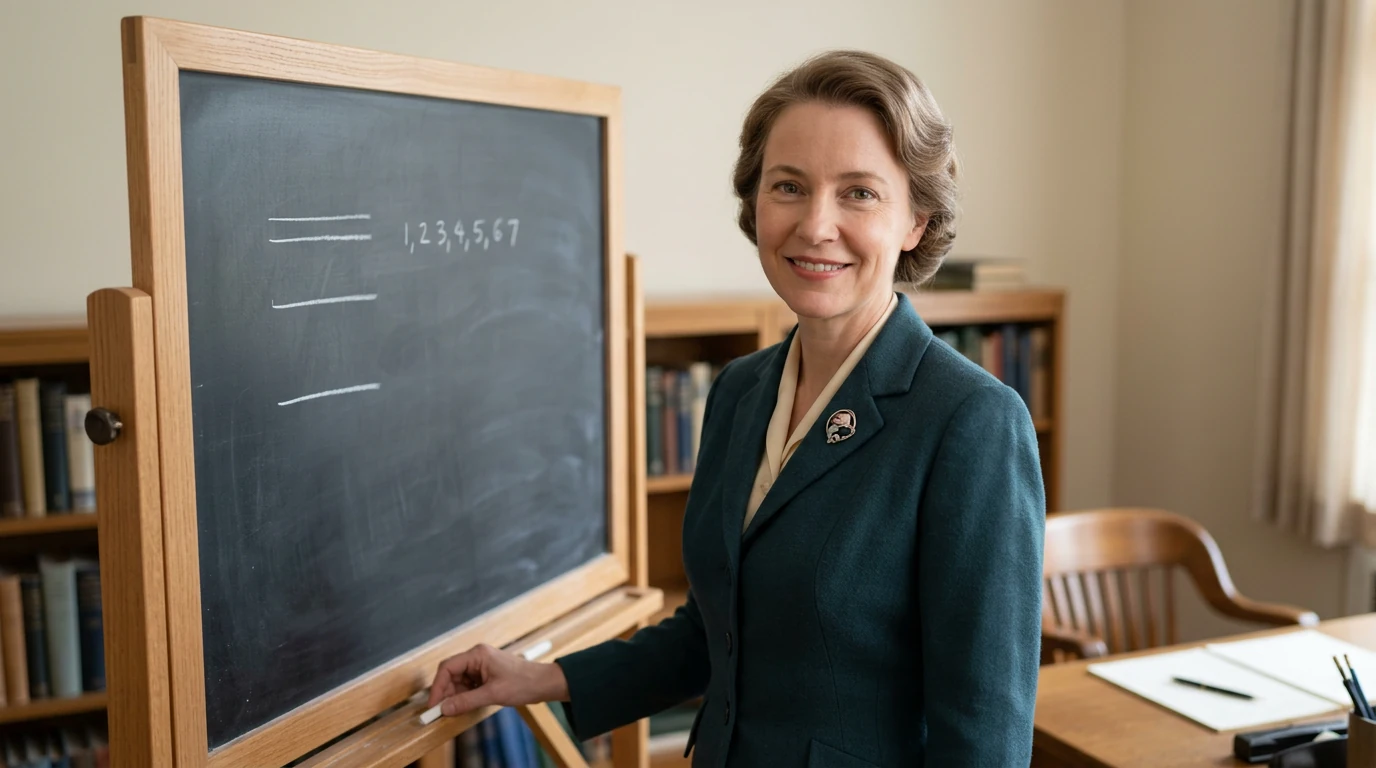
Maria Goeppert Mayer
1906–1972 · Theoretical nuclear physics and quantum mechanics
Maria Goeppert Mayer explained nuclear magic numbers through the shell model and earlier predicted two-photon processes, earning the 1963 Physics Nobel Prize.
Why is this scientist famous?
Maria Goeppert Mayer developed a nuclear shell model that explained why nuclei with certain numbers of protons or neutrons are unusually stable. In 1949 her work and an independently developed model by J. Hans D. Jensen gave the decisive explanation through the interaction between nuclear motion and spin.
Her research remains part of the foundations of nuclear-structure physics. Earlier work on how an atom can absorb two light particles together anticipated important processes studied decades later with lasers and used in optical techniques.
Maria's story
A girl determined to study science
Maria Goeppert was born in Kattowitz in 1906, when the city belonged to the German Empire, and grew up in Göttingen. Her father was a university professor, so higher education was expected, but opportunities for girls were more restricted than those for boys. She entered Göttingen University in 1924 intending to study mathematics. Lectures on the new quantum mechanics, especially those led by Max Born, drew her towards physics. She earned her doctorate in 1930 under Born. At a time when the rules of the microscopic world were being rewritten, she chose to tackle some of the hardest mathematical questions.
A prediction decades ahead of the lasers
Her doctoral research considered an unusual possibility: one atom might absorb two photons in a single quantum process, rather than a single photon. Such events were extraordinarily hard to observe with the weak light sources then available. Later, lasers made two-photon processes experimentally accessible, and the theory became important to nonlinear optics. She married chemist Joseph Edward Mayer early in 1930, completed her doctorate that year, and then moved to the United States. Her talent won access to research but not to the same paid academic career that was usually open to male physicists.
Important work without a secure professorship
Anti-nepotism rules linked to her husband’s appointments, together with wider barriers facing women, restricted Goeppert Mayer’s employment at Johns Hopkins and Columbia. She continued publishing while holding unofficial or poorly paid roles. During the Second World War she worked on isotope-separation research associated with the American atomic programme; one photochemical approach she investigated was not adopted as a practical solution. Later she worked at the University of Chicago and Argonne National Laboratory. Those posts gave her the freedom to think about a puzzle at the heart of nuclear physics: why are some atomic nuclei much more stable than their neighbours?
The secret of the magic numbers
The numbers 2, 8, 20, 28, 50, 82 and 126 appeared repeatedly in especially stable combinations of protons or neutrons. By 1948 Goeppert Mayer had published evidence supporting closed nuclear shells; in 1949 she developed an explanation involving strong coupling between a nucleon’s intrinsic spin and its motion inside the nucleus. The shells are quantum energy levels, not tiny physical layers like an onion. Jensen and collaborators arrived at closely related results independently. The two researchers later became collaborators and co-authored the 1955 book *Elementary Theory of Nuclear Shell Structure*. Their contributions deserve separate credit.
Recognition that came late
Goeppert Mayer became a full professor at the University of California, San Diego in 1960. In 1963 she and Jensen shared half the Nobel Prize in Physics for nuclear shell structure; Eugene Wigner received the other half for different theoretical work on atomic nuclei. She was only the second woman to win a Physics Nobel, after Marie Curie. She died in San Diego in February 1972. Today her nuclear model remains fundamental in explaining patterns of nuclear stability, while her much earlier two-photon calculations also connect her name with modern laser-based optical science.
What did they discover?
Two-photon quantum theory
Predicted and mathematically analysed processes in which atoms absorb or emit two photons in a single quantum event.
Evidence for closed nuclear shells
Connected unusually stable proton and neutron numbers with filled quantum energy levels in nuclei.
Spin–orbit nuclear shell model
Explained the larger magic-number sequence by accounting for spin–orbit coupling; Jensen independently developed a closely related account.
Shared nuclear-structure synthesis
Co-wrote *Elementary Theory of Nuclear Shell Structure* (1955) with J. Hans D. Jensen.
Amazing facts
She intended to study mathematics until Max Born’s quantum-mechanics seminars captured her interest.
Her doctoral work predicted two-photon absorption decades before powerful lasers allowed researchers to observe it readily.
Early in her American career, some universities would let her research but not appoint her to an ordinary paid faculty position.
She pursued a photochemical approach to uranium isotope separation during wartime work, although it was ultimately impractical.
The nuclear “magic numbers” include 2, 8, 20, 28, 50, 82 and 126; they describe proton or neutron counts associated with extra stability.
A question from Enrico Fermi about spin–orbit coupling helped her see how to explain the magic numbers.
Jensen independently reached a related shell-model result before they met; they later wrote a book together.
She did not obtain a full professorship until 1960, despite her major earlier research.
She was the second woman awarded the Nobel Prize in Physics, following Marie Curie.
The unit used for a two-photon absorption cross-section is named the Goeppert-Mayer (GM) unit.
Timeline
Born in Kattowitz, then part of the German Empire.
Entered the University of Göttingen.
Married Joseph Mayer, completed her doctorate under Max Born and moved to the United States.
Published her detailed theory of two-photon processes.
Published a paper assembling evidence for closed shells in atomic nuclei.
Developed the successful spin–orbit account of nuclear magic numbers.
Co-authored *Elementary Theory of Nuclear Shell Structure* with Jensen.
Became a professor at the University of California, San Diego.
Learned that she and J. Hans D. Jensen would share half the Nobel Prize in Physics for nuclear shell structure; Eugene Wigner received the other half for separate work.
Died in San Diego on 20 February.
Awards & honours
Related Super Scientists
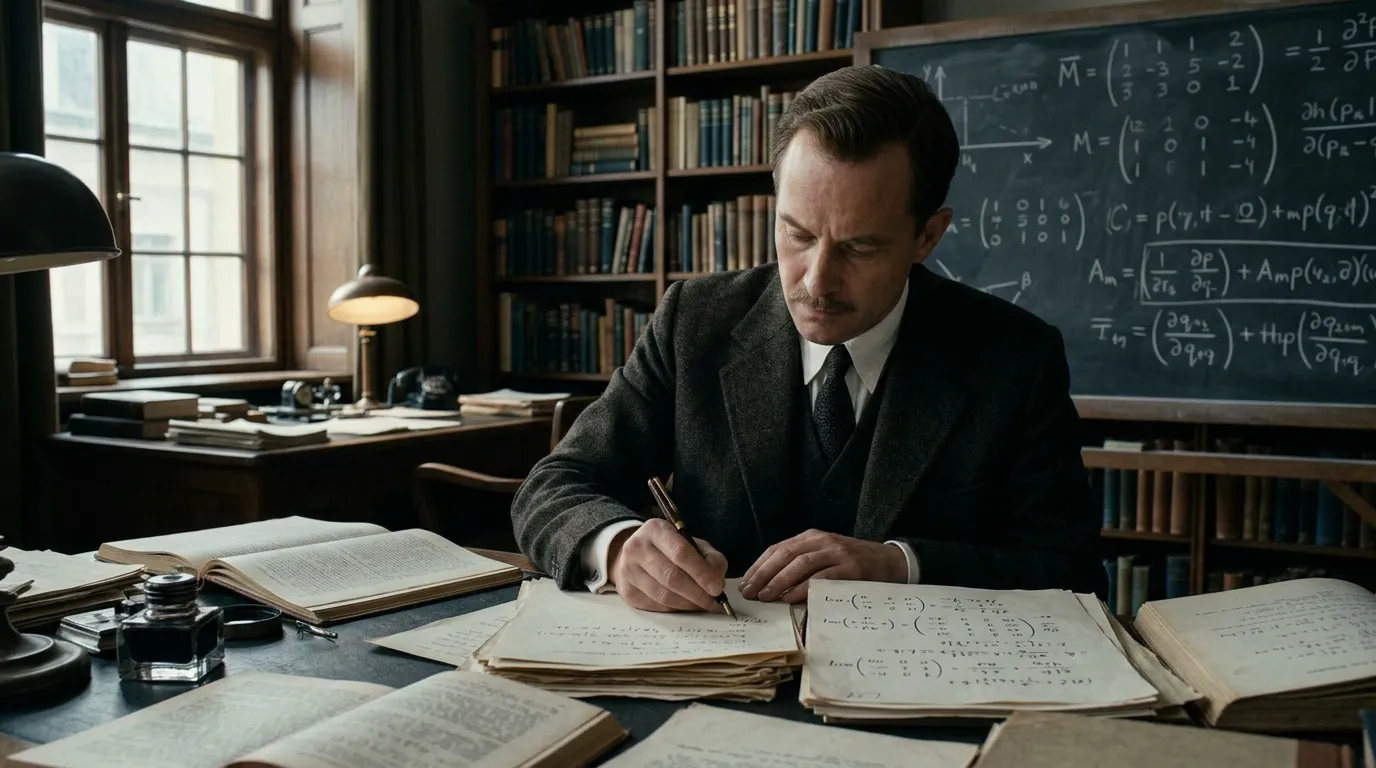
Max Born
1882–1970 · Theoretical Physicist
Making fundamental contributions to quantum mechanics, including the probabilistic interpretation of the wavefunction known as the Born rule, and helping develop matrix mechanics. He received the 1954 Nobel Prize in Physics.
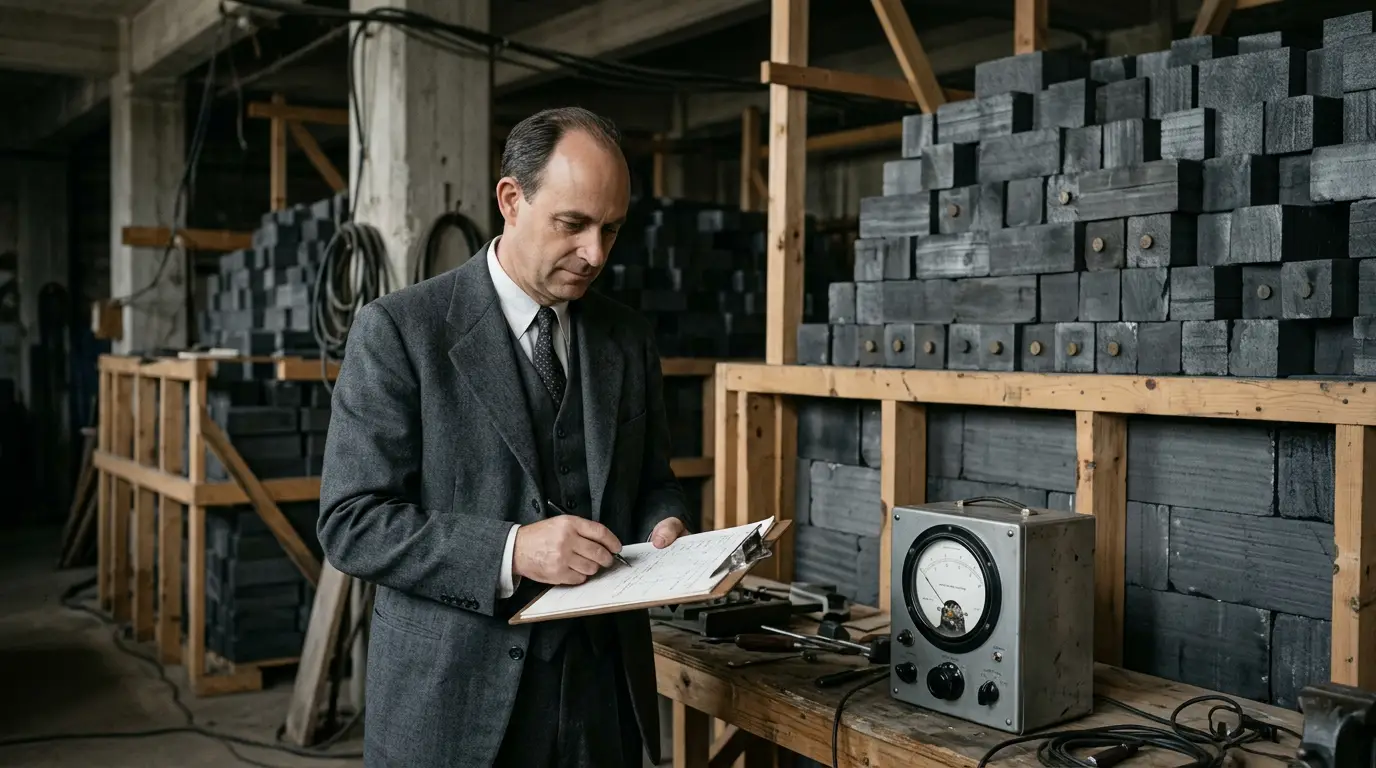
Enrico Fermi
1901–1954 · Physics — theoretical and experimental
An Italian-American physicist who led the first controlled nuclear chain reaction and developed Fermi-Dirac statistics.
Marie Curie
1867–1934 · Physicist & Chemist
Pioneering the study of radioactivity and discovering the elements polonium and radium with Pierre Curie.