_(2).jpg)

Ludwig Boltzmann
1844–1906 · Statistical mechanics and thermodynamics
Ludwig Boltzmann used probability and the motion of atoms to explain heat, gas behaviour and entropy, establishing statistical mechanics.
Why is this scientist famous?
Ludwig Boltzmann showed how the collective motion of huge numbers of particles explains the measurable properties of matter.
Statistical mechanics underlies modern materials science, chemistry, information theory and the physics of thermal systems.
Ludwig's story
A world too small to see
Ludwig Eduard Boltzmann was born in Vienna on 20 February 1844. He studied mathematics and physics at the University of Vienna and received his doctorate in 1866. Scientists were learning to measure the pressure, temperature and heat of gases, but individual atoms and molecules could not yet be observed directly. Boltzmann asked whether those large-scale properties could be explained by the different motions and energies of enormous numbers of tiny particles.
From molecules to temperature
Boltzmann developed mathematical ways of describing how many molecules occupy different energy and speed ranges. Working in a field shaped by James Clerk Maxwell, he helped establish the statistical explanation of gas behaviour. An ordinary gas does not have every molecule moving at exactly one speed. Instead, speeds follow a distribution, and measurable temperature and pressure reflect the collective behaviour of many particles. Statistical mechanics made probability an essential partner of the laws of motion.
Why time seems to have a direction
The second law of thermodynamics says that entropy tends to increase in an isolated system. Boltzmann explored why this happens if each particle still follows mechanical laws. He connected entropy to the number of microscopic arrangements compatible with a large-scale state. His analysis did not prove that every imaginable microscopic motion must increase entropy at every instant; rather, it helped explain why increasing entropy is overwhelmingly likely for familiar many-particle systems.
An equation on a gravestone
Boltzmann is closely linked with the equation S = k log W, which connects entropy with a count of possible microscopic arrangements. That compact expression was engraved on his tombstone, although historians note that he himself did not write it in precisely that famous form. He held academic positions at Graz, Vienna, Munich and Leipzig, and his explanations of atom-based physics faced critics at a time when the status of atoms was debated.
The hidden rules of everyday matter
Boltzmann died at Duino, near Trieste, on 5 September 1906. His legacy extends from gases to chemistry, computing and the study of materials. He demonstrated that a simple-looking property such as temperature can emerge from staggering numbers of microscopic events. The key idea is not that nature is lawless, but that probability becomes extraordinarily powerful when we study immense collections of particles.
What did they discover?
Statistical mechanics
Explained large-scale heat and gas behaviour using the statistics of many particles.
Entropy and probability
Related entropy to the number of microscopic arrangements associated with a state.
Molecular speed distributions
Advanced the Maxwell–Boltzmann description of gas-molecule speeds.
Atomic interpretation of heat
Helped establish a quantitative framework for the thermal movement of atoms.
Amazing facts
He earned a doctorate from the University of Vienna in 1866.
Josef Stefan was among his important teachers.
He became a professor at Graz in 1869, aged twenty-five.
He helped develop the distribution of molecular speeds named after Maxwell and Boltzmann.
He worked on electromagnetism as well as heat and probability.
He taught at several universities, including Vienna, Graz, Munich and Leipzig.
The formula S = k log W appears on his gravestone.
Historians note that the gravestone formula is not exactly how he wrote it in his original papers.
Timeline
Born in Vienna, Austrian Empire.
Earned a doctorate at the University of Vienna.
Appointed professor of mathematical physics at Graz.
Published an influential statistical analysis of gas molecules.
Became professor of mathematics at Vienna.
Returned to Graz as professor of physics.
Became professor of theoretical physics in Vienna.
Died at Duino near Trieste.
Related Super Scientists

James Clerk Maxwell
1831–1879 · Physicist & Mathematician
Developing the classical theory of electromagnetism, showing mathematically that electricity, magnetism and light are connected, and making major contributions to kinetic theory, colour science and the understanding of Saturn's rings.
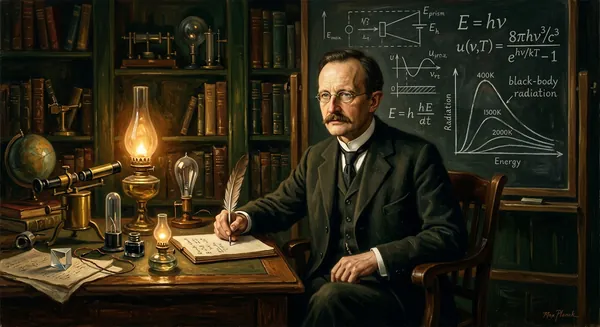
Max Planck
1858–1947 · Theoretical Physicist
Introducing the quantum of action while deriving his black-body radiation law, helping launch quantum theory.
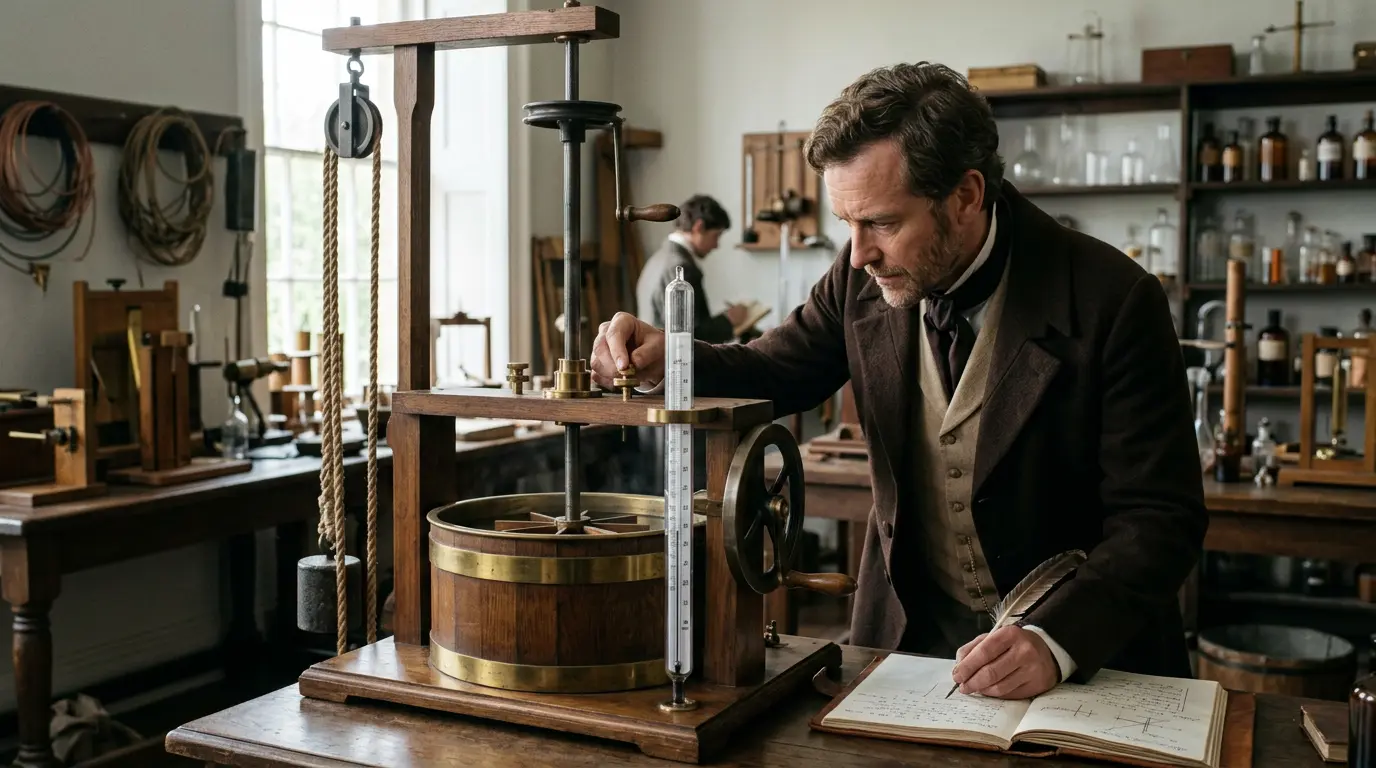
James Prescott Joule
1818–1889 · Physicist
Measured the mechanical equivalent of heat, discovered the electrical heating law bearing his name and made major contributions to the development of energy conservation and thermodynamics.