_(2).jpg)
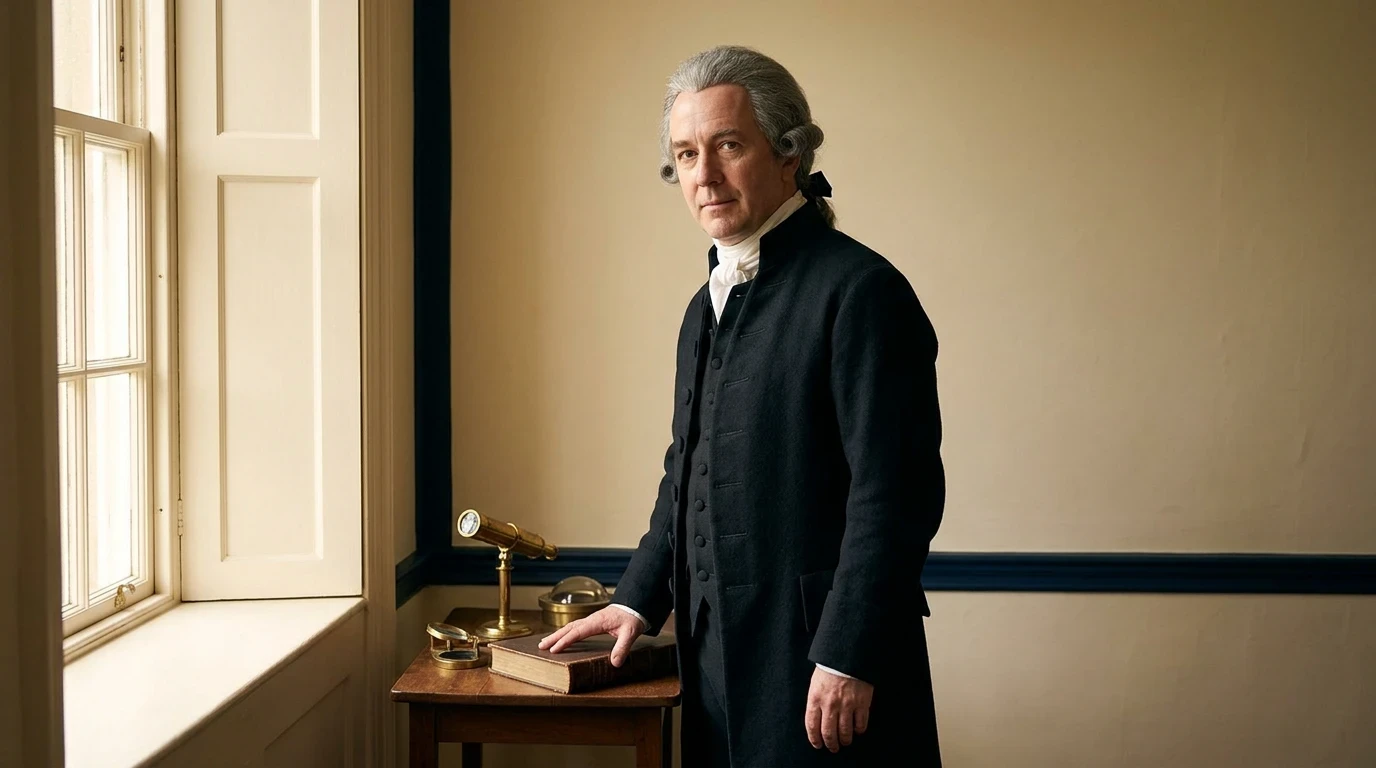
John Michell
1724–1793 · Gravitation, astronomy, magnetism and seismology
John Michell anticipated the idea of dark stars, investigated earthquakes and designed an experiment for measuring weak gravitational attraction.
Why is this scientist famous?
John Michell proposed dark stars from which light might not escape, studied earthquake waves and conceived the torsion-balance experiment later carried out by Henry Cavendish.
Michell’s work linked gravitational theory to observation. His dark-star argument anticipated a question later transformed by relativity; his torsion-balance idea led to measurements of the Earth’s density.
John's story
A mathematician who became a rector
John Michell was born on Christmas Day 1724 in Eakring, Nottinghamshire. At Queens’ College, Cambridge, he studied mathematics and developed interests far beyond one speciality. He became a fellow of the college and taught subjects including mathematics. He was later Woodwardian Professor of Geology at Cambridge, before settling as rector at Thornhill in Yorkshire. Being a clergyman did not prevent him from maintaining scientific friendships or producing original ideas about rocks, magnets and the heavens.
Earthquakes travel through the ground
After the devastating Lisbon earthquake of 1755, Michell considered how shocks travelled and why their effects reached places far from the epicentre. His study, presented to the Royal Society in 1760, argued that earthquakes spread as waves through the Earth. That was an important step towards seismology, although his explanation of their causes was not the modern theory of tectonic plates. Earlier, he had also argued that the force between magnetic poles decreased with the square of their separation, a result he did not publish with the experimental detail later associated with Coulomb.
Can a star be too massive to see?
Michell used Newtonian ideas about gravity and particle-like light to consider exceptionally massive stars. In a 1783 letter to Henry Cavendish, presented to the Royal Society and printed in 1784, he reasoned that light from some very large stars might never escape to an observer. He suggested that an unseen object could still reveal itself by the motions of a luminous companion. His “dark star” was not a modern general-relativistic black hole, but the striking question was related: could gravity hide an astronomical object from sight?
Weighing the Earth by tiny forces
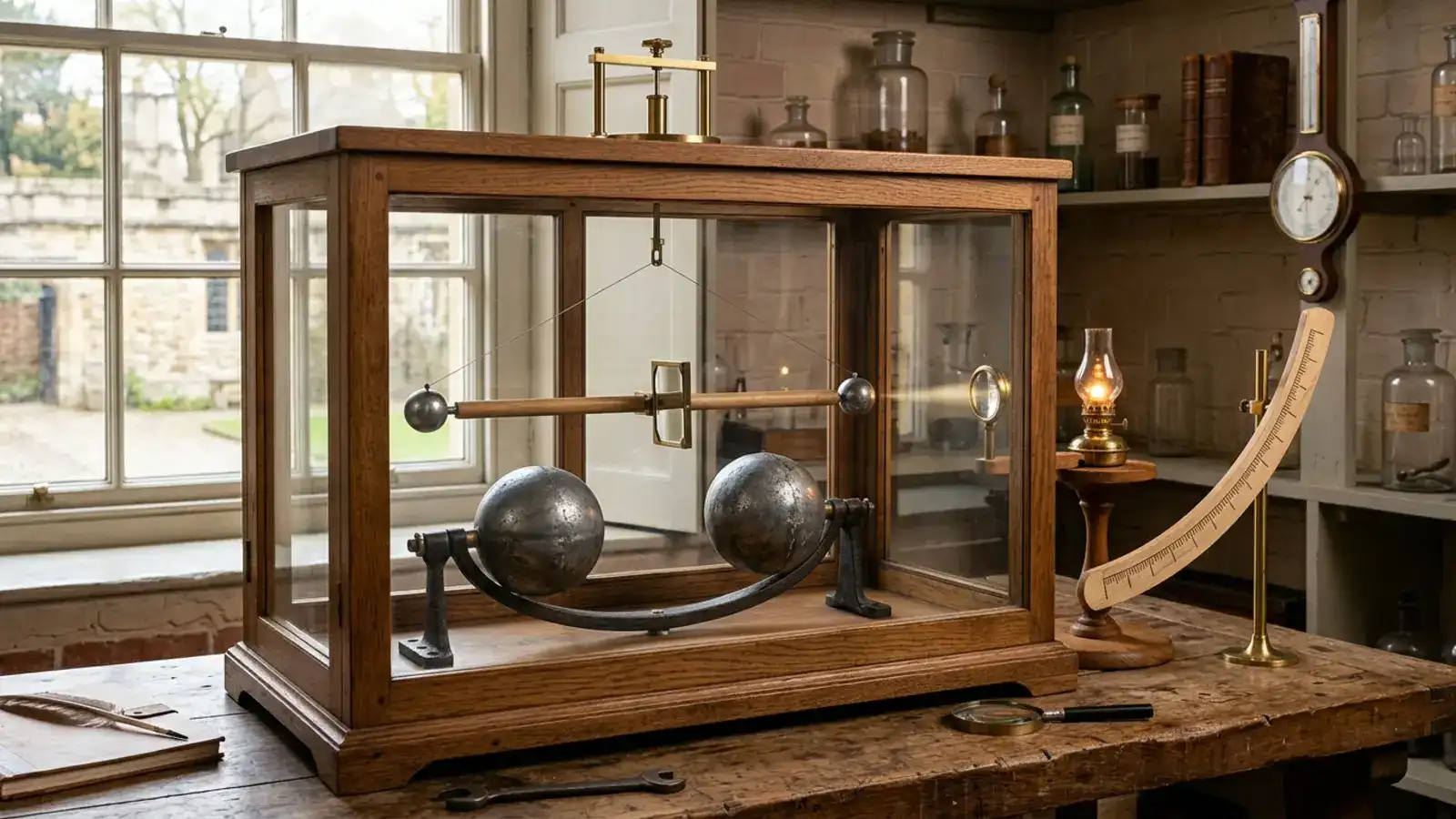
Michell also designed a torsion-balance approach to detect the extremely weak attraction between small masses. His apparatus and idea passed to Henry Cavendish, who refined the arrangement and completed the famous measurement in 1798, after Michell’s death. Cavendish’s result gave a remarkably accurate estimate of the Earth’s mean density. Giving Michell credit for conceiving the apparatus does not take away from Cavendish’s difficult and precise experiment: both contributions matter.
One scientist, several sciences
Michell examined double stars and the possibility that many apparent pairs were genuine gravitational systems rather than chance alignments. He also made reflecting telescopes and discussed the uses of astronomical measurements. His career is a reminder that early modern science rarely fitted today’s neat subject boundaries. He died at Thornhill in 1793, long before astrophysics could test ideas about objects whose gravity prevents their light from reaching us.
What did they discover?
Dark-star prediction
Used Newtonian gravity to argue that some sufficiently massive stars might be invisible yet detectable through companion stars.
Earthquake waves
Helped establish the study of earthquakes as disturbances travelling through the solid Earth.
Torsion-balance concept
Devised an apparatus and measurement strategy later used by Henry Cavendish to estimate Earth’s density.
Binary-star reasoning
Used statistical arguments to suggest that many stellar pairs are physically associated.
Amazing facts
He was born on 25 December 1724.
He served as a Church of England rector while publishing science.
He investigated the 1755 Lisbon earthquake and argued that seismic disturbances propagate as waves.
He wrote about inverse-square magnetic forces decades before Coulomb’s later experimental work.
His 1783 dark-star manuscript was published in 1784, not in 1783.
He suggested unseen stars might be inferred from the motions of visible companions.
He designed the torsion-balance apparatus idea later employed by Henry Cavendish.
No confirmed likeness of his face survives from his lifetime.
Timeline
Born in Eakring, Nottinghamshire.
Graduated from Queens’ College, Cambridge.
Presented his earthquake research to the Royal Society; elected a Fellow.
Appointed Woodwardian Professor of Geology at Cambridge.
Became rector of Thornhill, Yorkshire.
Presented through Henry Cavendish his argument about very massive dark stars; paper published in 1784.
Died at Thornhill.
Related Super Scientists
Henry Cavendish
1731–1810 · Experimental chemistry, gases and gravitation
Henry Cavendish investigated hydrogen and the composition of water and used an exceptionally sensitive torsion balance to measure the Earth’s mean density.
Isaac Newton
1643–1727 · Physicist & Mathematician
Formulating the laws of motion and universal gravitation.