_(2).jpg)
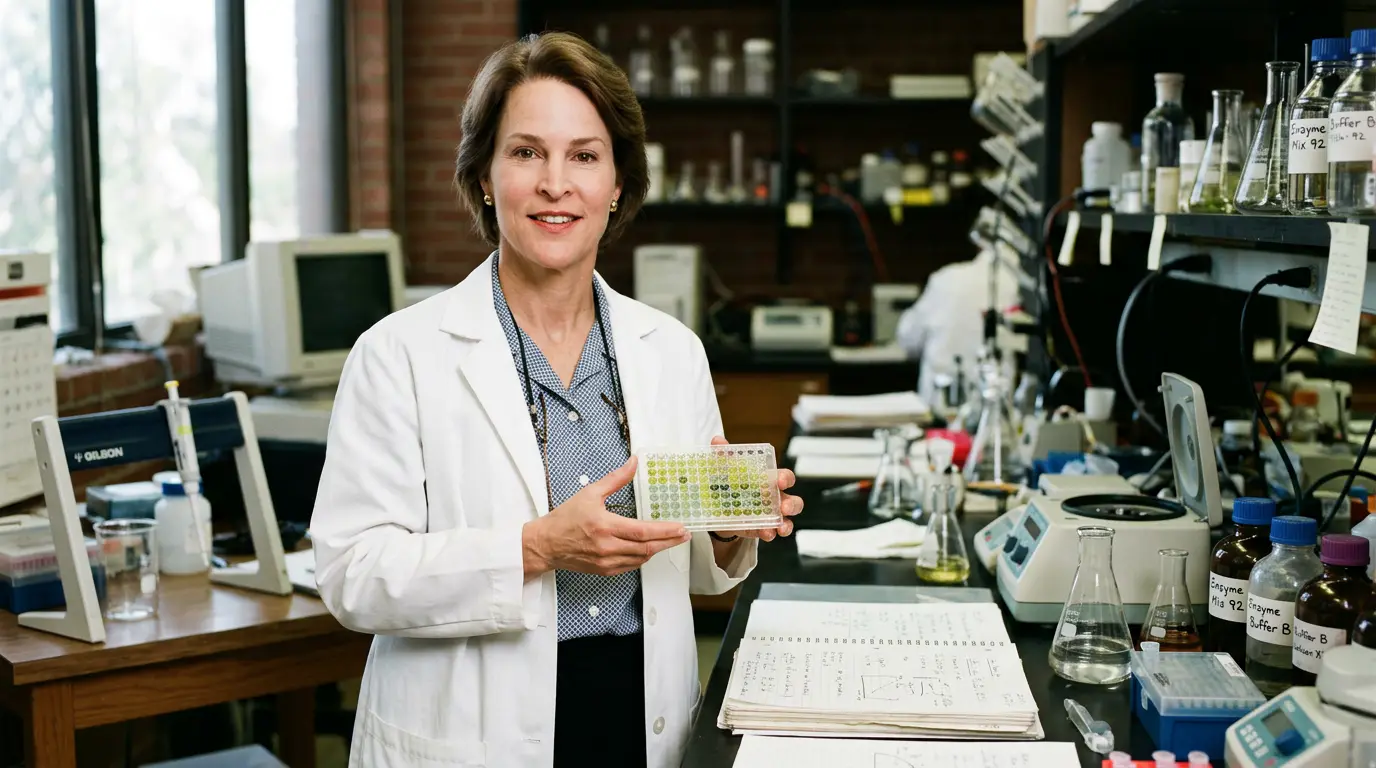
Frances H. Arnold
1956–present · Chemical engineering and protein engineering
Frances Arnold pioneered directed evolution, harnessing mutation and selection to create useful enzymes for cleaner chemistry, medicines and industry.
“I didn't want to fit into someone's box. I wanted to explore all the boxes.”
Why is this scientist famous?
Pioneered directed evolution of enzymes, using repeated mutation and selection to create proteins with useful new properties.
Directed evolution is used to create enzymes for pharmaceuticals, sustainable chemistry, fuels, diagnostics and reactions that are difficult to design from first principles.
Frances's story
An engineer who changed direction
Frances H. Arnold was born in Pittsburgh, Pennsylvania, on 25 July 1956. She studied mechanical and aerospace engineering at Princeton University, graduating in 1979. After working on solar-energy research, she moved into chemical engineering and earned a doctorate from the University of California, Berkeley, in 1985. She arrived at the California Institute of Technology in 1986 and soon began exploring how biological molecules could be engineered rather than merely analysed.
Why not let evolution do the designing?
Designing a better enzyme from its structure alone was extraordinarily difficult because scientists could not reliably predict how each genetic change would affect a protein. Arnold took a different approach. Her laboratory introduced random mutations into genes, produced many slightly different enzymes and screened them to find the best performers. The successful genes were then mutated again. Repeating this cycle copied the basic logic of natural evolution, but with researchers choosing the property they wanted to improve.
The first decisive demonstration
In the early 1990s Arnold’s group used directed evolution to improve the enzyme subtilisin so it worked far better in an organic solvent. After several rounds of mutation and selection, the evolved enzyme performed dramatically better than its starting form. The result showed that useful enzyme properties could emerge from combinations of mutations that scientists would not have known how to design directly. The method spread rapidly through protein engineering and was later extended by Arnold and many other researchers.
A technology used across chemistry
Directed evolution has been used to make catalysts for pharmaceuticals, fuels, industrial chemicals and reactions not previously known in biology. Arnold’s work earned major engineering and technology honours before she received half of the 2018 Nobel Prize in Chemistry, with the other half shared by George P. Smith and Gregory P. Winter for related uses of evolutionary methods. At Caltech she has continued developing enzyme engineering, biocatalysis and new ways of combining evolution with computation and machine learning.
What did they discover?
Directed evolution of enzymes
Arnold developed a practical cycle of mutation, screening and repeated selection that allows useful enzyme properties to evolve in the laboratory.
Improved enzyme performance
Her early experiments showed that successive rounds of directed evolution could produce enzymes that worked far better under demanding chemical conditions.
New biocatalysts
Her group has extended directed evolution to enzymes that catalyse useful reactions, including chemistry not previously known in the biological world.
Amazing facts
She earned her first degree in mechanical and aerospace engineering rather than chemistry or biology.
She worked on solar-energy research before turning to chemical engineering and protein design.
Her laboratory often finds useful mutations far from an enzyme’s active site, where their effects would have been hard to predict.
Her early directed-evolution experiments used repeated rounds of mutation and screening rather than trying to design every beneficial change in advance.
She was elected to the U.S. National Academy of Engineering in 2000.
She was inducted into the National Inventors Hall of Fame in 2014 for directed evolution of enzymes.
She became the first woman to receive the Millennium Technology Prize in 2016.
In 2018 she received half of the Nobel Prize in Chemistry for the directed evolution of enzymes.
Timeline
Born in Pittsburgh, Pennsylvania, United States.
Graduates from Princeton University in mechanical and aerospace engineering.
Completes a doctorate in chemical engineering at the University of California, Berkeley.
Arrives at Caltech, where she begins developing a research programme in protein engineering.
Publishes an influential demonstration of directed evolution applied to an enzyme.
Is elected to the U.S. National Academy of Engineering.
Receives the Charles Stark Draper Prize for Engineering.
Is inducted into the National Inventors Hall of Fame.
Receives the Millennium Technology Prize for pioneering directed evolution.
Receives half of the Nobel Prize in Chemistry for the directed evolution of enzymes.
Awards & honours
Related Super Scientists
Jennifer Doudna
1964–present · Biochemist
Co-developed CRISPR-Cas9, the gene-editing technology that allows scientists to rewrite DNA with extraordinary precision, and won the 2020 Nobel Prize in Chemistry for the work.
Linus Pauling
1901–1994 · Chemist
Transforming understanding of chemical bonding and molecular structure, major work on protein structure, and winning both the 1954 Nobel Prize in Chemistry and the 1962 Nobel Peace Prize.
Shankar Balasubramanian
1966–present · Chemistry, genetics and genome sequencing
With David Klenerman and their teams, Balasubramanian developed the sequencing-by-synthesis technology behind Solexa sequencing, an important advance in reading genomes.