_(2).jpg)
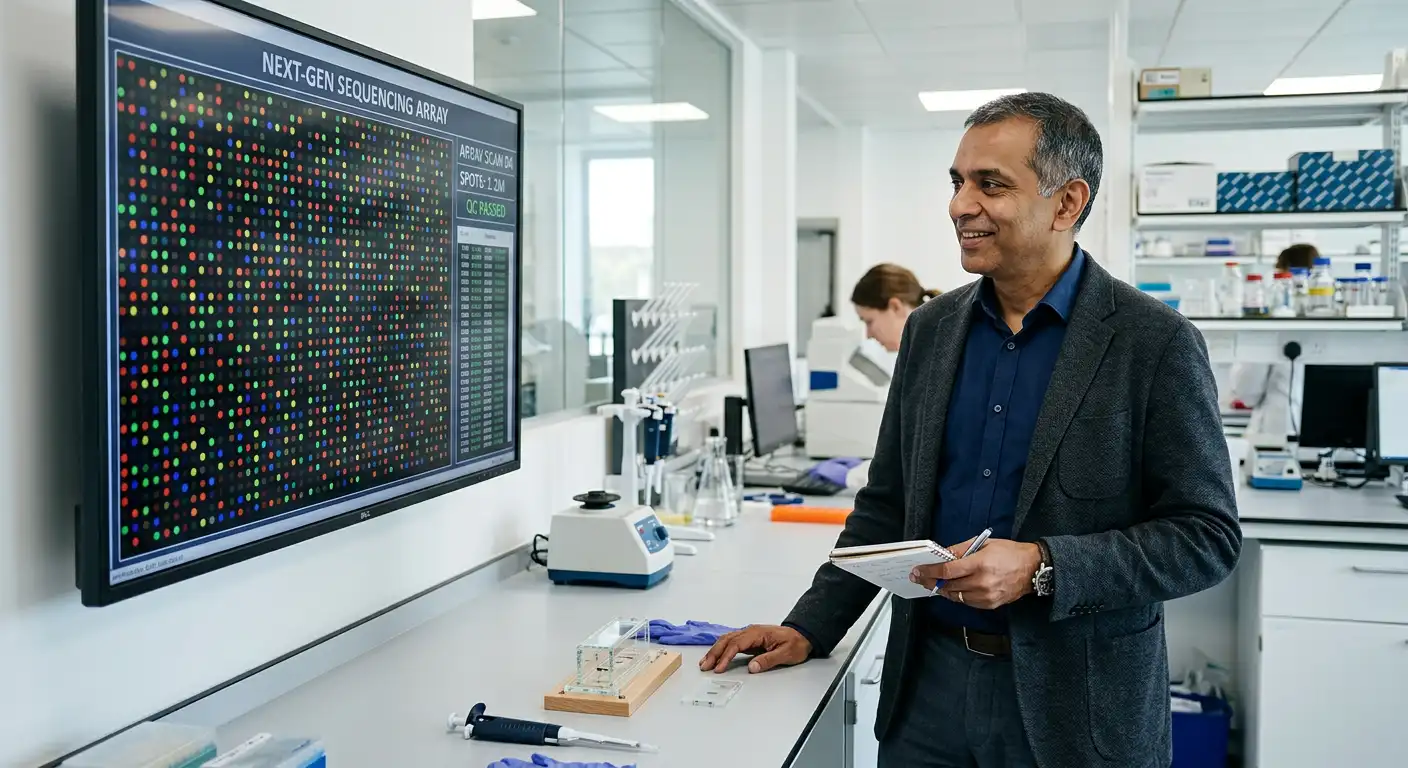
Shankar Balasubramanian
1966–present · Chemistry, genetics and genome sequencing
Shankar Balasubramanian co-developed a powerful DNA-reading method that allowed genetic information to be studied much faster and on a larger scale.
“This is how you learn, by trying things.”
Why is this scientist famous?
With David Klenerman and their teams, Balasubramanian developed the sequencing-by-synthesis technology behind Solexa sequencing, an important advance in reading genomes.
His contribution helps researchers investigate genomes at a scale once far harder to achieve. His continuing chemical biology research also asks how the structure and chemical modification of DNA affect its function.
Shankar's story
Reading life's instructions
Deoxyribonucleic acid (DNA) carries genetic information. Reading the order of its chemical building blocks is called sequencing. Shankar Balasubramanian helped develop a way to read huge numbers of DNA fragments in parallel, making large-scale studies more practical.
Born in Madras, now Chennai, in 1966, he moved to Britain with his family the following year. He studied natural sciences at the University of Cambridge and then completed a doctorate in enzyme chemistry. After postdoctoral research at Pennsylvania State University, he joined Cambridge's faculty in 1994.
From molecular chemistry to a new technology
At Cambridge, Balasubramanian began collaborating with David Klenerman. Their work explored watching DNA being copied using fluorescence, a process in which a substance absorbs light and emits light. This research helped lead to a practical approach to sequencing.
In sequencing by synthesis, a DNA-copying enzyme adds building blocks to a growing strand. Fluorescent labels allow instruments to identify additions over repeated cycles. Many fragments can be processed at once, and computers handle the resulting information. Balasubramanian and Klenerman founded Solexa in 1998 to develop the technology; Illumina acquired the company in 2007. Their advance built on earlier sequencing research and the work of many colleagues.
Exploring DNA's chemistry
Balasubramanian's research extends beyond sequencing instruments. His group studies the chemistry and behaviour of nucleic acids, including structures called G-quadruplexes. These can form in guanine-rich DNA regions and involve four strands or strand segments coming together. Investigating such structures helps researchers explore how DNA's shape and chemistry relate to gene activity.
Science with wide applications
Large-scale sequencing has become important for studying human variation, disease and many other biological questions. Balasubramanian shared the 2022 Breakthrough Prize in Life Sciences with Klenerman and Pascal Mayer. The same three researchers received the 2026 Wolf Prize in Chemistry for their contributions to low-cost next-generation DNA sequencing. These awards recognise advances made through different, complementary contributions to the field.
What did they discover?
Sequencing by synthesis
Co-developed the fluorescence-based DNA sequencing approach that allows millions of short DNA fragments to be read in parallel, enabling fast, large-scale genome sequencing.
Solexa sequencing platform
Co-founded Solexa (1998) to commercialise sequencing-by-synthesis technology; the platform was acquired by Illumina in 2007 and became foundational to modern genomics.
G-quadruplex biology
Led research into four-stranded DNA structures (G-quadruplexes) that form in guanine-rich regions, exploring how their chemistry and presence relate to gene activity.
Amazing facts
His work connects chemistry with the study of genes.
The DNA-reading method uses fluorescent signals.
It reads many DNA fragments in parallel.
He helped turn university research into a company.
His laboratory also investigates unusual four-stranded DNA structures.
He leads research associated with both Cambridge chemistry and its cancer research institute.
Timeline
Born in Madras, India.
Completes his Cambridge bachelor's degree.
Completes his Cambridge doctorate.
Joins the Cambridge faculty.
Co-founds Solexa with David Klenerman.
Illumina acquires Solexa.
Receives a knighthood for services to science and medicine.
Shares the Breakthrough Prize in Life Sciences with David Klenerman and Pascal Mayer.
Shares the Wolf Prize in Chemistry for pioneering DNA sequencing.
Awards & honours
Related Super Scientists
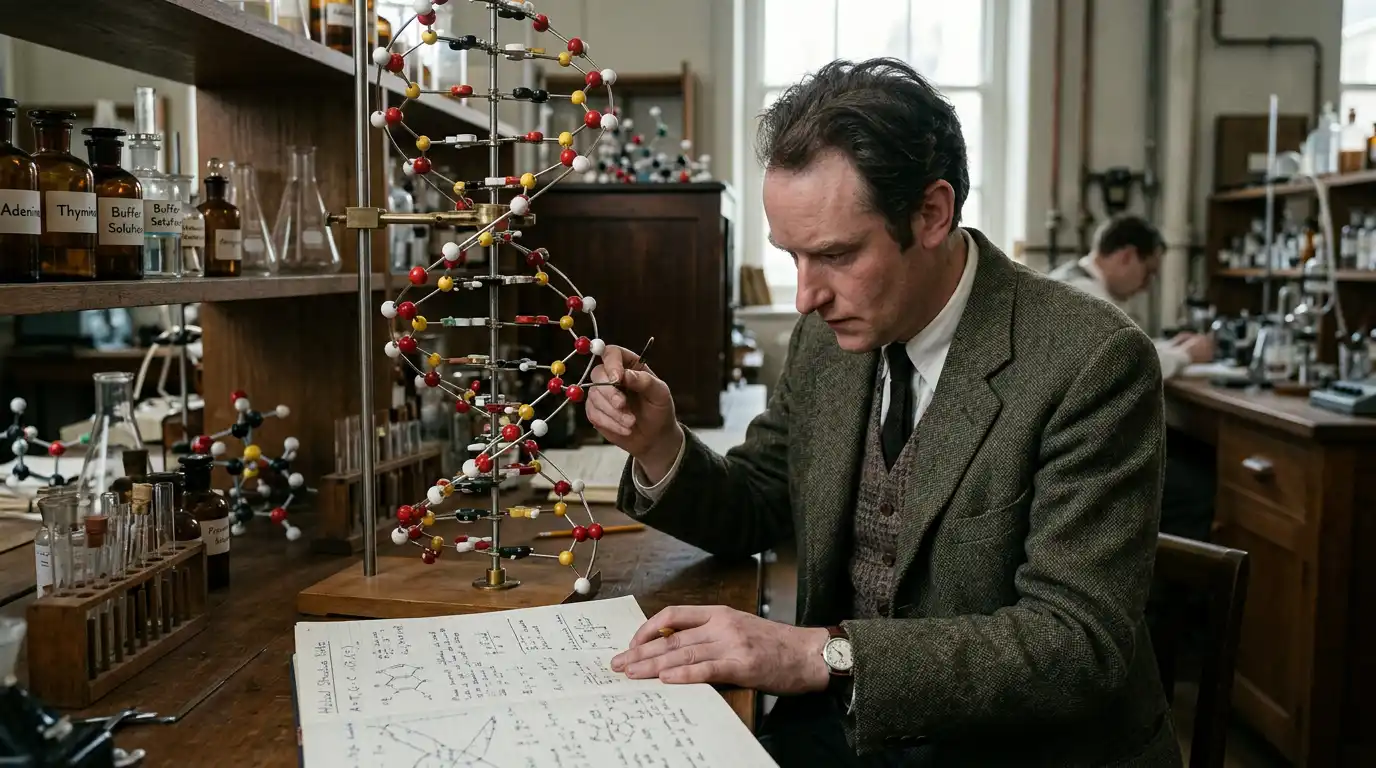
Francis Crick
1916–2004 · Molecular Biologist
Working with James Watson to develop the double-helix model of DNA in 1953 and later making major contributions to understanding genetic information and the genetic code. He shared the 1962 Nobel Prize in Physiology or Medicine with James Watson and Maurice Wilkins.
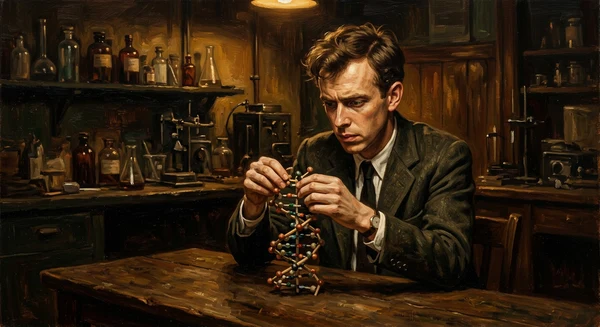
James Watson
1928–2025 · Molecular Biologist & Geneticist
Helping determine the double-helix structure of DNA with Francis Crick in 1953, using crucial X-ray diffraction and other experimental evidence produced by researchers including Rosalind Franklin, Raymond Gosling and Maurice Wilkins.