_(2).jpg)
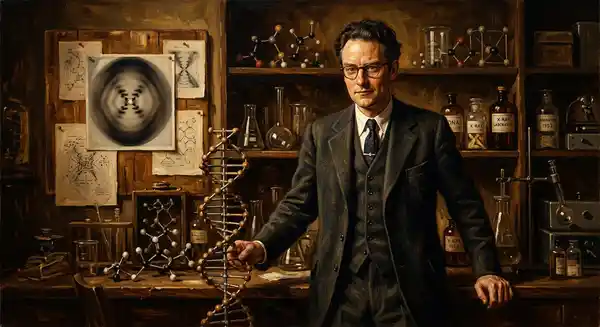
Francis Crick
1916–2004 · Molecular Biologist
Francis Crick was a British molecular biologist who worked with James Watson to develop the double-helix model of DNA in 1953. He shared the 1962 Nobel Prize in Physiology or Medicine with Watson and Maurice Wilkins.
“Almost all aspects of life are engineered at the molecular level, and without understanding molecules we can only have a very sketchy understanding of life itself.”
Why is this scientist famous?
Working with James Watson to develop the double-helix model of DNA in 1953 and later making major contributions to understanding genetic information and the genetic code. He shared the 1962 Nobel Prize in Physiology or Medicine with James Watson and Maurice Wilkins.
Francis's story
From Physics to Biology
Francis Harry Compton Crick was born on 8 June 1916 in Northampton, England. He was educated at Northampton Grammar School and Mill Hill School, then studied physics at University College London, receiving his BSc in 1937.
Crick began PhD research in physics, but his work was interrupted by the Second World War. During the war he worked for the British Admiralty on magnetic and acoustic mines. He left the Admiralty in 1947 and moved into biological research, working at the Strangeways Research Laboratory in Cambridge.
The DNA Double Helix
In 1949, Crick joined the Medical Research Council unit at the Cavendish Laboratory in Cambridge, led by Max Perutz. He met James Watson in Cambridge in 1951, and they began working together on the structure of DNA.
In 1953, Watson and Crick proposed the double-helix model of DNA. Their achievement was developing the double-helical molecular model — not discovering DNA itself. Important contributors to this work included Rosalind Franklin, whose X-ray diffraction work at King's College London was central to understanding the structure. Raymond Gosling produced Photograph 51 under Franklin's supervision, and Maurice Wilkins conducted X-ray studies of DNA at King's College London. Erwin Chargaff established important relationships among DNA base quantities.
Photograph 51 was not Watson's or Crick's photograph. The contributions of Franklin, Wilkins and others were essential to the model Watson and Crick proposed.
The Genetic Code
Crick completed a PhD in 1954 relating to X-ray diffraction of polypeptides and proteins — completing his doctorate after the DNA double-helix paper appeared.
Crick continued making major contributions after 1953. His later work included ideas about how genetic information is transferred, the adaptor hypothesis, and work with Sydney Brenner and others on the genetic code. He was elected a Fellow of the Royal Society in 1959.
The 1962 Nobel Prize in Physiology or Medicine was shared by Francis Crick, James Watson and Maurice Wilkins. Rosalind Franklin died in 1958 and could not receive the prize.
Later Career and Legacy
In 1976, Crick moved to the Salk Institute in California. His later research included neurobiology and the study of consciousness.
Crick died on 28 July 2004 in San Diego, California. His scientific importance extends well beyond the double helix — his work on the genetic code helped explain how biological information is stored and read in living organisms.
What did they discover?
The DNA Double Helix
In 1953, Crick and James Watson proposed the double-helix model of DNA. Important contributors included Rosalind Franklin's X-ray diffraction work, Maurice Wilkins's X-ray studies, and Erwin Chargaff's base-composition findings.
The Genetic Code
After 1953, Crick made major contributions to understanding how genetic information is transferred, including the adaptor hypothesis and work with Sydney Brenner on the genetic code.
Nobel Prize in Physiology or Medicine, 1962
Crick shared the 1962 Nobel Prize with James Watson and Maurice Wilkins for their work on the molecular structure of nucleic acids.
Amazing facts
Crick trained first as a physicist rather than a biologist.
His original PhD work was interrupted by the Second World War.
He worked on naval mine research during the war.
He completed his eventual PhD after the DNA double-helix paper appeared.
His later career included work on the genetic code and neuroscience.
Timeline
Born in Northampton, England.
Received BSc in physics from University College London.
Wartime Admiralty research began.
Joined the MRC unit at the Cavendish Laboratory, Cambridge.
Began working closely with James Watson.
Watson and Crick proposed the DNA double-helix model.
Completed his PhD.
Elected Fellow of the Royal Society.
Shared the Nobel Prize in Physiology or Medicine with Watson and Wilkins.
Moved to the Salk Institute in California.
Died in San Diego, California, USA.
Awards & honours
Related Super Scientists
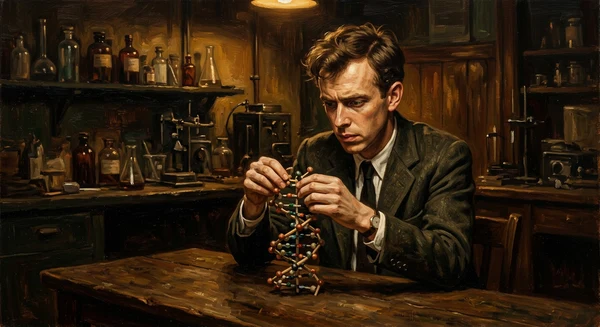
James Watson
1928–2025 · Molecular Biologist & Geneticist
Helping determine the double-helix structure of DNA with Francis Crick in 1953, using crucial X-ray diffraction and other experimental evidence produced by researchers including Rosalind Franklin, Raymond Gosling and Maurice Wilkins.
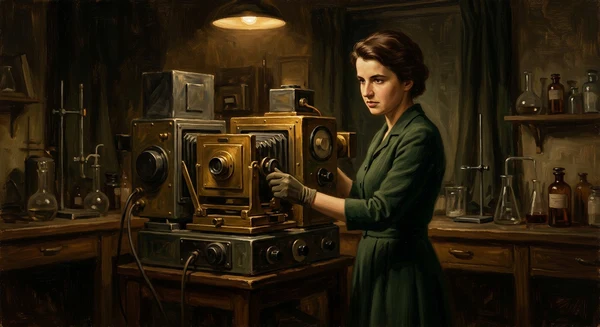
Rosalind Franklin
1920–1958 · Chemist & X-ray Crystallographer
Producing crucial X-ray diffraction data on DNA, including Photograph 51, with her student Raymond Gosling.
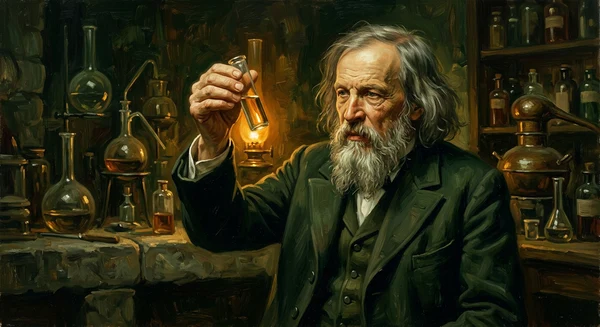
Dmitri Mendeleev
1834–1907 · Chemist & Inventor
Developed an influential periodic table and periodic law, leaving gaps for undiscovered elements and predicting several of their properties.