_(2).jpg)
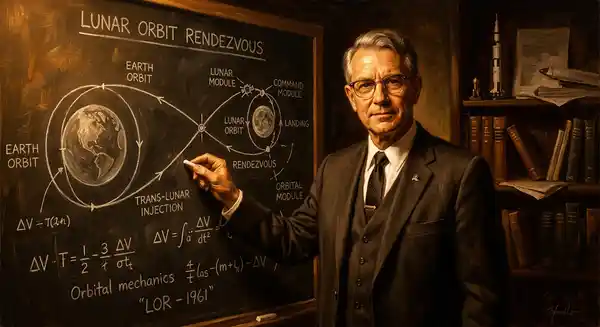
John C. Houbolt
1919–2014 · Aerospace Engineer
John C. Houbolt was an American aerospace engineer who became the most persistent and influential advocate for Lunar Orbit Rendezvous within NASA, playing an important role in its adoption for the Apollo programme.
“I believe the ultimate deliverable is not just going somewhere, but being able to come back.”
Why is this scientist famous?
His persistent technical advocacy of Lunar Orbit Rendezvous (LOR), the mission architecture NASA ultimately used for Apollo lunar landings.
John's story
An Engineer at Langley
John Cornelius Houbolt was born on 10 April 1919 in Altoona, Iowa, USA. He received his BS in Civil Engineering from the University of Illinois in 1940 and his MS in Civil Engineering from the same university in 1942.
In 1942, Houbolt joined NACA's Langley laboratory. He served in the Army Air Corps from 1944 to 1946, then returned to his research career. He earned a doctorate in technical sciences from ETH Zurich in 1957.
Lunar Orbit Rendezvous
Houbolt worked extensively in structural dynamics, aeroelasticity and orbital mechanics. He became one of NASA's strongest advocates for Lunar Orbit Rendezvous, or LOR — a mission architecture in which a separate lunar lander would travel to the Moon while the main spacecraft remained in lunar orbit.
Houbolt did not originate the concept alone. Other engineers, including William H. Michael Jr. and wider Langley teams, had investigated related rendezvous ideas. However, Houbolt became the most persistent and influential advocate for LOR within NASA.
He argued that LOR could reduce the mass and complexity of a lunar landing mission compared to alternative approaches. He bypassed normal management channels to argue directly for LOR, and his persistence helped persuade NASA leadership to adopt it for Apollo in 1962.
Beyond Apollo
Houbolt left NASA in 1963 to work at Aeronautical Research Associates of Princeton. He returned to NASA Langley in 1976 as Chief Aeronautical Scientist and retired in 1985.
His wider career included important work in structural dynamics and aeroelasticity. He authored more than 120 technical publications over his career. Houbolt was elected to the National Academy of Engineering in 1990.
Houbolt died on 15 April 2014 in Scarborough, Maine, USA.
What did they discover?
Advocacy of Lunar Orbit Rendezvous
Houbolt became the most persistent and influential advocate for LOR within NASA. He did not originate the concept alone, but his persistence helped persuade NASA to adopt LOR for Apollo in 1962.
NASA Exceptional Scientific Achievement Medal, 1963
Houbolt received the NASA Exceptional Scientific Achievement Medal in 1963 for his contributions.
Amazing facts
Houbolt bypassed normal management channels to argue directly for LOR.
His wider career included important work in structural dynamics and aeroelasticity.
He authored more than 120 technical publications.
He earned a doctorate in technical sciences from ETH Zurich in 1957.
He served in the Army Air Corps from 1944 to 1946.
Timeline
Born in Altoona, Iowa, USA.
Received BS in Civil Engineering from the University of Illinois.
Received MS in Civil Engineering; joined NACA Langley laboratory.
Received doctorate in technical sciences from ETH Zurich.
NASA chose Lunar Orbit Rendezvous for Apollo.
Received NASA Exceptional Scientific Achievement Medal.
Returned to NASA Langley as Chief Aeronautical Scientist.
Retired.
Elected to the National Academy of Engineering.
Died in Scarborough, Maine, USA.