_(2).jpg)
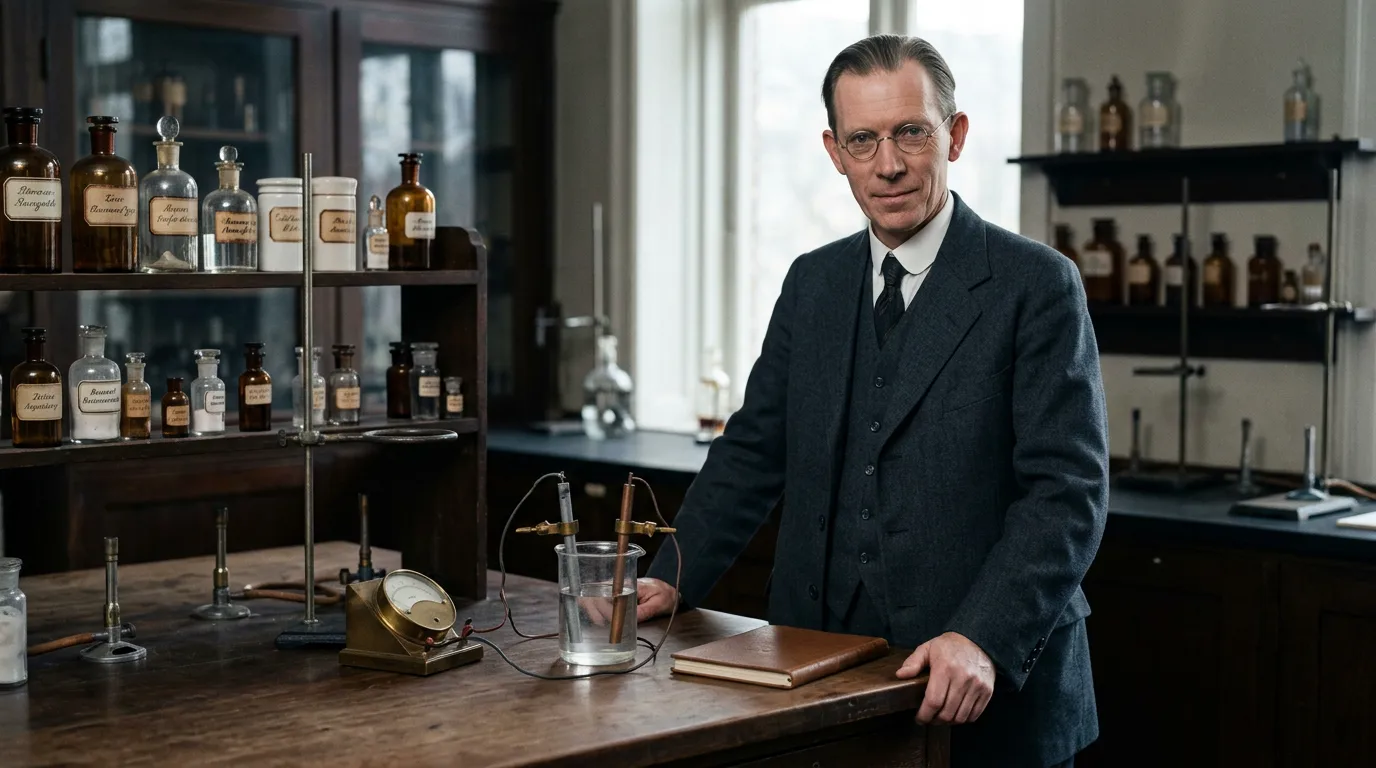
Johannes Nicolaus Brønsted
1879–1947 · Physical chemistry and acid–base theory
Johannes Brønsted explained acids and bases through the transfer of protons, transforming chemistry while also investigating solutions and reactions.
Why is this scientist famous?
Johannes Brønsted independently developed a proton-transfer theory of acids and bases in 1923, now known as Brønsted–Lowry theory.
The Brønsted–Lowry model helps students and chemists explain acid–base reactions, chemical equilibria and how substances behave in solutions.
Johannes's story
An engineer in training turns to chemistry
Johannes Nicolaus Brønsted was born on 22 February 1879 in Varde, Denmark. He originally studied engineering in Copenhagen, but chemical questions drew him in another direction. He earned a university qualification in chemistry in 1902 and completed a doctorate in 1908 by investigating what happens when different liquids are mixed. That year, after a competition with fellow chemist Niels Bjerrum, he was appointed to a new professorship in chemistry at the University of Copenhagen. His career would show how measuring the behaviour of substances can change the ideas used to explain them.
What makes a solution behave differently?
Brønsted worked in physical chemistry, which uses measurements and physical laws to understand chemical change. He studied why dissolved salts did not always behave as their concentrations alone might suggest. In such solutions, charged particles called ions affect one another, changing how they take part in reactions. He also studied chemical affinity, a way of examining how strongly chemical processes tend to proceed. These investigations made him attentive to the limits of familiar explanations of acids and bases.
A new way to think about acids and bases
Earlier definitions, especially that associated with Svante Arrhenius, often described acids and bases through the ions produced when substances dissolve in water. Brønsted saw that a more general explanation was needed. In 1923 he proposed that an acid is a substance capable of donating a proton, which is a positively charged hydrogen ion, while a base can accept one. An acid–base reaction could therefore be understood as a proton passing from one chemical species to another. The definition works beyond reactions in water and does not require every base to begin by producing hydroxide ions. It gave chemists a clear way to explain reactions that older definitions treated awkwardly.
An independent idea, and a useful pair
In the same year, British chemist Thomas Martin Lowry independently developed a closely related proton-transfer account. Their names now appear together in the Brønsted–Lowry theory, so the work should not be credited to Brønsted alone. When an acid gives away a proton, what remains is its conjugate base; when a base gains a proton, it becomes its conjugate acid. For example, ammonia can accept a proton from water and become an ammonium ion, while the water becomes a hydroxide ion. This makes acid–base chemistry a story of interacting partners, not simply a list of chemicals labelled acidic or alkaline. Gilbert Newton Lewis presented a different, wider electron-pair definition in 1923, which chemists also use today.
More than proton transfers
Brønsted researched reaction speeds, acid–base catalysis and the unusual behaviour of ions in solution. In 1920 he and George de Hevesy investigated separating mercury isotopes by careful distillation, achieving partial separation. His research also involved the chemistry of mixtures and the energy changes accompanying reactions. He directed the University of Copenhagen’s physical chemistry institute from 1930 and received the H. C. Ørsted Medal in 1928. The range of this work shows that his famous acid–base idea grew out of a much broader effort to make chemistry measurable.
A scientist with interests beyond the laboratory
Brønsted cared about protecting natural landscapes and became interested in political questions after the Second World War. In 1946 he also published an alternative presentation of thermodynamics that provoked debate and did not gain general acceptance. In October 1947 he was elected to the Danish parliament, but he died before taking his seat. He died in Copenhagen on 17 December 1947. His proton-transfer model remains a basic tool for understanding reactions in school chemistry, research laboratories and living systems.
What did they discover?
Proton-transfer acid–base theory
Defined an acid as a proton donor and a base as a proton acceptor in 1923, independently of Thomas Martin Lowry.
Conjugate acid–base relationships
Helped establish a framework in which donating a proton leaves a conjugate base and accepting one creates a conjugate acid.
Behaviour of electrolyte solutions
Investigated how interactions between dissolved ions influence the properties and effective activity of chemical substances.
Chemical affinity and reaction rates
Advanced the measurement and interpretation of how chemical reactions proceed and how their speeds depend on the reacting system.
Isotope separation research
Collaborated with George de Hevesy on the partial separation of mercury isotopes by distillation.
Amazing facts
He completed the first stage of an engineering examination before choosing university chemistry.
His 1908 doctoral research examined the behaviour of mixtures of different liquids, rather than the acid–base theory for which he became famous.
He won a competition for a newly established chemistry professorship against fellow Danish chemist Niels Bjerrum.
For years he also taught chemistry to engineering students, including future mechanical and electrical engineers.
His wife, Charlotte Warberg Brønsted, was among Denmark’s first five women to complete an engineering education.
He spent time as a visiting professor at Yale University in 1926.
He received the H. C. Ørsted Medal in 1928, named in honour of another important Danish scientist.
He was elected to Denmark’s parliament in 1947 but died before he could take his seat.
Timeline
Born in Varde, Denmark.
Completed the first part of his engineering examinations in Copenhagen.
Completed a university degree in chemistry.
Earned his doctorate and was appointed to a newly created university chemistry professorship.
Elected to the Royal Danish Academy of Sciences and Letters.
Worked with George de Hevesy on the partial separation of mercury isotopes.
Published his proton-transfer definition of acids and bases, independently of Thomas Martin Lowry.
Received the H. C. Ørsted Medal.
Became director of the University of Copenhagen’s physical chemistry institute.
Presented a disputed alternative formulation of thermodynamics.
Elected to Denmark’s parliament but did not take his seat.
Died in Copenhagen, Denmark.
Awards & honours
Related Super Scientists
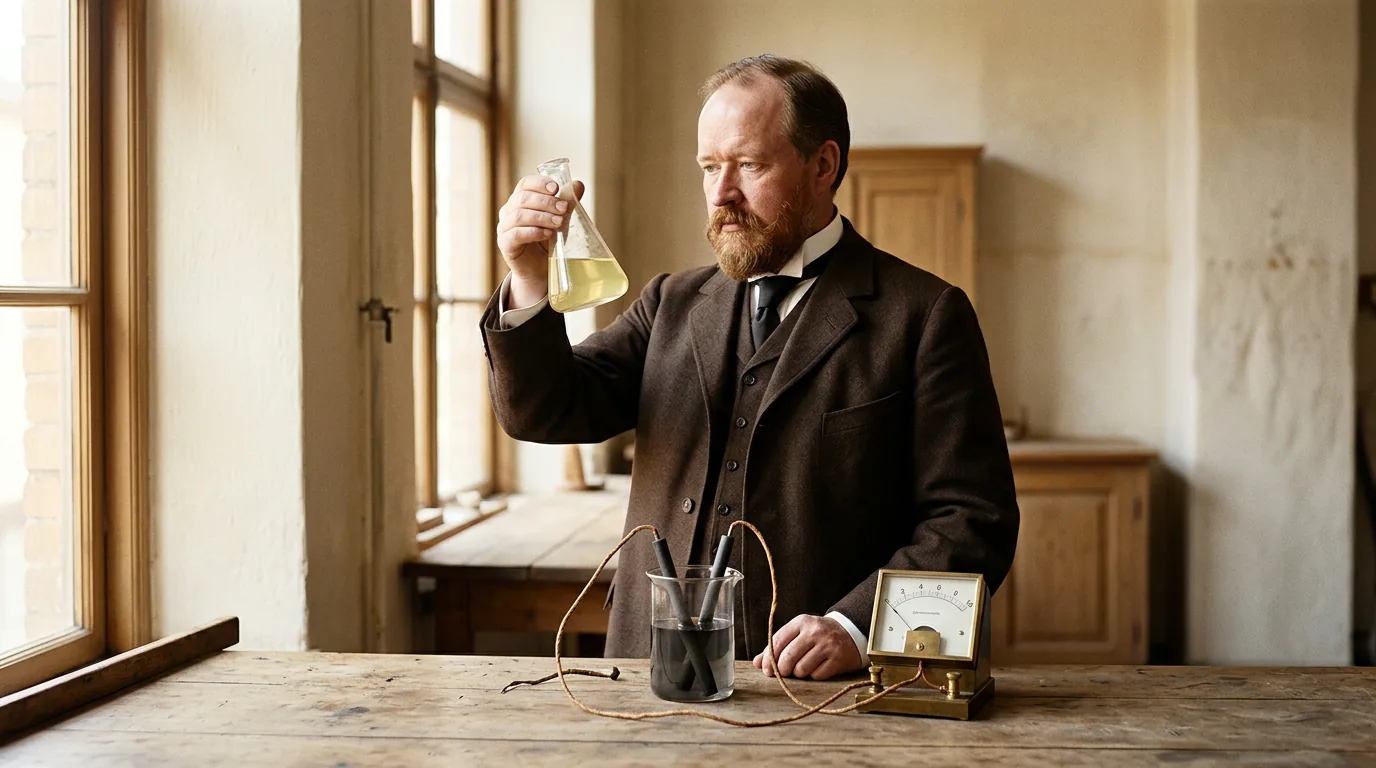
Svante Arrhenius
1859–1927 · Physical chemistry, electrolytes and early climate science
Svante Arrhenius explained how dissolved substances produce ions, developed chemical kinetics concepts and calculated how atmospheric carbon dioxide might affect climate.
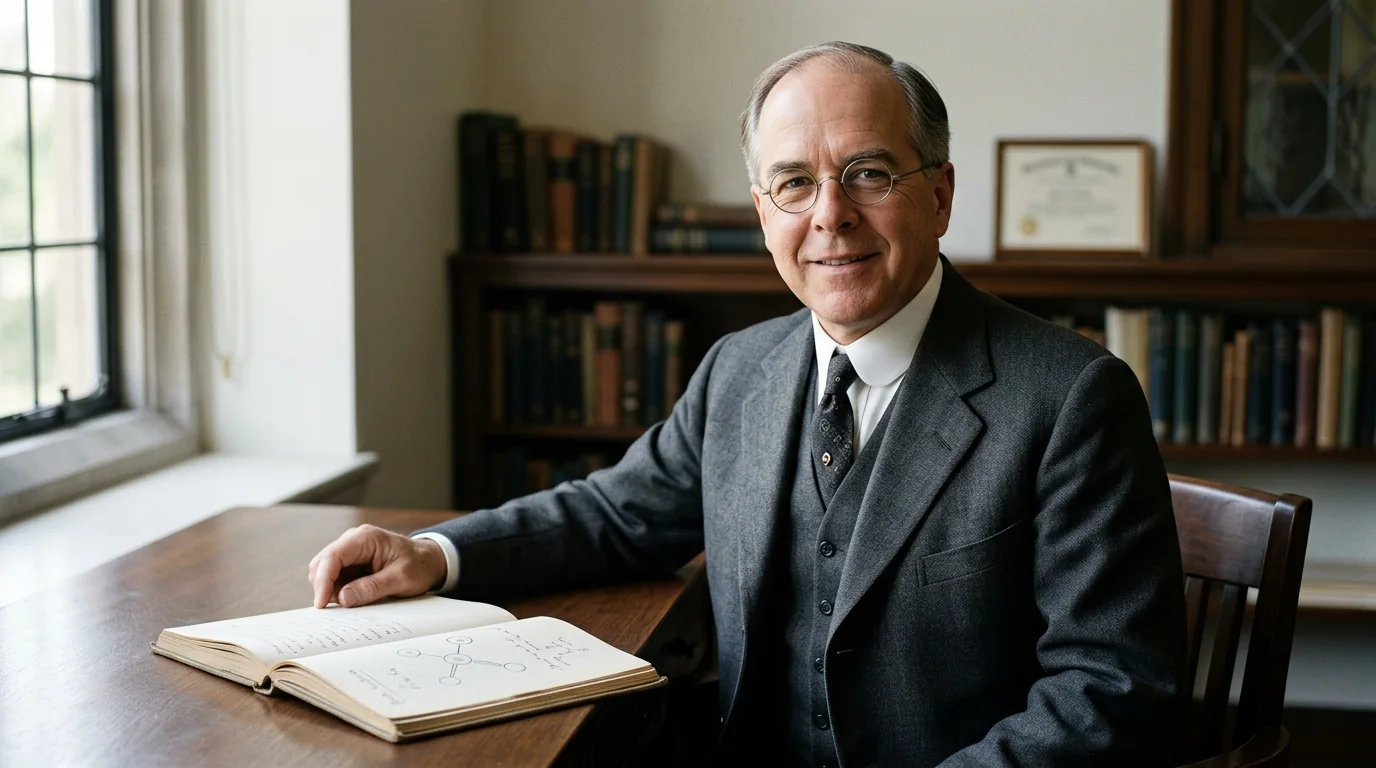
Gilbert Newton Lewis
1875–1946 · Chemical bonding, thermodynamics and acids and bases
Gilbert N. Lewis developed the electron-pair model of covalent bonding and Lewis structures, transforming how chemists explain atoms sharing electrons.