_(2).jpg)
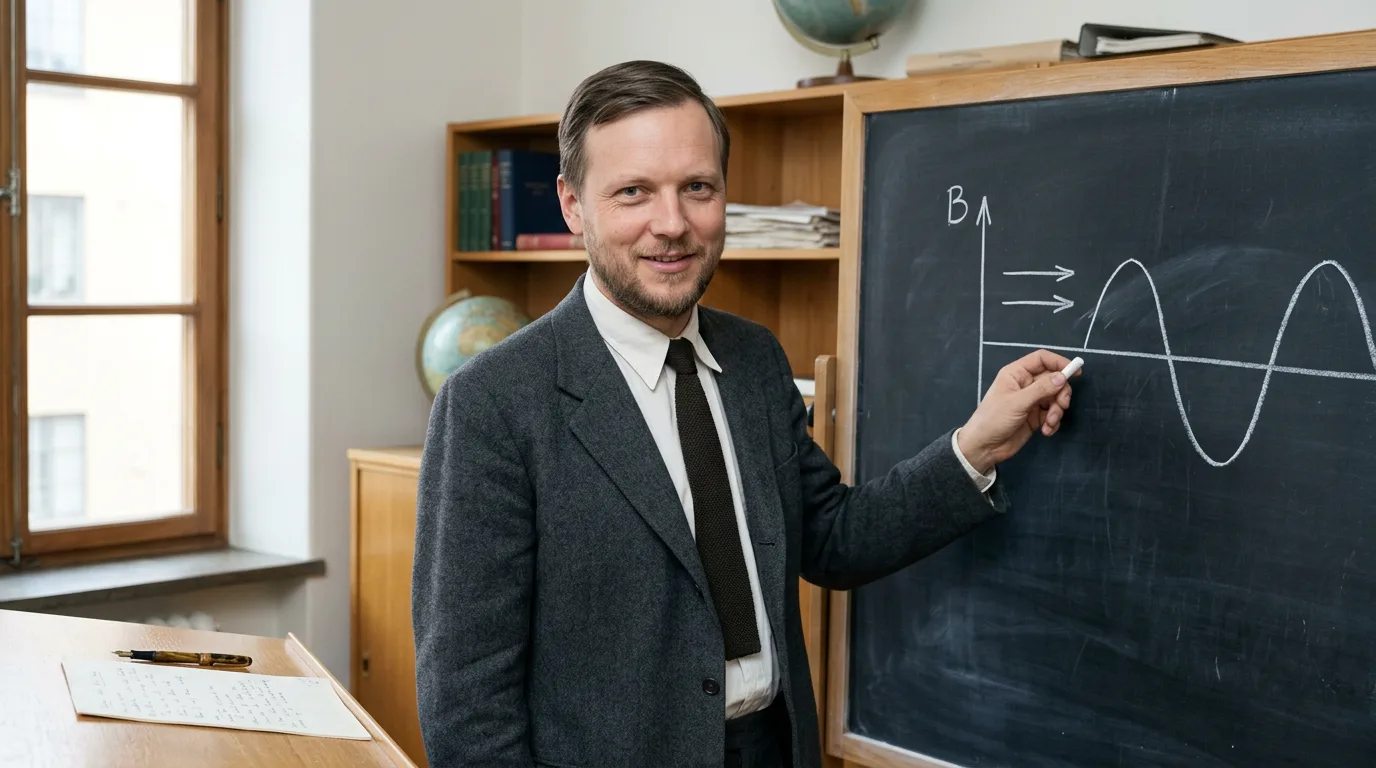
Hannes Alfvén
1908–1995 · Plasma physics and magnetohydrodynamics
Physicist Hannes Alfvén predicted waves travelling through magnetised plasma and helped establish the science used to study the Sun, space and auroras.
Why is this scientist famous?
Hannes Alfvén predicted waves that travel through electrically conducting matter in magnetic fields, helping explain the behaviour of plasma in space.
Understanding Alfvén waves helps researchers study the solar wind, auroras, plasma around planets and processes involved in fusion research.
Hannes's story
A world filled with invisible forces
Hannes Alfvén was born in Norrköping, Sweden, on 30 May 1908, and grew up in a family in which both parents were doctors. He studied physics at Uppsala University and completed a doctorate in 1934. His interests included electricity, magnetic fields and the motions of matter in space. These topics would soon come together in a new way of thinking about the Sun and its surroundings. Alfvén later became a professor at the Royal Institute of Technology in Stockholm, now known as KTH.
Matter that behaves like a fluid
Most material around us is made of solid objects, liquids or gases, but very hot or energetic gas can become plasma. Plasma contains charged particles, so electric and magnetic forces can shape the way it moves. Alfvén realised that plasma and magnetic fields should not always be studied separately. Instead, a moving electrically conducting fluid and the magnetic field running through it can influence each other. This interaction belongs to a field called magnetohydrodynamics, often shortened to MHD.
Predicting a new kind of wave
In 1942 Alfvén published a prediction that waves could travel through an electrically conducting fluid threaded by a magnetic field. In a simplified picture, a disturbed magnetic field can behave a little like a stretched string that carries a travelling wave. These disturbances are now called Alfvén waves. Other physicists were not immediately convinced, and experimental confirmation developed gradually. The idea eventually became central to understanding how energy and disturbances move through plasmas in space.
The physics of the Sun and Earth
The Sun continually releases a stream of charged particles known as the solar wind. Alfvén’s ideas gave scientists a way to investigate waves and magnetic interactions within that moving plasma. Similar physics is useful when studying Earth’s magnetic environment and the auroras that can light up polar skies. Plasma behaviour also matters in devices that attempt to use nuclear fusion as an energy source. Scientists have refined and extended Alfvén’s ideas as observations and experiments have improved.
A Nobel Prize and a lasting influence
Alfvén held professorships in Stockholm and later worked at the University of California, San Diego. In 1970 he received one half of the Nobel Prize in Physics for fundamental discoveries in magnetohydrodynamics; Louis Néel received the other half for different research on magnetism. Alfvén also engaged in public debate about science and its consequences, including the dangers of nuclear weapons. He died in 1995, after helping establish modern plasma physics as a major field of research. Waves carrying his name remain important wherever scientists study moving plasma and magnetic fields.
What did they discover?
Alfvén waves
In 1942 he predicted waves travelling through conducting fluids in magnetic fields, a key idea in modern solar, space and plasma physics.
Foundations of magnetohydrodynamics
He helped build the theoretical framework explaining how magnetic fields and electrically conducting fluids affect one another.
Applications to space plasma
His ideas helped explain disturbances in the solar wind and magnetic environments around planets, including processes relevant to auroras.
Connections to fusion research
Magnetohydrodynamics is also important for understanding the behaviour of hot plasma in efforts to produce controlled fusion energy.
Amazing facts
Both of Alfvén’s parents worked as doctors, but he chose a career studying physics.
Alfvén argued publicly about the dangers of nuclear weapons as well as working on plasma physics.
His famous 1942 wave theory was not welcomed immediately by every scientist.
An Alfvén wave carries disturbances along a magnetic field through conducting matter.
Scientists can use spacecraft measurements to investigate waves in the solar wind.
He divided his academic work between Sweden and the University of California, San Diego.
In 1966 he published a fictional tale about a great computing machine.
He received the 1970 Nobel Prize in Physics alongside Louis Néel, whose prize recognised a separate area of magnetism.
Timeline
Born in Norrköping, Sweden.
Completed a doctorate at Uppsala University.
Became professor of electronics at the Royal Institute of Technology in Stockholm.
Published his prediction of waves travelling through magnetised conducting fluids.
Became professor of plasma physics at the Royal Institute of Technology.
Published a fictional story about a great computing machine.
Began working as a professor at the University of California, San Diego.
Received one half of the Nobel Prize in Physics.
Received the Lomonosov Gold Medal.
Died in Sweden.
Awards & honours
Related Super Scientists
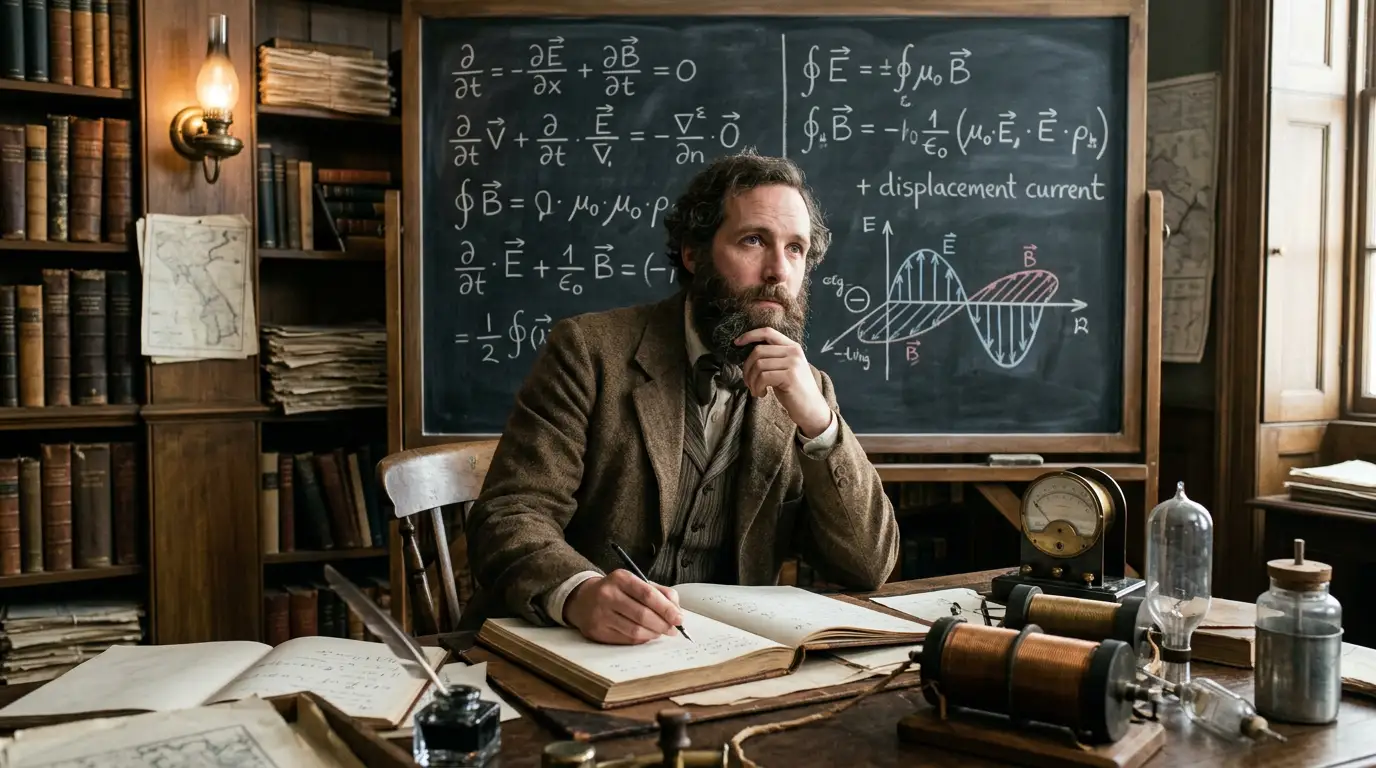
James Clerk Maxwell
1831–1879 · Physicist & Mathematician
Developing the classical theory of electromagnetism, showing mathematically that electricity, magnetism and light are connected, and making major contributions to kinetic theory, colour science and the understanding of Saturn's rings.
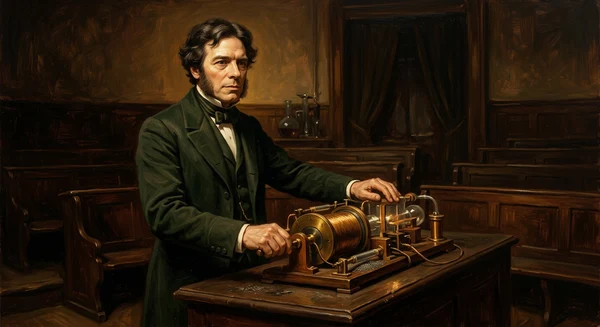
Michael Faraday
1791–1867 · Physicist & Chemist
Discovered electromagnetic induction and created pioneering devices that became the foundations of the electric motor, transformer and generator.