_(2).jpg)
Francis Halzen
1944–present · Particle physics and neutrino astronomy
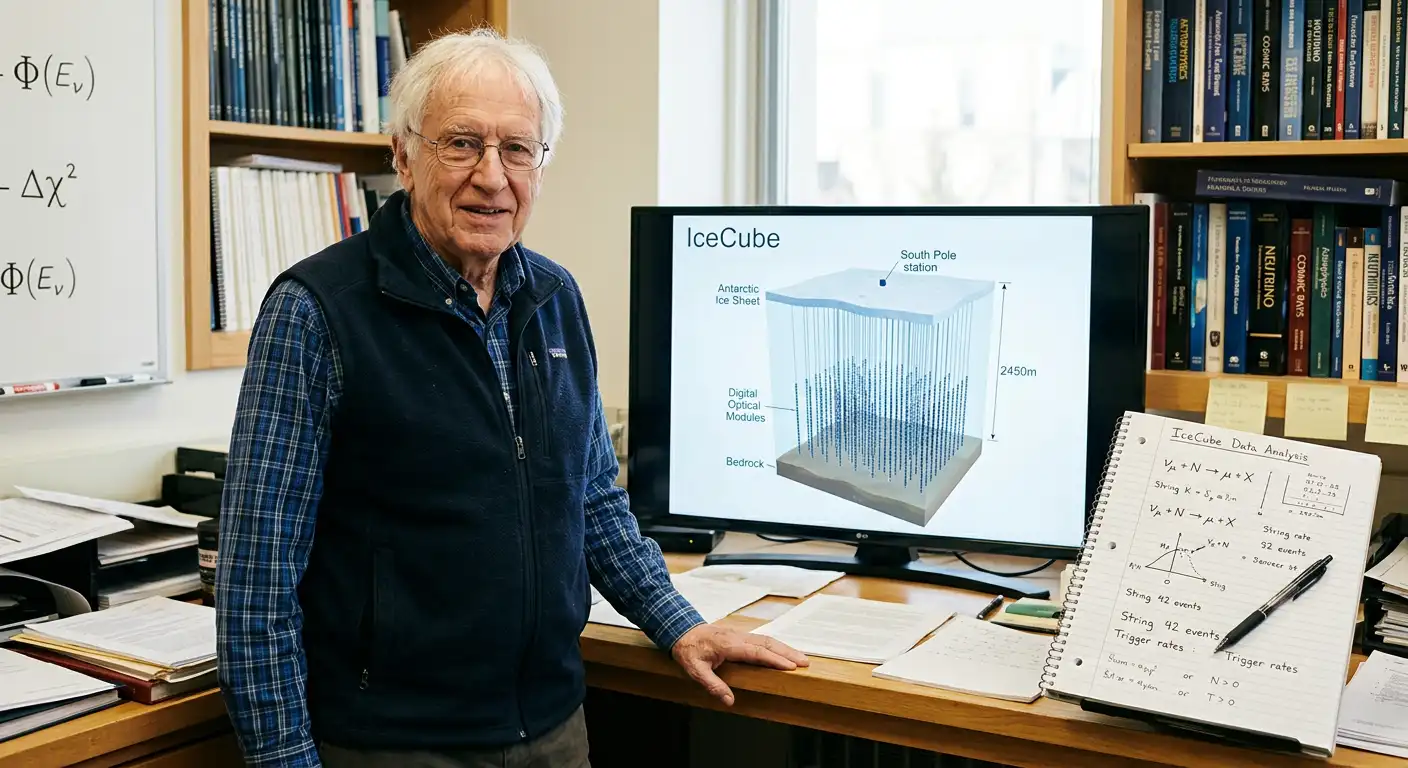
Francis Halzen helped lead the creation of IceCube, an Antarctic observatory that detects neutrinos and opens a new way to investigate the universe.
“Neutrino astronomy exists.”
Why is this scientist famous?
Halzen helped make Antarctic ice into a vast detector for particles arriving from space, opening a new way of investigating the universe's energetic objects.
IceCube enables researchers to investigate energetic cosmic sources using particles that can travel nearly undisturbed across vast distances. Its observations complement other kinds of astronomy.
Francis's story
A different way to explore space
Most telescopes collect light. Francis Halzen helped develop an observatory that searches instead for neutrinos, particles that rarely interact with matter. Some arrive from extremely energetic events in space and carry clues about where they came from.
Born in Belgium in 1944, Halzen earned a master's degree in 1966 and a doctorate in 1969 at the university in Leuven. He later joined the physics faculty at the University of Wisconsin–Madison in 1972. His work helped connect the study of tiny particles with questions about the wider universe.
An observatory beneath the ice
Building a neutrino observatory presented an unusual problem: if most neutrinos pass through matter unnoticed, how can enough interactions be detected to study them? The solution required an enormous volume of transparent material and very sensitive instruments.
Halzen and his collaborators explored the possibility of using deep Antarctic ice. A predecessor experiment, the Antarctic Muon and Neutrino Detector Array (AMANDA), helped test the approach. Engineers used hot-water drilling to lower instruments into deep holes before the water refroze. IceCube grew from this combination of physics, engineering and international teamwork. Its final detector string was installed in December 2010, and its first fully instrumented physics run began in 2011.
Finding messages from the cosmos
The original completed IceCube array contained 5,160 optical modules on 86 strings within roughly a cubic kilometre of ice. It detects light produced by charged particles arising from neutrino interactions. Scientists analyse these faint signals to learn about the incoming particles.
In 2013, the IceCube Collaboration reported strong evidence for very high-energy neutrinos of astrophysical origin. This result helped establish a new astronomical messenger alongside light. Halzen's leadership was important, but the detector and discoveries were the work of a large collaboration.
Recognition
Halzen received the 2015 Balzan Prize for astroparticle physics. In 2026, he was awarded the Nobel Prize in Physics for contributions to understanding astrophysical neutrinos. His career demonstrates that exploring space can require looking deep beneath our own planet's surface.
What did they discover?
IceCube Neutrino Observatory
Helped develop and lead IceCube, a cubic-kilometre detector in Antarctic ice that identifies neutrinos arriving from space by their rare interactions with the ice.
High-energy astrophysical neutrinos
IceCube's 2013 report provided strong evidence for very high-energy neutrinos of astrophysical origin, helping establish neutrino astronomy as a field.
AMANDA proof of concept
Contributed to the Antarctic Muon and Neutrino Detector Array, the predecessor experiment that demonstrated Antarctic ice could serve as a neutrino detection medium.
Amazing facts
His best-known observatory is beneath Antarctic ice.
Its original completed array contained more than 5,000 light detectors.
Hot water helped engineers drill the deployment holes.
IceCube followed a smaller experiment called AMANDA.
Neutrinos are sometimes nicknamed ghost particles because they interact so rarely.
The project needed engineers and scientists from many institutions.
Timeline
Born in Belgium.
Completes his master's degree.
Completes his doctorate.
Joins the Wisconsin–Madison physics faculty.
The final IceCube detector string is installed.
IceCube reports strong evidence for high-energy astrophysical neutrinos.
Receives the Balzan Prize for astroparticle physics.
Receives the Nobel Prize in Physics.