_(2).jpg)
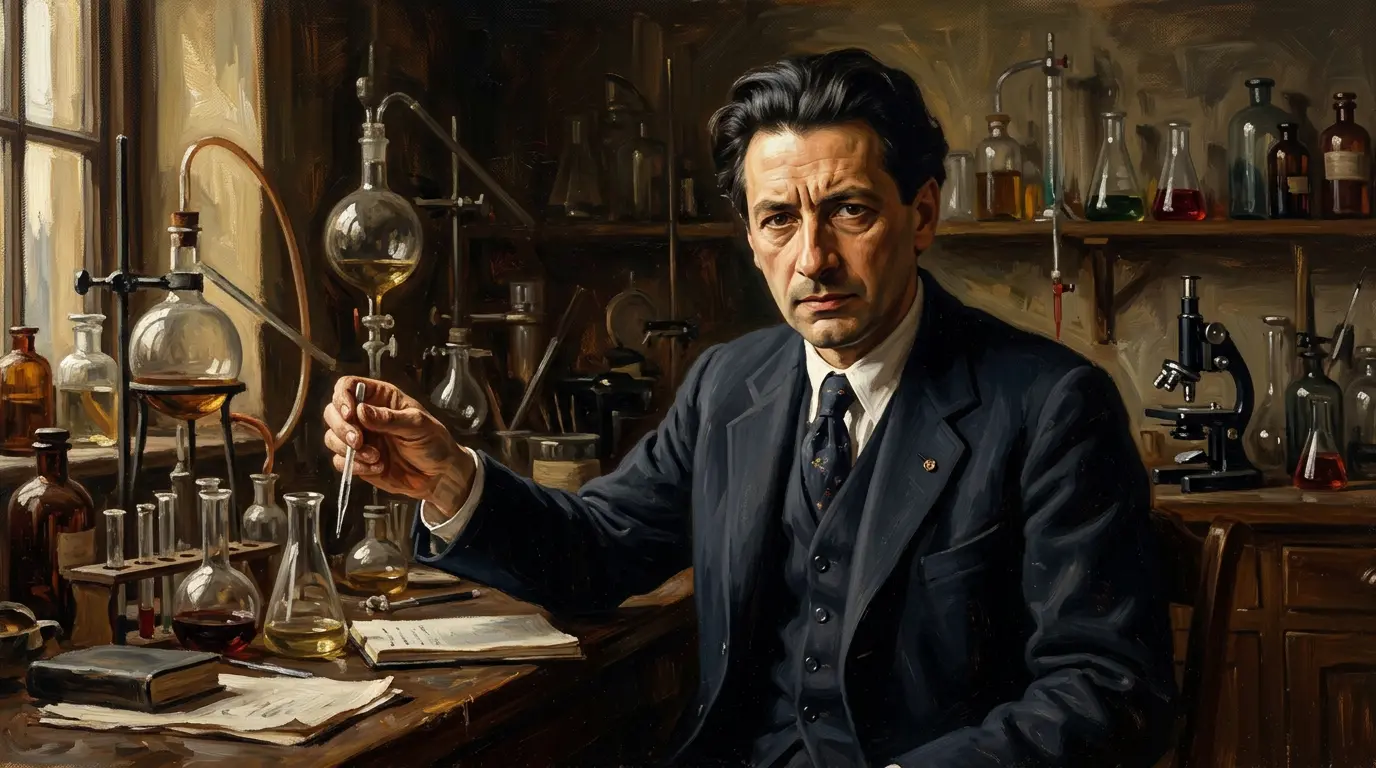
Ernst Boris Chain
1906–1979 · Biochemist
A German-born British biochemist who played a central role in the Oxford penicillin project, helping isolate, purify and concentrate penicillin into a usable medicine.
Why is this scientist famous?
Playing a central biochemical role in the Oxford penicillin project by helping isolate, purify and concentrate penicillin, investigating its chemistry and helping turn it into a usable antibacterial medicine.
Chain helped solve the biochemical problems that had prevented penicillin from becoming a practical medicine. His later work on fermentation and semisynthetic antibiotics contributed to the growth of industrial biotechnology and antibiotic development.
Ernst's story
Early Life and Education
Ernst Boris Chain was born in Berlin on 19 June 1906. His father was an industrial chemist, and Chain chose chemistry as his scientific field. He studied chemistry and physiology at Friedrich-Wilhelm University in Berlin and graduated in 1930. He conducted research at the Charite Hospital in Berlin and completed doctoral work there. Chain was Jewish and left Nazi Germany for Britain in 1933. He became a naturalised British citizen in 1939.
Cambridge and Oxford
After arriving in Britain, Chain worked briefly at University College Hospital Medical School in London. He then worked at Cambridge under Nobel laureate Frederick Gowland Hopkins from 1933 to 1935, receiving a Cambridge Ph.D. in 1935. In 1935 he moved to Oxford to work in Howard Florey's department at the Sir William Dunn School of Pathology.
The Penicillin Project
In 1938, Florey and Chain agreed to investigate antibacterial substances made by microorganisms, including penicillin. Alexander Fleming had discovered penicillin's antibacterial effect in 1928, but penicillin was unstable and difficult to purify. Chain, working with chemist Edward Penley Abraham and others, developed biochemical methods for isolating, purifying and concentrating penicillin. Norman Heatley subsequently made crucial improvements in extraction, assay and practical production methods. The Oxford team's purified penicillin was tested in animals in 1940 and then in patients in 1941.
Penicillin Chemistry and the Beta-Lactam Ring
Chain's work was central to understanding penicillin's biochemical and chemical properties. Chain and Edward Abraham proposed that the beta-lactam ring was a key part of penicillin's structure. Dorothy Hodgkin's X-ray crystallographic work later confirmed the beta-lactam structure. Chain shared the 1945 Nobel Prize in Physiology or Medicine with Alexander Fleming and Howard Florey.
Rome, Imperial College and Later Life
After the Second World War, Chain worked at the Istituto Superiore di Sanita in Rome, where his work included fermentation technology and semisynthetic penicillins. He joined Imperial College London in 1961 and helped establish its new Department of Biochemistry, which opened in 1964. He served as Professor of Biochemistry at Imperial College until 1973. He was also an accomplished pianist and at times seriously considered a professional musical career. He died in Mulranny, Ireland, on 12 August 1979.
What did they discover?
Purification and Concentration of Penicillin
Chain developed biochemical methods with Edward Abraham for isolating, purifying and concentrating penicillin, overcoming its notorious instability.
Beta-Lactam Ring Structure
Chain and Abraham proposed that the beta-lactam ring was key to penicillin's structure, later confirmed by Dorothy Hodgkin's X-ray crystallography.
Semisynthetic Penicillins and Fermentation
In his later career at Rome and Imperial College, Chain worked on fermentation technology and semisynthetic penicillins, contributing to industrial biotechnology.
Amazing facts
Chain's father was an industrial chemist, and Chain chose chemistry as his scientific field.
He was also an accomplished pianist and at times seriously considered a professional musical career.
Chain left Germany in 1933 after the Nazis came to power.
He worked with Frederick Gowland Hopkins at Cambridge before moving to Oxford.
Penicillin was so unstable that developing methods to isolate and concentrate it was a major biochemical challenge.
Chain worked closely with Edward Abraham on purification and later on understanding penicillin's chemical structure.
Chain and Abraham supported the beta-lactam-ring structure later confirmed by Dorothy Hodgkin's X-ray work.
Chain shared the 1945 Nobel Prize with Fleming and Florey.
He later worked in Rome on fermentation technology and semisynthetic penicillins.
At Imperial College he helped build a biochemistry department with a large fermentation pilot plant, linking laboratory biochemistry with industrial-scale biotechnology.
He became a Fellow of the Royal Society in 1949 and was knighted in 1969.
Timeline
Born in Berlin on 19 June
Graduated in chemistry and physiology from Friedrich-Wilhelm University, Berlin
Left Nazi Germany for Britain and worked in London before moving to Cambridge
Received a Cambridge Ph.D. and moved to Oxford to work in Howard Florey's department
Began systematic research with Florey on naturally occurring antibacterial substances, including penicillin
Oxford team's animal experiments demonstrated penicillin's therapeutic promise
Penicillin clinical trials began in Oxford
Shared the Nobel Prize in Physiology or Medicine with Alexander Fleming and Howard Florey
Began work in Rome at the Istituto Superiore di Sanita on antibiotics, fermentation and related biochemical research
Elected Fellow of the Royal Society
Joined Imperial College London
Imperial's new Department of Biochemistry opened under Chain's leadership
Knighted
Retired from his Imperial College professorship
Died in Mulranny, Ireland, on 12 August